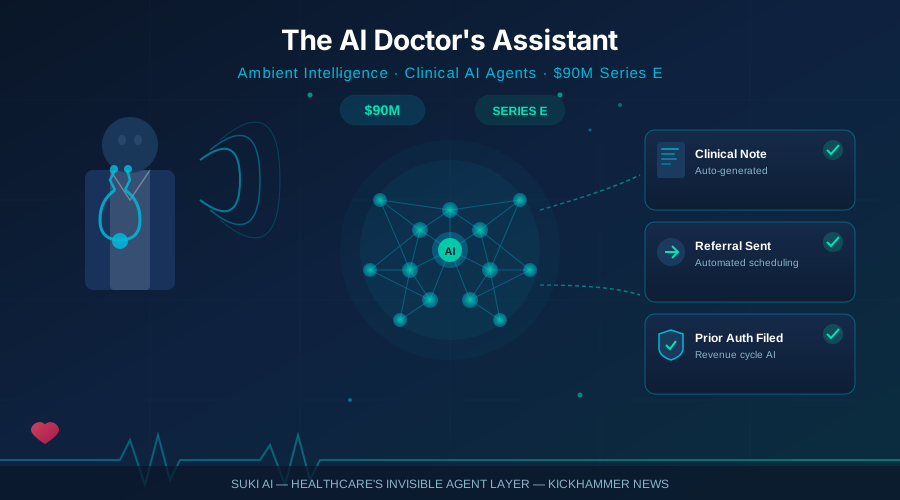
Suki’s Series E is the latest bet that the future of healthcare AI isn’t chatbots — it’s invisible agents that do the work doctors hate most.
Every physician knows the feeling. The last patient of the day has left the room, but the real work is just beginning: two, sometimes three hours of typing notes into an electronic health record system, catching up on prior authorization requests, sending referrals, reconciling codes. It’s called “pajama time“ in medicine — the hours clinicians spend staring at screens after their families have gone to bed, completing the documentation that the healthcare system demands but that training never prepared them for.
Suki, an Ambient Clinical Intelligence company founded to make that paperwork disappear, just secured $90 million in a Series E round led by Healthier Capital to build the next chapter of that vision — and the chapter looks considerably more ambitious than a transcription app.
From Scribe to Agent
When Suki launched, its core pitch was straightforward: use AI to listen to a doctor-patient conversation and automatically draft the clinical note. The company called it ambient scribing, and it worked. More than 450 healthcare organizations adopted the technology. Patient encounters supported by Suki grew more than 190 percent year over year in 2026. Revenue doubled in 2025 and is on track to double again. A source familiar with the company told Axios that Suki projects $60 to $80 million in revenue for the year — a run rate that puts it firmly in the territory of companies preparing for a public offering.
But Suki’s leadership made a strategic decision to not stop at the note.
The $90 million will be used to accelerate what the company calls agentic workflows — AI that doesn’t just document what happened in an appointment but takes action after the appointment ends. Post-visit tasks like sending referrals, scheduling follow-ups, completing prior authorization forms, and triggering revenue cycle workflows are the next frontier. These are exactly the administrative tasks that have made the electronic health record feel less like a tool and more like a second full-time job. Suki wants to automate them.
The company already quantifies the financial impact it delivers to clinicians: an average of $2,600 per provider per month in productivity and revenue gains, as validated by KLAS, an independent healthcare technology research firm. The bet is that agentic expansion will make that number significantly larger.
The Partner Play
The round also signals a maturation in Suki’s business model that goes beyond selling directly to hospitals and clinics. The company runs a parallel business called Suki for Partners — a suite of SDKs and APIs that lets other healthcare technology companies embed Suki’s ambient intelligence into their own platforms. That business, which counts more than 30 health-tech partners in its ecosystem, has grown more than tenfold over the past two years.
It’s a meaningful strategic pivot. Rather than competing head-to-head with every EHR and clinical workflow vendor, Suki is positioning itself as infrastructure — the AI layer that other products plug into. In the same way that Twilio became the calling and messaging backbone for thousands of apps without most end users ever knowing Twilio’s name, Suki is building toward a future where its ambient intelligence runs inside the tools physicians already use, invisibly and automatically.
Aman Mahajan, MD, PhD, MBA, a partner at lead investor Healthier Capital, joins Suki’s board of directors as part of the round. Healthier Capital focuses exclusively on healthcare technology and brings operational depth that traditional venture firms don’t always offer. Other participants in the Series E include Crosslink Capital and Hercules Capital as new investors, with existing backers Venrock, Flare Capital Partners, Hedosophia, Philips Ventures, and Zoom Ventures all returning.
A Crowded Market That’s Still Early
Suki is not alone in the ambient AI clinical space. Microsoft’s Nuance DAX Copilot is deeply embedded in Dragon Medical and has the advantage of Microsoft’s enterprise distribution and Azure infrastructure. Abridge, spun out of Carnegie Mellon, has deals with major academic medical centers and has made a strong play for the high-end hospital market. Freed targets independent practices with a lower-cost consumer-style product. Ambience Healthcare focuses on specialty care workflows. And a wave of well-funded startups continues to enter the space each quarter.
The ambient scribing market in the United States alone is now estimated at several billion dollars annually, and the opportunity scales further if agentic workflows — referrals, prior authorizations, coding, revenue cycle — are included. Analysts at Gartner estimated in mid-2026 that less than 15 percent of U.S. physician practices have adopted any form of ambient AI documentation. The runway is enormous.
What distinguishes Suki’s positioning is its EHR-agnostic architecture. Unlike Nuance, which is tightly coupled to Microsoft’s ecosystem, or EHR-native solutions that work only within a specific system, Suki is designed to work with Epic, Cerner/Oracle Health, athenahealth, and virtually any other platform. That flexibility matters in a healthcare market where system consolidation is slow and enterprise software decisions take years.
The recent addition of “Ask“ — a feature that brings clinical knowledge from Wolters Kluwer’s UpToDate Expert AI directly into physician workflows — is another signal that Suki is building toward something more than documentation. UpToDate is the gold-standard clinical reference for practicing physicians; integrating it into the ambient layer means a physician can query real-time evidence-based guidance during or immediately after a patient encounter without breaking their workflow to open another application.
The Bigger Picture
The healthcare industry is often the last to adopt transformative technology and among the first to feel its consequences when things go wrong. But the pressure physicians face — burnout rates above 50 percent, documented correlations between documentation burden and patient outcomes, a projected shortage of more than 100,000 physicians by 2034 — is creating genuine urgency for AI that works reliably in clinical environments.
Suki’s growth numbers suggest it has crossed the credibility threshold that separates promising pilots from durable businesses. The shift toward agentic workflows is the next test: can an AI that documents what doctors say also reliably take action on their behalf, across the complex, fragmented, high-stakes ecosystem of modern healthcare?
The $90 million says a significant number of sophisticated healthcare investors believe the answer is yes. The next few years will prove whether the pajama-time problem in medicine is finally approaching a real solution.


