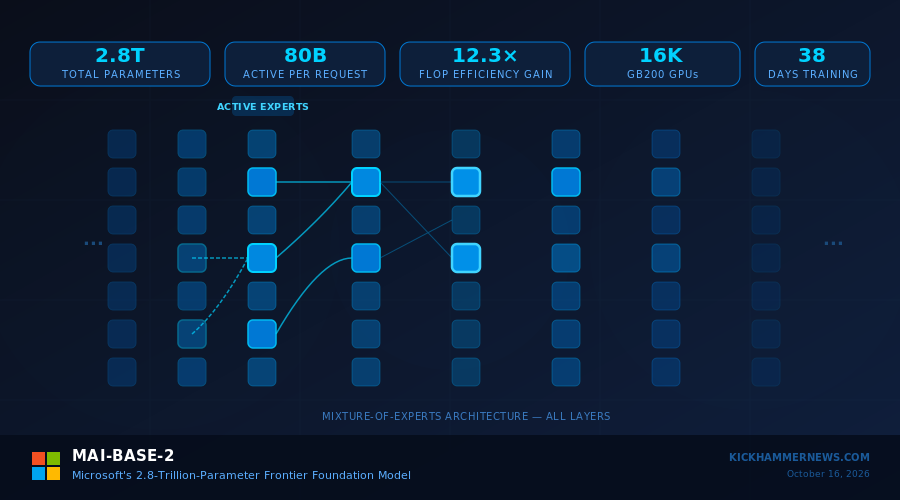
When Microsoft announced the Maia 300 chip three days ago, the AI world read it as a declaration: the company was serious about owning its own silicon destiny. Today, we learned what that silicon was being used to build. Microsoft has completed pre-training on MAI-Base-2, a 2.8-trillion-parameter mixture-of-experts foundation model that the company claims outperforms every open-weight model in existence — at up to 12 times the training efficiency of DeepSeek’s best base model.
This is not a product launch. It is a shot across the bow of every lab that thought the open-weight frontier was their turf.
The Numbers That Matter
MAI-Base-2 is a mixture-of-experts (MoE) model with 2.8 trillion total parameters, of which roughly 80 billion are active during any given inference pass. That architecture — a massive pool of “expert” subnetworks with only a fraction activated per token — is the same approach used by Mistral’s Mixtral family, Meta’s newer models, and Google’s Gemini. But Microsoft has pushed the design further than anyone has publicly disclosed.
Where MAI-Base-1 alternated between dense and MoE layers, MAI-Base-2 applies MoE in every single layer. The result is a model that is simultaneously far larger in capacity and far more computationally efficient than a dense model of equivalent capability.
The training run itself was staggering in scale: 16,000 NVIDIA GB200 GPUs running continuously for 38 days across August and September 2026. Microsoft processed a 50-trillion-token training mixture — a dataset 36 percent larger in unique tokens than what was used for MAI-Base-1. Of that mixture, 4.5 trillion tokens were multimodal visual data, accounting for 18 percent of training. The model was trained natively with vision from the start, using an encoder-free VLM architecture that Microsoft says eliminates the bottlenecks associated with separate vision encoder modules.
The efficiency gains are the headline claim. Microsoft says MAI-Base-2 achieves 4.2 to 12.3 times the pre-training FLOP efficiency of DeepSeek-V4-Pro-Base — currently considered the most capable open-weight base model available — as measured by bits-per-byte on held-out evaluations. Compared to its predecessor, MAI-Base-1, the gains range from 6.3 to 12.7 times.
How They Got There
The engineering breakthroughs behind MAI-Base-2 are worth unpacking because they represent the frontier of what large-scale training looks like in 2026.
The team developed what they call “source scaling” — a new method for determining the optimal scaling ladder for MoE models based on layer count rather than the traditional approach of scaling hidden dimensions independently. Hidden size is computed as a function of layer count, and attention heads scale proportionally, enabling more predictable performance across model sizes.
Microsoft also implemented new scaling laws for learning rate and weight decay, both of which had been poorly characterized for MoE models at this scale. The Muon optimizer — a second-order momentum technique that had previously been applied at smaller scales — was used for approximately 2.1 percent of iteration time, contributing to training stability. Activation gradient clipping was applied throughout.
Perhaps the most significant engineering achievement was in MFU (model FLOP utilization). After adopting dropless multi-round MoE — which eliminates the load-balancing waste associated with token dropping — the team raised MoE MFU from 24 percent to 35 percent. The overall average MFU across the full run was 21 percent, with a goodput of 89 percent, meaning hardware was productively utilized nearly nine-tenths of the time despite the enormous scale of the cluster.
Microsoft emphasized that no distillation from other models was used. Every bit of MAI-Base-2 was trained from scratch on data processed entirely in-house.
The Open-Weight Elephant in the Room
Here is the tension at the center of this announcement: MAI-Base-2 is not available to download.
Microsoft says the model is currently undergoing post-training — the RLHF, instruction tuning, and safety work that transforms a raw pre-trained model into a deployable product — and that more results will be shared “soon.” When it is released, the weights will be licensed to trusted partners through Microsoft’s Foundry platform. This is not the same as open weights.
The comparison to DeepSeek is pointed. DeepSeek releases its base models openly, which is a large part of why they have become reference points for the open-weight frontier. By benchmarking against DeepSeek and claiming a 4-12x efficiency advantage, Microsoft is positioning MAI-Base-2 as the model that redefines what the open-weight frontier should be — while simultaneously declining to release it openly.
Whether partners with Foundry access will be able to deploy weights at will, fine-tune freely, and redistribute derivative models remains unspecified. The history of “trusted partner” licensing in AI suggests the answer is: not the way Llama or DeepSeek weights can be used.
What This Means for the Landscape
MAI-Base-2 joins a growing list of foundation models that the major tech companies are building for their own infrastructure rather than selling as a service. Google has its Gemini base family. Amazon is reportedly building Olympus. Apple has its own base models for Apple Intelligence. And now Microsoft — which famously invested tens of billions of dollars into OpenAI — has built a rival model that in its own benchmarks surpasses anything publicly available.
This is not a coincidence. The economics of frontier AI have changed. At 16,000 GB200 GPUs for 38 days, MAI-Base-2 represents a training run that would have cost hundreds of millions of dollars to rent from a cloud provider. Microsoft owns that infrastructure. It is using that ownership to build models that give it independence from its own portfolio companies — including OpenAI.
The knowledge cutoff of MAI-Base-2 is March 2026, which will limit its utility in rapidly changing domains until post-training updates address it. But with MAI-Base-3 reportedly already in preparation, the cadence suggests Microsoft intends to run new frontier pre-training every six to nine months.
For the open-weight AI community, the story is more complicated. A Microsoft model that beats DeepSeek by double-digit efficiency multiples is genuinely exciting news — but only if you can get your hands on it. Right now, that club is small. The rest of the world is still waiting.


