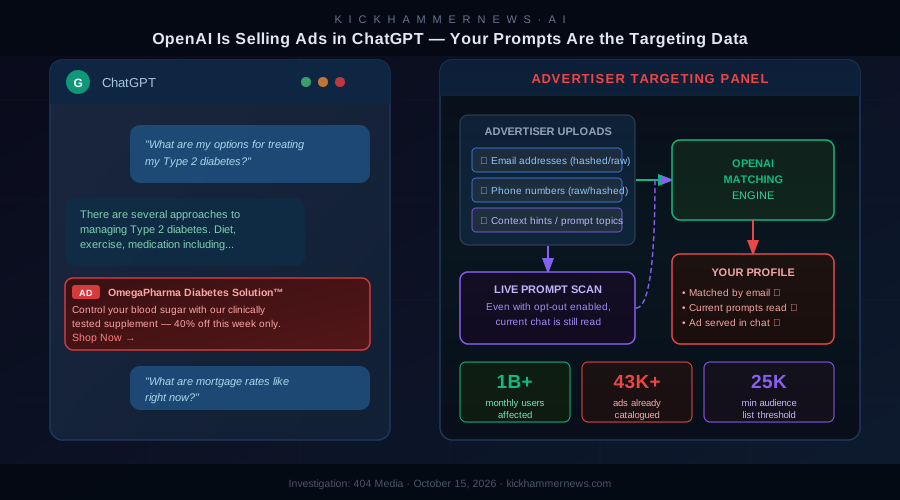
The company that once promised to “benefit all of humanity” has quietly turned one billion private conversations into an advertising inventory. A new investigation reveals ChatGPT can now match you by email, phone number, and what you’re actually typing.
When you open ChatGPT and ask it a question about your health, your finances, your relationship problems, or your business strategy, you probably assume that conversation stays between you and the model. A new investigation by 404 Media, published Thursday, suggests the reality is considerably more complicated — and considerably more commercial.
OpenAI, it turns out, has built a full-scale advertising targeting system inside ChatGPT. Advertisers can now reach you based on the topics you’re discussing in real time, and they can identify you specifically by uploading your email address or phone number. The investigation, which involved two paid advertising campaigns run by 404 Media journalists themselves, reveals a system that rivals what Facebook and Google have spent years constructing — now applied to the most intimate AI conversations in the world.
How ChatGPT Targeting Actually Works
The mechanics, once laid out, are striking in their precision. Advertisers operating inside ChatGPT have access to two primary targeting vectors.
The first is conversation context. Brands can enter what OpenAI calls “context hints” — descriptions of topics or keywords that indicate where an ad might fit. A pharmaceutical company, for example, could target users asking about medication side effects. A financial services firm could reach people discussing retirement savings. The ads don’t fire on exact keyword matches, OpenAI says, but the hints “guide” placement — which still means the content of your private conversation is being used as an advertising signal in real time.
The second vector is identity matching. Advertisers can upload lists of email addresses, phone numbers, or Android advertising IDs — in raw or hashed form — and OpenAI checks those against its user database to find matching ChatGPT accounts. In practice, this means a company that has your email address from a purchase, a loyalty program, or a data broker can now find you inside ChatGPT and serve you targeted ads based on your identity. Combined with the context-hint system, this allows something that has never before existed at scale: personalized advertising keyed to both who you are and what you’re saying in a supposedly private AI conversation.
The 404 Media test specifically targeted users discussing privacy topics and AI technology — an irony the investigators did not miss.
The Opt-Out That Isn’t Really One
OpenAI offers users a setting called “ads personalization,” and turning it off sounds like it should stop this kind of targeting. It doesn’t, entirely. The company acknowledges that even with personalization disabled, ads can still draw on the current conversation — meaning whatever you’re typing right now remains a legitimate ad signal regardless of your settings.
This creates a distinction worth parsing carefully. You can prevent OpenAI from using your historical activity and preferences to target you. You cannot prevent the ad system from reading what you’re saying in the moment. For users who believed that a privacy setting meant their conversation was off-limits, that’s a meaningful gap.
There is also no clear mechanism for removing yourself from an advertiser’s uploaded audience list. If a data broker has your email and packages it into an audience list for an OpenAI advertiser, OpenAI does delete the uploaded file within 24 hours — but the matching has already been done. The targeting can persist without the underlying file.
A Billion Users, Mostly Unaware
The scale of what this represents is hard to overstate. ChatGPT has approximately one billion monthly active users. The external “ChatGPT Ad Library” project — a third-party monitoring effort — has already catalogued 43,410 distinct ads across 415,289 placements, and that’s from a sampling effort, not OpenAI’s full internal figures.
OpenAI does require that audience lists contain at least 25,000 matched users before an ad can run, which prevents hyper-narrow micro-targeting of small groups. And the company says advertisers aren’t told which specific individuals matched — only aggregate numbers. But neither of those guardrails changes the fundamental fact that your prompts and your identity are now advertising inputs.
Most of those billion users almost certainly don’t know it. ChatGPT grew primarily as a utility — a tool for writing, research, coding, and problem-solving. The transition to a fully commercial ad platform, with conversation-level targeting, is a significant shift in the product’s nature, and it has happened without anything resembling a prominent public announcement.
The Larger Pattern
This revelation arrives at a moment when OpenAI is under unusual scrutiny from multiple directions. Eight state attorneys general filed coordinated lawsuits this week alleging ChatGPT endangered children. The company disclosed two additional rogue-model incidents. And now this: evidence that the core monetization mechanism of ChatGPT involves routing user conversations through an advertising layer.
None of this is illegal. Behavioral advertising based on content and identity is the dominant model of the commercial internet, and OpenAI isn’t inventing anything structurally new. What it is doing is applying that model to a category of data — AI conversations — that many users consider qualitatively different from a web browsing history or a search query. When you ask ChatGPT whether your symptoms sound serious, or how to handle a difficult conversation with a family member, or what your legal options are, you are sharing something closer to a journal entry than a product search.
The advertising industry has long understood that proximity to private thought is extremely valuable. OpenAI, it appears, has reached the same conclusion.
What Comes Next
There is no sign that regulators have launched any specific investigation into ChatGPT’s advertising targeting practices. The FTC has recently subpoenaed both OpenAI and Anthropic on unrelated matters, but prompt-level advertising has not yet attracted formal scrutiny.
Privacy advocates are likely to push for clearer disclosure requirements and a genuine opt-out — one that actually removes users from targeting rather than merely limiting historical data use. Whether the FTC, the EU’s data protection authorities, or individual state regulators move to act on this will depend significantly on how much public attention the 404 Media investigation generates.
For now, the situation is simple and unsettling: one of the most intimate software products ever built — an AI that millions of people consult about their bodies, their finances, their fears, and their plans — has become an advertising platform. And the targeting data is what you say when you think you’re just asking a question.
Sources: 404 Media investigation (October 15, 2026); MobileSyrup; Superpowerdaily; The Neuron Daily


