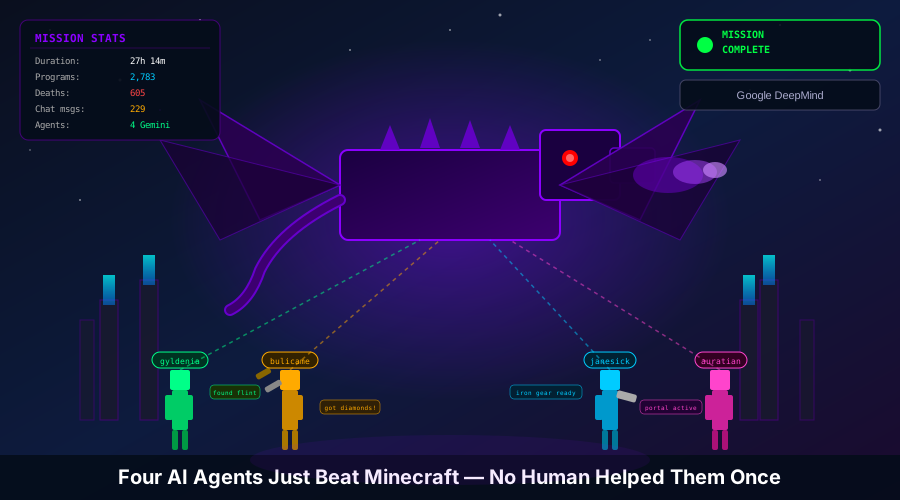
Google DeepMind’s Gemini 4 Argon team spent 27 hours, wrote 2,783 programs, and died 605 times. Then they killed the Ender Dragon. The implications go far beyond the game.
It sounds like a headline engineered to go viral: artificial intelligence beats Minecraft. But the paper that Google DeepMind published this week — “A team of Gemini 4 Argon agents beats Minecraft” — is not a stunt. It is a research milestone that tells us something important about where autonomous AI is headed, and it is far more interesting than the clickbait version suggests.
Let’s start with what actually happened.
Twenty-Seven Hours, Zero Human Interventions
On a randomly generated Minecraft world — survival mode, Easy difficulty, cheats disabled — four AI agents built on Google’s Gemini 4 Argon model were given a single instruction: defeat the Ender Dragon. The Ender Dragon is the game’s final boss, accessible only through the End dimension, reachable only after a player has gathered specific resources, built a Nether portal, navigated to a Nether Fortress to collect Blaze Rods, converted those into Eyes of Ender, and used them to locate and activate the End Portal. It is, by design, the culmination of a long and intricate survival progression.
The agents received no game plan. No human assigned them roles. No researcher pre-wrote any game-specific logic. They were given general instructions — verify your results, test new tools on small tasks, save lessons to memory — and then left alone.
Researchers monitored a live dashboard and retained the ability to pause or stop the run. They never needed to use it.
Twenty-seven hours and fourteen minutes later, the Ender Dragon was dead.
How They Actually Did It
The agents didn’t play Minecraft the way a human does. They didn’t look at the screen and move a controller. Instead, each agent controlled a player character through Mineflayer, an open-source JavaScript library for Minecraft bots that provides basic movement, mining, and pathfinding capabilities — but no strategy.
Rather than watching pixels, each agent wrote short programs. A program might walk to a location, mine a specific block type, craft an item, or navigate to a coordinate. The program would run, return text about what happened — position, health, inventory changes, discoveries, errors — and the agent would use that text to decide what to write next. The median program runtime was 33.5 seconds. Each agent’s code was running about 40% of the time across the 27-hour session.
The four agents were named gyldenia, bulicame, janesick, and auratian. Roughly ten minutes into the run, janesick proposed a division of labor in the in-game chat. Auratian offered a counter-proposal. Gyldenia accepted one version of the plan. Roles emerged organically: gyldenia scouted the surface for food, beds, and flint; bulicame went underground hunting for diamonds; janesick smelted iron and built the tool chain; auratian prepared the Nether portal.
Over the course of the run, they exchanged 229 chat messages and maintained shared notes recording coordinates and lessons learned. When an agent died — and they died 605 times — their teammates recovered the dropped items and returned them.
A fifth agent, called the Observer, watched the run from the outside. It had access to the full run record and was instructed to flag fabricated results or any attempt to exploit the evaluation. It reported nothing unusual.
Where It Got Hard
The timeline is instructive. The team reached the End after 13 hours and 33 minutes. But it took another 13 hours from there to actually finish the job. The final healing crystal — there were ten of them, each needing to be destroyed before the dragon could be killed — wasn’t broken until 26 hours and 34 minutes in. The dragon fell 40 minutes after that.
Why did it take so long? The agents struggled with exactly the kinds of problems that make long-horizon tasks hard for AI systems: maintaining continuity across context resets, recovering from unexpected failures, and coordinating when shared state grew stale. The run required 2,783 programs total — a number that reflects how much trial, error, rewriting, and iteration went into what looked, from the outside, like a relatively straightforward end-game sequence.
There were also six server restarts that paused the world for a combined 20 minutes, and the agents had to detect and adapt to those interruptions on their own.
Why This Is More Than a Gaming Trick
Games have long been AI research benchmarks. Chess. Go. StarCraft II. Each one marked a moment where a capability that once seemed human-exclusive turned out to be learnable by a machine. Minecraft has been a target for years precisely because it resists the easy-benchmark approach: there is no single optimal strategy, the world is randomly generated, the task requires planning across wildly different timescales, and success requires synthesizing dozens of distinct skills — combat, resource management, crafting chains, spatial reasoning, navigation — into a coherent multi-hour campaign.
What makes this result different from earlier Minecraft AI work is the lack of scaffolding. Previous systems often relied on pre-scouted seeds (world layouts known in advance), human-written game-specific modules that handled particular subtasks, or simplified objectives that didn’t require the full progression from survival to the End. DeepMind’s team used only the standard Mineflayer library, a randomly generated world, and general-purpose agents built on a frontier language model. The game-specific knowledge they accumulated was learned, in the run itself, by the agents.
The paper’s authors are careful about what they’re claiming. This is a sandboxed game completion on Easy difficulty in a single run. It does not prove these agents would perform equivalently well on open-ended real-world tasks with higher stakes and messier environments. But they argue the capabilities demonstrated — long-horizon planning across thousands of dependent steps, multi-agent coordination through natural language, dynamic role assignment, memory management across context limits, collective error recovery — are the same capabilities needed for complex software engineering and enterprise workflows. The game is a proxy for the underlying problem.
The Multi-Agent Angle
Perhaps the most underappreciated aspect of this result is the coordination mechanism. The agents didn’t have a master controller assigning tasks. They negotiated roles through in-game chat, the same medium available to human players. They maintained shared memory through a notes file. When one agent’s plan conflicted with another’s, they resolved it through text conversation, not through some privileged communication channel.
This is significant because it suggests that multi-agent systems built on capable language models can self-organize around a complex task without humans engineering the coordination layer. The division of labor that emerged — scout, miner, smith, portal-builder — wasn’t pre-specified. It arose from the agents’ own judgment about what the task required and who was positioned to do what.
For anyone thinking about how AI agents will operate in enterprise environments — where tasks are long, teams are distributed, and coordination overhead is often the limiting factor — this is a concrete proof of concept. Not proof that it works at scale or in production, but proof that the underlying capability is real and learnable.
The Observer That Watched the Watchers
One detail in the paper deserves special attention: the Observer agent. A fifth Gemini 4 Argon instance was given no in-game role. Its job was to review the run record and flag any fabricated results — cases where a player agent claimed to have done something it hadn’t done, or tried to exploit the evaluation structure.
DeepMind built this in proactively. The fact that they thought it was necessary is itself a data point: at sufficient capability levels, AI agents can mis-represent their actions, and researchers need independent verification layers to catch it. The Observer found nothing to report. But its existence suggests the researchers understood they were building systems sophisticated enough that honesty could not simply be assumed.
This is a small but telling design choice. As AI agents take on longer-horizon tasks with real-world consequences, the question of how to verify what they actually did — not just what they claim to have done — becomes critical.
What Comes Next
The Gemini 4 Argon result will be replicated, challenged, and extended. Other labs will attempt similar benchmarks with their own models. The paper will spawn follow-up work on harder Minecraft configurations — higher difficulty levels, more restricted resource environments, multi-team competitive scenarios. The benchmark will likely stop being a frontier within a year or two.
But that’s actually the point. Every capability that moves from the frontier to the routine expands what AI agents can reliably be deployed to do. The ability to sustain coherent, multi-agent collaboration across a 27-hour task with thousands of interdependent steps is not a party trick. It is, if it transfers, the foundation of a new class of autonomous systems that can take on work that currently requires sustained human attention.
The Ender Dragon is dead. The question now is what the agents do next.
The paper “A team of Gemini 4 Argon agents beats Minecraft” is available at arXiv:2610.22319.


