October 17, 2026
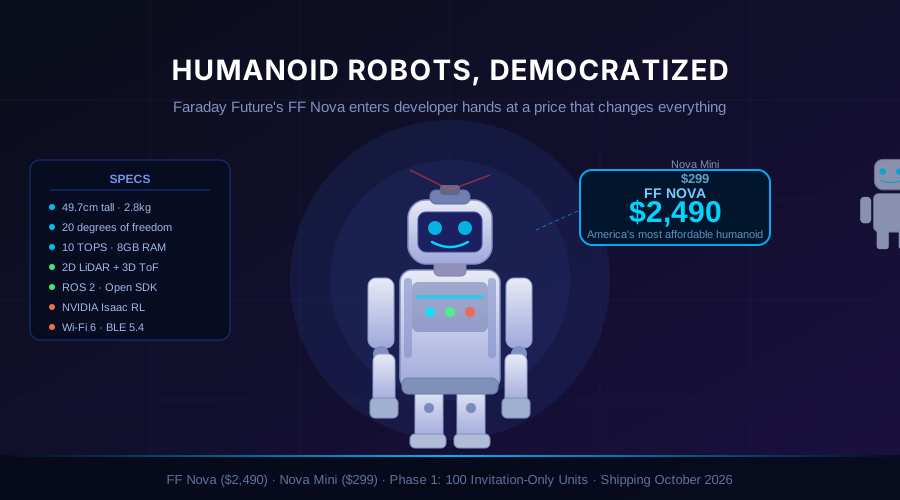
There is a punchline buried somewhere in the announcement. Faraday Future — the electric vehicle startup that spent a decade burning through billions of dollars, cycling through CEOs, and promising cars that never quite arrived — has just launched a humanoid robot priced lower than a used laptop. Or more precisely, its spinout company FF EAI Robotics has. The FF Nova went on sale October 15 at $2,490. The next cheapest humanoid robot available in the United States costs nearly twice as much.
That price point is not an accident, and it is not a toy gimmick. It is a deliberate bet that the real money in physical AI is not in selling finished machines to factories, but in building a developer ecosystem first — and that to do that, you have to get hardware into as many hands as possible, as cheaply as possible.
What $2,490 Actually Buys You
The FF Nova stands 49.7 centimeters tall and weighs 2.8 kilograms. It has 20 degrees of freedom — two in the head, six in the arms, twelve in the legs — enough for genuinely bipedal locomotion, waving, and the ability to pick itself back up after being knocked over. On its own legs it walks at 0.1 meters per second, which is a crawl by human standards. Attach the optional wheeled base and it reaches 0.8 meters per second, which is still a crawl, but a faster crawl.
The sensor suite is more impressive than the price suggests. There is a 2D LiDAR mounted on top, a wide-angle camera rated at roughly four megapixels, a 3D time-of-flight sensor, and a three-microphone array for sound localization and voiceprint recognition. A two-inch face display shows 240×296 pixels of expression. On-board compute handles 10 trillion operations per second with 8 GB of RAM and 32 GB of storage — enough to run inference locally while staying tethered to cloud models for heavier tasks. The robot connects via Wi-Fi 6 and Bluetooth LE 5.4, and it receives software updates over the air.
The software stack is what will determine whether developers actually build anything meaningful with it. FF Nova runs on ROS 2, the open-source robotics operating system that has become the industry standard for research and development. An open SDK is included. A separate developer skills package costs an additional $390 and unlocks a planned reinforcement learning pipeline built on NVIDIA Isaac, plus a forthcoming Skills Store where developers can share or sell the behaviors they train. The company is framing Nova not just as a robot but as a platform — the physical equivalent of a developer board.
The Kid Version
Alongside Nova, FFR launched the Nova Mini at $299. At 34.9 centimeters tall and under a kilogram, the Mini is aimed at children eight and older, K-12 classrooms, and after-school programs. It has 17 servos, 40-plus voice commands, 50-plus preloaded dance moves, block-based visual programming, and a teach-by-hand mode where kids can physically pose the robot to create new sequences.
A companion curriculum — the Physical AI Spark Program — offers 16 live online classes over eight weeks in groups of six to ten students. It costs $499 and ends with students choreographing and performing a robot dance. FFR says it is in talks with Montessori networks, early childhood providers, and elementary schools.
The two-product strategy has a logic to it. The Mini makes humanoid robotics experiential for children who will grow up expecting to work alongside physical AI systems. The Nova makes it accessible to the engineers and researchers who will actually build those systems. Neither is priced as a professional industrial tool. Both are priced to spread.
The Faraday Future Problem
Any honest account of this announcement has to spend a moment on Faraday Future. The company is one of the great cautionary tales in technology history: a billion-dollar EV promise that failed to deliver at scale, a securities fraud settlement, a revolving door of executives, and a share price that cratered from its SPAC listing high. The EV dream never really died — Faraday technically still makes the FF 91, a luxury car that reached limited production in 2023 — but the company ran out of momentum.
What is emerging from the wreckage is a pivot that nobody predicted. FF EAI Robotics Ecosystem Inc. was spun up as a separate entity to focus on embodied AI, and on October 12 it signed a deal to acquire Faraday Future’s robotics assets in an all-stock transaction valued at about $200 million. Under the terms, Faraday Future will hold roughly 65.7% of FFR after closing. The deal is expected to finalize by the end of October. FFR CEO Jerry Wang called the launches “an important step for FFR in bringing Physical AI from the laboratory to real-world applications.” That is the anodyne press-release version of what is actually a survival strategy: take the brand, the engineering talent, and the existing infrastructure, strip out the EV division’s liabilities, and rebuild around robots.
Whether the pivot holds is an open question. But the product itself is real — and the price is real.
Putting $2,490 in Context
To understand why the Nova’s price matters, consider the market it is entering. The Unitree R1 AIR, one of the most competitively priced full-scale humanoid robots currently shipping to consumers, costs $4,900. The Unitree G1 runs $13,500. Figure AI’s Figure 03, deployed with BMW and other industrial partners, has no published consumer price because it is not sold to consumers. Boston Dynamics’ Atlas is similarly enterprise-only. The 1X Technologies NEO is available for pre-order at $20,000.
None of these machines are 50 centimeters tall. None of them are primarily targeting elementary school curricula. The FF Nova and Nova Mini are not competing directly with industrial humanoids — they are competing with Arduino boards and Raspberry Pi kits for the attention of the developer-hobbyist-educator market that eventually seeds every major technology platform.
The NVIDIA Isaac integration is the signal that FFR understands this. Isaac is NVIDIA’s platform for simulation-to-real training: you build a virtual environment, train a behavior through reinforcement learning, then transfer the learned policy to a physical robot. It is the workflow being used by essentially every serious robotics research lab in the world. Bringing it to a $2,490 developer device, with an open SDK and a planned Skills Store, is how you build the equivalent of the App Store for embodied AI — not by controlling the hardware supply chain, but by becoming the platform that the best developers choose to build on.
The Catch — and the Opportunity
The Nova is slow. Walking at 0.1 meters per second means roughly twelve minutes to cross a typical classroom. The detachable wheels help, but they turn the robot into something that looks more like a telepresence cart than a humanoid. The compute is limited by full-scale standards. The initial run is capped at 100 units, invitation-only, with the first 20 ready for immediate delivery.
These are real limitations. They are also limitations that assume the Nova’s value proposition is locomotion and physical manipulation at scale. If the real value is in training data generation, RL curriculum development, classroom engagement, and SDK ecosystem building — all of which the Nova is well-suited for — then the walking speed becomes a secondary concern.
The consumer launch is still phases away. Phase One is the current 100-unit developer window, applications through developer.ff.com for seven days. Phase Two opens to all developers and educational institutions. Phase Three is the mass-market consumer launch, timeline unspecified.
Between the hardware, the software platform, the education play, and the NVIDIA partnership, FFR has built something that, at minimum, deserves to be taken seriously. The electric vehicle that never arrived may be funding the robot that actually ships.


