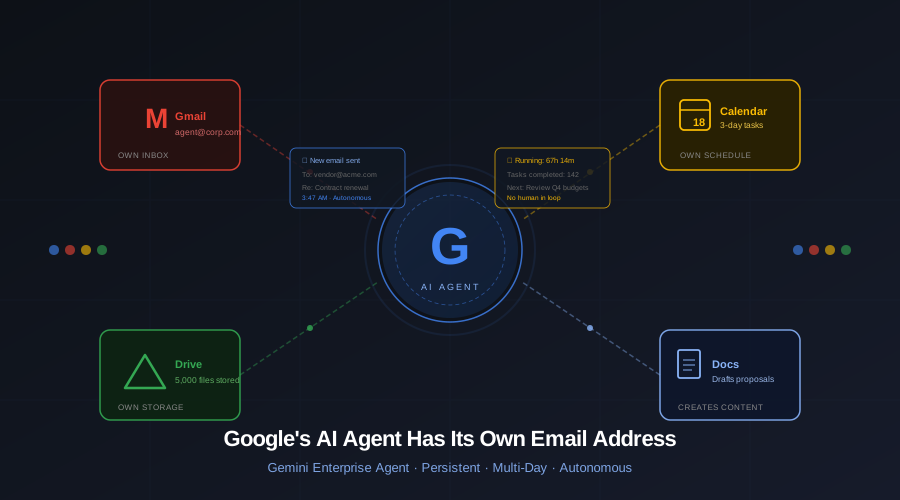
Your new AI coworker just got a company email address. It also has a calendar and a Google Drive. It sends emails on your behalf, books meetings, drafts proposals, and keeps working through the weekend while you’re asleep. It doesn’t need to be told to start every Monday — it never stopped.
On October 8, 2026, at its annual “Gemini at Work” conference, Google Cloud unveiled what it called the “Gemini agent” — a universal AI agent designed to handle enterprise work autonomously for days at a time. The announcement is, on its surface, another AI productivity pitch in a crowded market. Dig into the technical details, and you realize something more unusual is happening: Google is creating AI agents that exist as independent digital entities inside your organization’s infrastructure, complete with their own inboxes, calendar entries, and cloud storage.
The Agent That Lives Inside Your Org
Here is the detail that sets this apart from every other enterprise AI announcement: persistent Gemini Agents receive dedicated Gmail accounts, Google Calendar access, and Google Drive storage. They are not borrowing yours. They are not impersonating you. They operate as distinct accounts inside your organization’s Google Workspace — sending and receiving email under their own address, creating calendar events in their own name, and generating and organizing documents in their own Drive folder.
The implications are not subtle. When a Gemini agent emails a vendor to request a quote, the email comes from an address like `procurement-agent@yourcompany.com`. When it schedules a review meeting after completing a report, the calendar invite lists the agent as the organizer. When it stores research it gathered across a 72-hour task, those files exist in Drive independent of any individual employee’s account.
This is a different architecture than what most enterprise AI tools have offered. Microsoft Copilot, Salesforce Einstein, and ServiceNow’s Now Assist all operate as assistants — they augment human workers by acting within an authenticated user’s session, with the human’s permissions and under the human’s name. The Gemini agent model is different: these agents are first-class members of your Google Workspace tenant.
Running for Days, Not Minutes
The other landmark feature is persistence. Enterprise AI has mostly operated in sessions — you open the tool, give it a task, wait for results, and close it. Tasks that require dozens of steps across multiple systems over multiple days have generally been out of scope.
Google is ending that paradigm. The Gemini Enterprise Agent Platform is architected for “long-running tasks” — work that requires the agent to monitor an email inbox for a week, coordinate across multiple time zones, update documents as new information arrives, and synthesize results on a schedule rather than on demand.
Google’s documentation describes use cases such as: automatically tracking contract renewal dates, emailing relevant counterparties when renewals approach, receiving and processing their responses, flagging exceptions for human review, and filing completed contracts in structured Drive folders — all without a human touching the workflow after the initial setup.
In the language of AI research, this is what’s called an agentic loop running in production. The Gemini agent doesn’t wait for a prompt. It waits for conditions — a new email, a calendar trigger, a file update — and acts.
The Race Google Is Running
The timing of this announcement isn’t incidental. Microsoft has spent the better part of two years positioning Copilot as the definitive enterprise AI product, building it deeply into Microsoft 365 and pitching it at every enterprise account Microsoft holds. OpenAI’s DevDay earlier this month featured a competing announcement: “agent computers” that give AI systems their own virtual desktops.
Google’s answer is a bet on the Workspace ecosystem. The argument is simple: if your company already runs on Gmail, Google Docs, Sheets, Meet, and Calendar — the majority of mid-sized and large enterprises globally — then an AI agent that lives natively inside that infrastructure can do more, more reliably, than an agent that must authenticate into third-party systems.
Google is also leaning on its data integration advantage. The Gemini agent can pull context from across all connected Workspace apps simultaneously — a single task can reference a relevant email thread from six months ago, the current draft of a proposal in Docs, a Sheets budget model, and an open item in a Calendar invite. This cross-app context window is, Google argues, unique to an agent that runs inside the infrastructure rather than outside it.
The Governance Problem Nobody Wants to Talk About
There is an obvious and uncomfortable corollary to persistent, first-class AI agents operating under their own email addresses: how do you know what they’re doing?
An AI agent with its own inbox can receive and respond to emails without any human in the loop. It can make commitments — scheduling calls, agreeing to terms, forwarding sensitive documents — that are legally and operationally significant. And unlike an employee, it does not have the social inhibitions that might cause a human to pause and ask “wait, should I really send this?”
Google has acknowledged the governance challenge directly. The Gemini Enterprise Agent Platform includes an audit log of all agent actions, a configurable approval-gate system that can require human sign-off before the agent sends outbound emails or makes calendar commitments, and role-based controls that limit what data an agent can access and what actions it can take. Administrators can see, in real time, what every deployed agent is doing.
But analysts are already noting that “can” is doing a lot of work. These controls exist in the platform. Whether organizations actually configure and enforce them — and whether employees know that the email they received came from an agent rather than a colleague — is an organizational problem, not a technical one.
Remio AI’s analysis of the launch called governance “the real test” and noted that many enterprise organizations do not have the internal processes to responsibly manage autonomous agents operating in email and calendar. “The platform is ready before the governance culture is,” the company wrote.
What This Means for Your Inbox
The practical reality is that enterprise email — already drowning in cc’d threads, calendar invites, and automated notifications — is about to gain a new category of sender. AI agents operating as Workspace accounts will send emails that look, structurally, identical to emails from human colleagues. They will have company email addresses. They will attach files. They will follow up if they don’t hear back.
For some tasks, this will be genuinely useful. For many knowledge workers, the most tedious parts of their jobs are exactly the kind of multi-step, multi-day coordination tasks that Gemini agents are designed to handle. If an AI agent can manage the entire lifecycle of a contract renewal without pulling a procurement manager into a dozen email threads, that represents real time saved.
The question is what the accumulation of these agents does to the communication fabric of an organization. If every department deploys agents for every repetitive workflow, the volume of agent-generated communication could dwarf human-generated communication within months. A company of 500 people could be running dozens of concurrent agents, each sending and receiving email around the clock.
Google is betting that organizations will manage this well. The governance tools exist. What remains to be seen is whether enterprise IT and HR and legal teams can move fast enough to set the rules before the agents do.
The future of work may have just gotten an email address. Whether the rest of the organization is ready to correspond with it is a different question.


