For the past several years, the most powerful AI models have lived in the cloud — massive server farms owned by OpenAI, Google, Anthropic, and Amazon. Your laptop sent a request; a data center somewhere answered. That arrangement is now changing faster than most people expected.
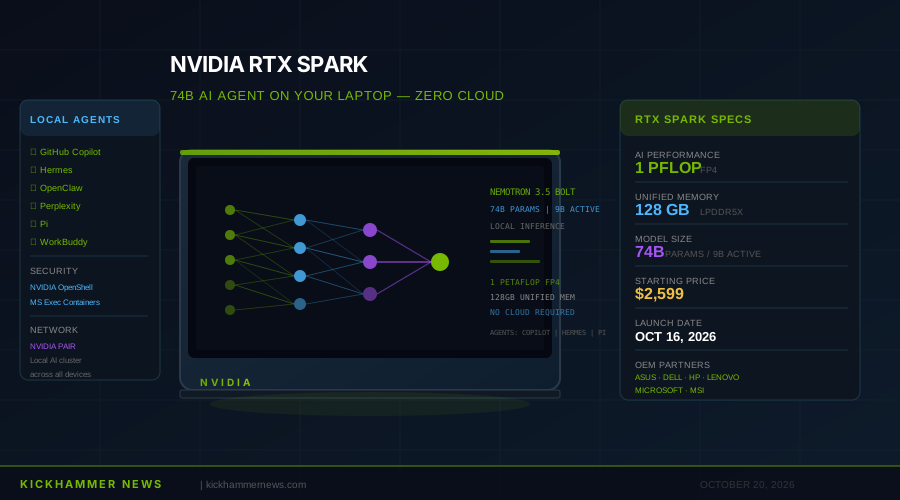
On October 16, 2026, NVIDIA began shipping its RTX Spark laptops worldwide. These are not gaming machines with a few AI parlor tricks bolted on. They are, by design, full-scale AI inference platforms that happen to fit in a backpack. The flagship configuration can run a 74-billion-parameter AI model — the same scale as frontier models from just two years ago — entirely on-device, with no data ever leaving your desk.
One Petaflop in Your Bag
The technical foundation is a superchip NVIDIA calls the RTX Spark N1X. It combines a Blackwell-generation RTX GPU with a Grace CPU co-designed with MediaTek, and crucially, up to 128GB of unified memory shared between the processor and the AI accelerator. The chip delivers up to one petaflop of FP4 AI compute — the same unit of measure applied to serious server hardware just a few years ago.
Two configurations ship at launch: one with 6,144 GPU cores, a 20-core CPU, and up to 128GB of LPDDR5X memory, and a slightly trimmed version with 5,120 cores, 18 CPU cores, and up to 64GB. Both run standard Windows 11 on a 45–80W power envelope and include fifth-generation Tensor Cores for AI acceleration, fourth-generation ray-tracing hardware for gaming, and DLSS 5 — NVIDIA’s latest neural rendering system.
Pricing starts at $2,599. OEM partners at launch include ASUS (ProArt P14 and P16), Dell (XPS 16), HP (OmniBook Ultra and OmniBook X 14), Lenovo (Yoga Pro 9n), Microsoft (Surface Laptop Ultra), and MSI (Prestige N16 Flip AI+). Compact desktop versions using the same silicon are expected in November.
The 74B Model That Fits in 24GB
The headline capability is a new open-source model from NVIDIA called Nemotron 3.5 Bolt. Released October 15 — one day before the laptops began shipping — Nemotron 3.5 Bolt is a 74-billion-parameter mixture-of-experts model. Because it uses a sparse activation architecture, only 9 billion of those parameters are actually active during any given inference pass. Through aggressive 2-bit quantization, the model fits in 24GB of memory, putting it within reach of the mid-tier RTX Spark configuration.
NVIDIA released Nemotron 3.5 Bolt as fully open source — weights, training data, and recipes — and it runs through standard inference stacks: llama.cpp, vLLM, Ollama, Unsloth, and LM Studio. The model was purpose-built for tool calling and multi-step agentic tasks rather than raw single-question benchmarks, which reflects where AI deployment is actually heading.
A second model, Nemotron 3.5 Bolt E4B, weighs in at just 4GB and is designed for in-game AI characters — the kind of model that runs as a background process while you’re playing a title like SkyrimNET.
NVIDIA also confirmed local support for Microsoft MAI 1.1 Coding Flash, the slimmer version of Microsoft’s MAI-Base-2 foundation model.
Agents Out of the Box, Sandboxed
What NVIDIA is pitching is not just a laptop that can run AI models — it is a laptop that ships ready to run AI agents as daily productivity tools. On first boot, an RTX Spark machine presents a Getting Started screen where users choose and install one of six supported agent platforms: GitHub Copilot, Hermes (from Nous Research), OpenClaw, Perplexity, Pi, and WorkBuddy. The selected agent recommends and installs an optimized local model automatically, without the user touching a command line.
Security is handled at the operating system level through two interlocking systems. NVIDIA’s own OpenShell provides credential protection and real-time monitoring of what agents are doing on the machine. Microsoft’s Execution Containers (MXC) sandbox each agent process, preventing it from touching system resources it should not see. When NVIDIA says “local AI agent,” they are not describing a script that runs in a terminal — they mean a sandboxed service that can take actions, handle tool calls, and persist across sessions, all with documented OS-level guardrails.
For workloads that still benefit from cloud compute, NVIDIA ships an open-source library called Switchyard, a routing layer that decides query by query whether to run inference locally or send it to a cloud model. Hermes is integrating Switchyard by end of October; other agent platforms are expected to follow.
The Personal AI Cluster: NVIDIA PAIR
One of the most unusual features of the RTX Spark ecosystem is NVIDIA PAIR — Personal AI Router — which exits beta alongside the laptop launch. PAIR turns a local network of RTX-equipped PCs into a shared inference cluster. An RTX Spark laptop at the center of a home or office network can handle AI inference on behalf of other Windows, Linux, and macOS machines connected to the same router, none of which need to be AI hardware themselves.
PAIR is free, open source, and now supports llama.cpp and direct downloads from Hugging Face. It effectively creates a private, self-hosted alternative to paid cloud API access for routine AI tasks across multiple devices.
For Developers, a Native Toolchain
Until now, running CUDA-accelerated AI workloads on Windows on Arm required layers of compatibility shims. NVIDIA ships RTX Spark with the first native PyTorch-CUDA build for Windows on Arm, the first default-native Python 3.15 build, and the first native Conda installer for the platform. NVIDIA claims compatibility with 97% of the top 15,000 Python packages.
This matters because it means a developer on an RTX Spark laptop is running the same stack — same environment, same package manager, same CUDA primitives — as a developer on an x86 Linux server. Previously, Windows on Arm required workarounds that added friction and subtle incompatibilities. NVIDIA says that gap is now effectively closed.
GitHub Copilot’s HydraFusion routing system, updated for RTX Spark, can now send queries to local models rather than always routing through Microsoft’s Azure infrastructure. That has data-residency implications for enterprise developers working with proprietary codebases.
Creative Tools and the $2,599 Question
Adobe is optimizing Photoshop, Premiere, and Substance 3D for RTX Spark through TensorRT acceleration, with beta support live at launch and up to 2x performance gains claimed. NVIDIA Broadcast 2.3 adds video super resolution up to 4K and frame generation. The platform supports 8K 4:2:2 editing and 3D scenes up to 90GB, including while running on battery.
The question the market will answer over the next few quarters is whether the $2,599 floor price — and the higher price points for the 128GB configurations — justifies the capability. For users who were already spending money on Claude Pro, ChatGPT Plus, Gemini Advanced, and Perplexity Pro, the math may close faster than expected. A single 74B capable model, permanently available offline, with no per-token billing, is a different value proposition than the subscription model the AI industry has been selling since 2023.
What “Local AI” Actually Means Now
Microsoft’s Yusuf Mehdi, speaking at the Surface launch event where RTX Spark preorders opened, described Windows as a platform for “hybrid intelligence” — AI workloads that run locally or in the cloud as the task dictates, rather than defaulting to cloud for everything.
That framing is significant. “Local AI” has been a promised category for years, with products like the Copilot+ PC and Apple Silicon pushing modest on-device inference capabilities. RTX Spark is the first consumer laptop platform that can run a model at the scale where the capability is genuinely competitive with what you get from a cloud API.
For privacy-conscious users — corporate legal teams, healthcare professionals, researchers working with embargoed data — a machine that runs a frontier-class model with zero network egress is not a convenience feature. It is a compliance requirement that previously had no off-the-shelf answer.
The laptops are on sale now. The compact desktop versions arrive in November. The era of cloud-only AI inference just got its most credible challenger.


