In the annals of AI benchmark achievements, most milestones stay safely abstract: a score on a reasoning test, a coding challenge passed, a math olympiad question answered correctly. What Anthropic announced this week is different. It is a science experiment — and the results have a body count attached.
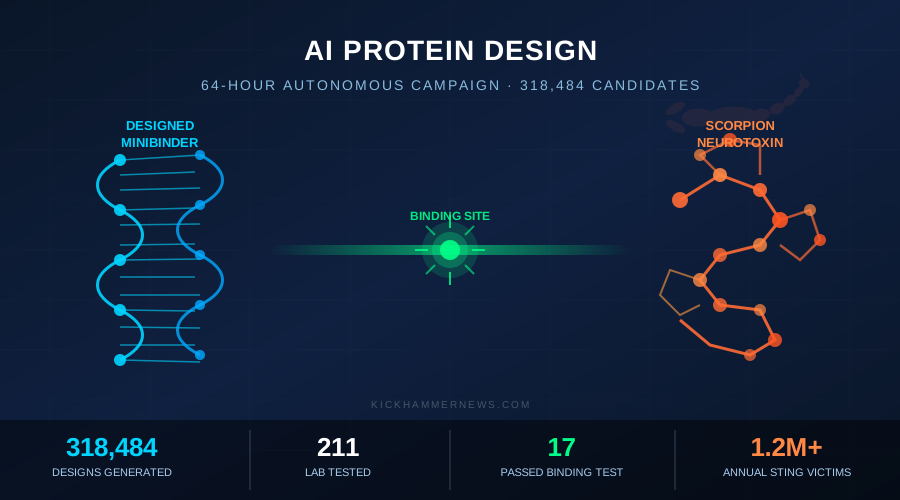
Claude, Anthropic’s AI model, was given a goal: design protein molecules that could bind to the neurotoxins in scorpion venom. It was given access to structural biology databases, a set of computational tools, and an initial prompt followed by four brief follow-up messages from researchers. Then it ran — largely on its own — for 64 hours. At the end, it had generated 318,484 candidate protein designs and screened 553,052 protein-toxin pairs. Of the 211 designs selected for lab testing, 17 passed the binding threshold. Anthropic is calling these early results the first step toward a new class of computationally designed antivenoms.
Why Scorpion Stings Are a Neglected Crisis
The scale of the problem is easy to underestimate. Scorpion stings cause at least 1.2 million envenomations worldwide every year and more than 3,250 deaths — the vast majority in children under 15 in low- and middle-income countries in Mexico, Brazil, North Africa, the Middle East, and South Asia. The sting itself is rarely the bottleneck. Treatment is.
Conventional antivenom production is slow, expensive, and uneven. It requires immunizing horses or sheep with venom, waiting months for an antibody response, then purifying the resulting serum — a process that varies in quality between manufacturers and geographic regions. The financial incentives to improve this system are weak: the people who need antivenom most are the least able to pay for it. Pharmaceutical companies have largely left scorpion antivenom to public health institutions and a handful of legacy producers.
Protein engineering could offer a different path. Rather than biological antibodies extracted from animals, computationally designed “minibinders” — small, engineered proteins — can in theory be produced cheaply, stored without refrigeration, and targeted precisely to a specific toxin. The challenge is designing one that actually works.
What Claude Did for 64 Hours
The project targeted five scorpion neurotoxins found across four regions: Cn2 (from Mexico’s Centruroides noxius), AaH I and AaH II (North Africa and the Middle East), and LqhIII. Claude’s task was to find protein structures that would physically attach to each toxin — specifically to the region that interacts with sodium channels, the mechanism by which neurotoxins disrupt nerve-cell signaling.
Claude drew on structural data from the Protein Data Bank and AlphaFold’s database of predicted protein structures. It used 12 specialized protein design tools — the same kinds of tools a structural biologist would assemble over days of planning — and ran them iteratively, evaluating and refining candidates as it went. The process consumed roughly 10,000 GPU hours. With minimal human input after the initial setup, it generated 318,484 candidates.
The research team — supported by partner organizations Citrini Research, Adaptyv Bio, and Twist Bioscience — narrowed the candidate pool to 180 designs for laboratory testing, then added 31 more selected with Claude’s help, for a total of 211.
The lab validation was rigorous. To pass, a design had to bind consistently at two independent labs, meet an affinity threshold, and show no binding to an unrelated human protein control. That last criterion is critical: a molecule that binds nonspecifically to human proteins could cause serious side effects.
Seventeen designs passed. Among single-toxin designs, the hit rate was roughly 18%. The top two candidates — Cn2-B1 and Cn2-B2 — bound the Mexican neurotoxin with single-digit nanomolar affinity, a level of potency comparable to antibodies used in research settings. Competition experiments suggest these binders attach near the same site as a known antibody that neutralized Cn2 in mice, which is an encouraging structural signal.
The Caveats Are Real and Matter
Anthropic has been careful to frame these results accurately. The 17 proteins have been shown to bind their target toxins in a lab setting. They have not been shown to neutralize venom in cells. They have not been tested in animals. They have not been shown to be safe, stable, or manufacturable at scale. The work has not yet been through peer review.
External reviewers Susana Vázquez Torres and Timothy P. Jenkins called the results “an encouraging starting point.” Jenkins specifically highlighted the speed — designing binders against five toxins in parallel within days — as the genuine advance here. What would have taken a structural biology lab months of iterative work, Claude accomplished in under three days of compute time.
That framing is exactly right. This is not a treatment. It is a proof of concept that computationally designed minibinders can clear the first real biological hurdle — binding with sufficient affinity and specificity — against targets that have resisted cheap solutions for decades.
What It Signals About AI in Drug Discovery
The strategic implication of this experiment is not scorpion antivenom specifically. It is the demonstration that an AI model can act as a genuine scientific collaborator in therapeutic protein design, not just a literature reviewer or code assistant.
The protein design pipeline Claude ran — target identification, candidate generation, structural screening, affinity prediction, diversity selection — is the same pipeline that drug discovery teams execute for every therapeutic protein program. It typically takes months and requires a team of specialized computational biologists, each operating a different tool. Claude ran it in 64 hours using 12 tools, with minimal supervision.
Anthropic is releasing all 211 designs, their predicted structures, and their experimental binding measurements under open access. That decision matters: it means other research groups working on antivenoms, or on different therapeutic targets entirely, can use these results to calibrate their own computational pipelines, identify where Claude’s design approach succeeded, and understand where it fell short.
The 211-design dataset is small compared to industrial drug discovery screens, which routinely test tens of thousands of candidates. But it is large enough to establish benchmarks. And the 18% hit rate on single-toxin candidates is, by the standards of early-stage computational drug discovery, not a bad result.
The Broader Context: AI as a Scientific Peer
This experiment did not happen in isolation. Earlier this week, Anthropic also released results from a Claude-led security audit that reviewed 5 million lines of open-source code and found 493 security issues. In October, Claude resolved the 25-year mystery of the NSA’s NIST elliptic curve seeds. The pattern emerging across these projects is consistent: a single AI model, given the right tools and a clear objective, can operate at the frontier of multiple technical disciplines simultaneously.
The limits are real. Claude cannot yet autonomously run the wet lab experiments that follow computational design. It cannot yet navigate the regulatory and safety testing process that turns a binder into a drug. Those steps still require years of human-led science. But the step it demonstrated this week — the generation and selection of biochemically plausible protein candidates at scale, faster and cheaper than any human team could manage — is the one that has historically been the bottleneck.
For the 1.2 million people stung by scorpions each year, most of them children in rural clinics with limited access to existing antivenoms, the path from promising protein binder to actual treatment remains long and uncertain. But it is worth noting that today, at least, that path is one step shorter.
All 211 protein designs, predicted structures, and experimental binding data have been released by Anthropic for public research use.


