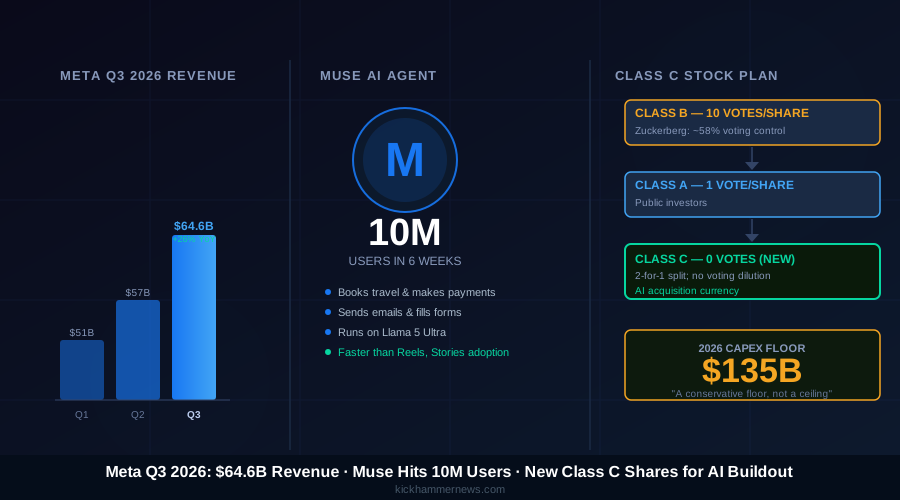
Meta Platforms reported its third-quarter 2026 earnings on Tuesday, and the headline number was staggering: $64.6 billion in revenue, up 26% year-over-year. By almost any measure, the company is printing money. But buried inside the quarterly report was an unusual admission — Meta is planning to create a completely new class of non-voting shares to fund the AI buildout it says it cannot afford to slow down.
That combination tells you something important about where we are in the AI arms race. The most profitable social media company in history has decided that its existing earnings aren’t enough. It needs a new financial instrument entirely.
Muse Takes Off Faster Than Anyone Expected
The clearest signal in the earnings report wasn’t the revenue beat — it was the Muse number. Meta’s personal AI agent, which launched on September 9th as a U.S. rollout across iOS, Android, and Meta’s own hardware, reached 10 million users in six weeks.
For context: that’s a faster adoption curve than Instagram Stories, faster than Reels, and faster than almost any product Meta has launched since the original News Feed. Mark Zuckerberg called the trajectory “extraordinary” on the earnings call and said it exceeded internal projections by a significant margin.
Muse is Meta’s answer to the personal AI agent wars that have erupted across the industry in 2026. Where Claude Duet (Anthropic) emphasizes proactive background work and privacy, and ChatGPT’s Dots (OpenAI) focuses on seamless integration with existing workflows, Muse is explicitly consumer-first: it books travel, fills web forms, sends emails on your behalf, makes payments through Meta Pay, and can reach across apps on your device to take actions. It runs primarily on Llama 5 Ultra, Meta’s frontier open-weight model.
The 10 million figure matters for another reason: it’s early validation that consumers will actually let a third-party AI act in their name, not just talk to it. The gap between chatting with AI and trusting AI to spend your money has been the central question hanging over the personal agent market. Meta’s early numbers suggest the gap is narrowing faster than skeptics expected.
Revenue contribution from Muse is still minimal — the product is free to use, with monetization expected to come from transaction fees and future Muse Pro tiers. But Wall Street responded positively to the user growth numbers, pushing Meta shares up roughly 4% in after-hours trading before profit-taking erased some of those gains.
The Earnings Beat, Clouded by a $9.9 Billion Legal Charge
The revenue figure of $64.6 billion beat analyst consensus of approximately $62.1 billion. Net income would have been dramatically higher if not for a $9.9 billion one-time legal charge — the settlement cost for an antitrust case related to Meta’s 2012 Instagram acquisition and 2014 WhatsApp acquisition, both of which the FTC revived and won on appeal in late 2025. After the charge, reported net income came in at around $14.3 billion, well below what clean earnings would have shown.
Advertising remains the engine. AI-powered ad targeting improvements — specifically Meta’s Advantage+ suite, which uses AI to automate creative testing, audience selection, and bid optimization — drove a 19% increase in average price per ad, even as ad impressions grew 12%. Advertisers are getting more return per dollar, which means they’re spending more dollars.
Meta also disclosed that daily active users across its family of apps (Facebook, Instagram, WhatsApp, Threads) hit 4.4 billion — essentially half the world’s adult population using at least one Meta product every day.
The Part That Should Make You Stop: A New Class of Stock
The most structurally significant announcement buried in the earnings materials is the plan to issue Class C shares — a new, non-voting class of stock that Meta will use to fund its AI infrastructure buildout.
This is unusual. Google did something similar in 2014, and Snap did it at its IPO, but Meta has only ever had two share classes: Class A (one vote per share, held by public investors) and Class B (ten votes per share, held primarily by Zuckerberg, giving him approximately 58% of total voting power). Class C would be issued to existing shareholders in a 2-for-1 split-like transaction — every existing share gets one additional Class C share — but the new shares carry zero voting power.
Why does this matter? Because it allows Meta to issue shares as currency for acquisitions or employee compensation without diluting Zuckerberg’s control of the company. If Meta wants to acquire an AI startup for $5 billion in stock, it can pay in Class C shares rather than cash, leaving its cash reserves intact for the infrastructure build while keeping Zuckerberg’s voting bloc untouched.
Meta raised its full-year 2026 CapEx floor to $135 billion — a number that would have been almost unimaginable as recently as three years ago. That’s the floor. Management called it “a conservative floor, not a ceiling.” The spending covers data center construction, custom AI silicon (Meta’s MTIA chip is now in its third generation), and network infrastructure to run Muse at scale, train successors to Llama 5, and keep the AI ad targeting systems running.
To put $135 billion in context: it exceeds the annual GDP of Hungary. Meta expects to spend it in a single calendar year.
What This Says About the AI Moment
There’s a paradox embedded in Meta’s quarter. The company earned more revenue in three months than most countries generate in a year. And its leadership decided that still wasn’t enough — that the only way to fund the AI ambition they’ve described was to restructure the company’s capital base.
The AI arms race has moved past the point where any single company’s cash flow, however enormous, is sufficient to sustain it. Anthropic filed its IPO S-1 this week. OpenAI has been raising capital at a pace that would have seemed absurd in 2022. Google and Microsoft are spending at similar scales.
The new Class C shares tell you something the revenue numbers alone don’t: Meta’s leadership believes the AI investment window is still open and narrowing, and that winning it is worth bending the company’s financial architecture to accommodate.
For Zuckerberg personally, the Class C structure has an additional appeal. He can fund billions in AI investment through equity issuance without any risk of losing the voting control that has defined his tenure at Meta since the company went public. The AI buildout, in other words, will not cost him his grip on the company.
What Comes Next
Meta said Muse will expand internationally in “the coming months,” starting with Canada, the UK, and Australia. A Muse Pro tier — with expanded capabilities, higher action limits, and access to Llama 5 Ultra’s full context window — is planned for early 2027, with pricing expected to be similar to Claude Max or ChatGPT Pro.
On the model side, Meta said Llama 6 training has begun, with a planned research preview in Q1 2027. The company reiterated its commitment to open weights for Llama 6, though it said it was “still evaluating” the frontier variant’s release conditions — language that suggests the full-capability version of the model might be subject to safety review delays.
The Class C shares require shareholder approval and are expected to be voted on at a special meeting in early 2027.
For now, the number that will echo through the rest of the AI earnings season is simple: 10 million users in six weeks. That’s the speed at which the world is adopting AI agents that can take real actions on your behalf. Everything else is the infrastructure cost of keeping up with it.


