For the past five years, the most influential AI company in the world didn’t have a single robot to its name. OpenAI shut down its robotics team in 2021, citing the massive cost of physical data collection compared to the near-infinite supply of text and images on the internet. The lesson, as Altman later described it: we weren’t ready.
Now, OpenAI believes it is.
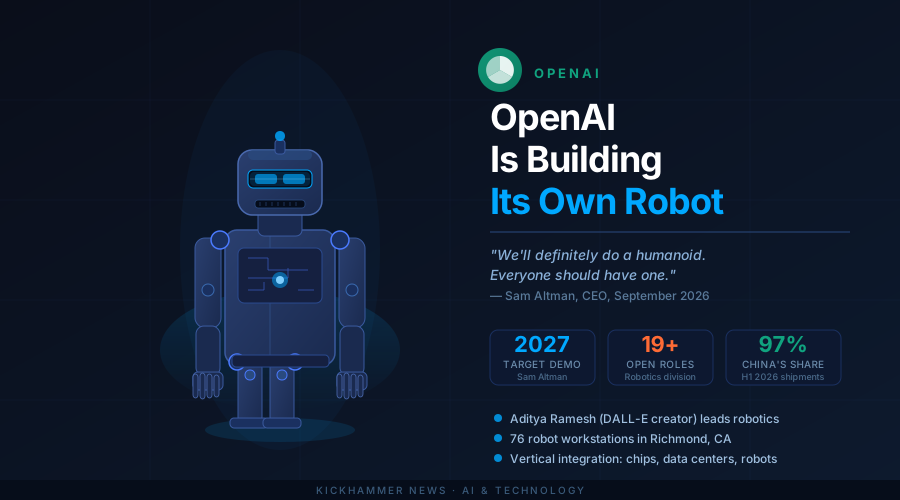
On September 3, 2026, Sam Altman confirmed on the Sources podcast what the robotics industry had been expecting for months: OpenAI will build its own humanoid robot. “We’ll definitely do a humanoid, and other form factors as well,” he said. And in a line that sounded more like a manifesto than a product roadmap: in the long run, he said, everyone should have one.
A demo is targeted for 2027. Then, Altman expects, humanoid robots on city streets — “a few years after that.”
The Strategic Logic Behind the Robot
To understand why OpenAI is building a robot, you first need to understand what it’s actually building: a vertically integrated company that controls every layer of the AI stack. The company is developing its own chips (project Titan), its own data centers (Stargate), a personal AI device with Jony Ive’s io studio, and now — robots.
In Altman’s telling, the form factor matters less than the intelligence inside it. “The AI brain is the important part,” he said. The physical body is almost an afterthought — a delivery mechanism for intelligence. But it’s a delivery mechanism with one massive advantage over a chatbot: robots generate physical interaction data. Every time a robot opens a door, picks up an object, or navigates around a chair, it creates training signal that a model trained only on text and images simply cannot get.
This is the core reason OpenAI left robotics in 2021 and the core reason it’s back. The company discovered that language models learned extraordinarily well from internet data — making physical data collection unnecessary for that generation of AI. But vision-language-action models — the architecture OpenAI is now pursuing for its robots — need embodied experience. A model that outputs motor commands rather than words needs a body to learn from.
The Richmond, California facility that now operates 76 robot workstations exists for exactly this reason: generating teleoperated training data at scale.
Why OpenAI Didn’t Just Stay with Its Partners
OpenAI learned this lesson the hard way.
In 2023, it backed 1X Technologies, a Norwegian humanoid startup, with a $23.5 million investment. The partnership generated real data and a few impressive demos. But in February 2025, Figure AI — a separate humanoid startup that had partnered with OpenAI to develop AI software for its robots — ended the collaboration, reportedly over disagreements about where the value would accrue.
The pattern was unmistakable: when you supply the brains but a partner owns the body, you don’t control the full feedback loop. Physical training data stays with the robot maker. Customer relationships stay with the robot maker. The robot maker captures an increasingly large share of the value — and eventually, the AI supplier becomes a commodity vendor.
OpenAI has watched that dynamic play out across software too. It’s why the company built Stargate rather than simply buying AWS credits. It’s why it’s building Titan rather than relying entirely on Nvidia. The insight is consistent: at the frontier of AI, whoever controls the physical infrastructure controls the future.
The Competition OpenAI Is Entering
The humanoid robotics market that OpenAI is entering looks nothing like the one that existed when it left in 2021.
In the first half of 2026, roughly 19,100 humanoid robots were shipped globally. Chinese manufacturers — led by AGIBOT and Unitree — account for over 97% of those shipments. They have cost advantages, supply chain advantages, and a multi-year head start in production scale. Unitree’s G1 now sells for under $16,000. AGIBOT’s A2 is deployed in warehouses, construction sites, and logistics facilities across China and Southeast Asia.
The Western competition includes Tesla’s Optimus, which entered limited production in late 2025 but has not shipped customer units as of this writing. Boston Dynamics continues refining its Atlas platform. Google DeepMind released Gemini Robotics 2 on July 30 — a robot control system, not a robot, but a sign that the search giant is embedding itself in the physical AI stack. Skild AI, which raised $1.4 billion in January 2026 to build a general-purpose robot brain, is positioning itself as the model layer that other robot makers use — the exact role OpenAI once played in text AI.
Against this field, OpenAI’s advantages are real but not obvious. It has the most capable language model family in production. It has Aditya Ramesh — the VP of Research who created DALL-E — leading the robotics division. It has the financial resources to pursue multi-year hardware development timelines. And it has Altman’s track record of being directionally right about technology bets that looked premature.
The Hardware Problem Nobody Talks About
Sam Altman calls the AI brain the important part. But the physical body has a bill-of-materials problem that no amount of intelligence can solve on its own.
Actuators — the motors and drive systems that let a humanoid move — account for 40 to 60 percent of the total manufacturing cost. They’re precision components that require rare-earth materials, and China dominates both the processing of rare earths and the manufacturing of the actuators themselves. OpenAI’s current job listings include four roles specifically focused on actuator and motor design — an unusual investment for a software company that has historically outsourced everything physical.
The company is also recruiting for PCB layout, thermal simulation, firmware engineering, and prototyping. Nineteen robotics roles were open in San Francisco as of mid-October, up from eleven when the division formally launched at the end of May 2026. The shift from software-only roles to hardware-intensive engineering is the clearest sign yet that OpenAI is serious about vertical integration here — that this isn’t a research announcement or a strategic hedge, but a real product development effort.
One significant gap: when hardware leader Caitlin Kalinowski resigned in March 2026, OpenAI had not announced a replacement as of late October. The vacancy at the top of its hardware organization is a genuine concern for a company trying to compress what normally takes years of manufacturing iteration.
What “A Demo in 2027” Actually Means
Altman was careful to calibrate expectations: “a cool demo” in 2027. Not a product. Not a ship date. Not a manufacturing commitment.
The history of humanoid robotics demos is a graveyard of implied promises. Boston Dynamics has been showing impressive robot videos for more than a decade; broad commercial deployment remains limited. Tesla first showed Optimus in 2021 and only reached limited production in 2025. The gap between “demonstrated capability” and “scalable product” in robotics is measured in years and billions of dollars.
OpenAI’s 2027 demo will almost certainly show a robot doing things that look impressive in a controlled environment: folding laundry, making toast, carrying boxes. The Richmond facility’s 76 workstations are generating exactly the kind of task-specific training data needed to make those demos possible. Whether those capabilities survive contact with the chaos of a real home or warehouse is a separate question — one that won’t be answered by a single demo.
The more honest framing may be in Altman’s 2025 essay “The Gentle Singularity,” in which he described a world where robots begin entering physical spaces in 2027 and gradually take over more physical tasks over the following years. It’s a long arc, not a product launch.
What This Means for the Rest of the Industry
OpenAI entering the humanoid robotics market with full vertical integration intent will reshape the competitive dynamics for every other player.
For companies that have been building their robots on OpenAI models, the message is now unambiguous: OpenAI is coming for your market. 1X, Figure (which returned to independence), and any other humanoid startup that was counting on OpenAI as a neutral model supplier should be updating their strategies accordingly.
For Nvidia, it’s a signal that even one of its most important software partners is trying to reduce dependence on third-party infrastructure — adding robots to a list that already includes chips and data centers.
For Google and Amazon, which are also pursuing physical AI through Gemini Robotics and their own robotics investments, OpenAI’s move accelerates the race to own not just the intelligence layer but the physical world that intelligent systems operate in.
And for everyone who has thought of AI as a software phenomenon — as something that lives in servers and speaks through screens — OpenAI’s robot announcement is a reminder that the endgame was always embodied. The brain, as Altman keeps saying, is the important part. But a brain without a body can only go so far.
OpenAI’s robotics division is based in San Francisco. The Richmond, California training facility operates 76 robot workstations. Sam Altman’s comments about OpenAI’s humanoid plans were made on the Sources podcast on September 3, 2026.


