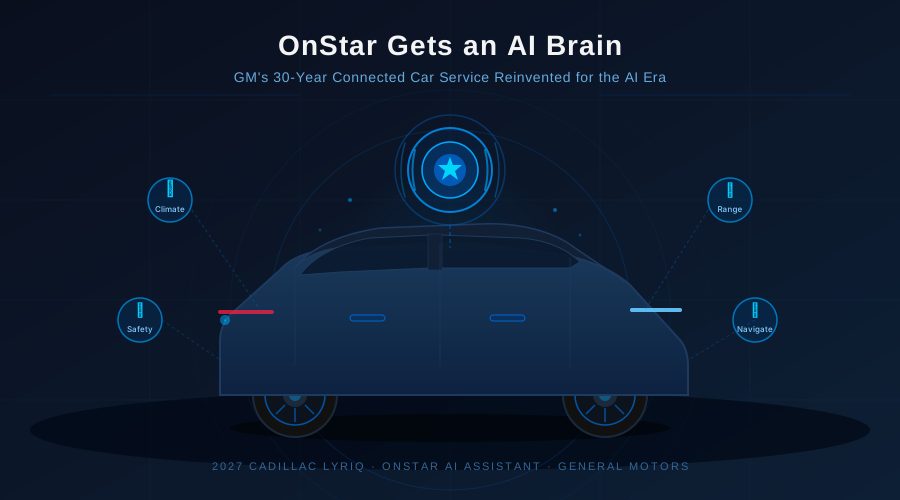
General Motors spent three decades turning OnStar into the connected-car service every American driver knows — that reassuring voice that kicks on when your airbags deploy, that gets you directions when you’re lost, that calls 911 when you can’t. Now GM is tearing that identity down and rebuilding it around an AI assistant that understands natural language, monitors your vehicle in real time, and — unlike the Gemini-powered system it’s quietly replacing — doesn’t send your driving data to Google.
The company announced on October 22, 2026 that an AI assistant will debut in the 2027 Cadillac Lyriq via an over-the-air software update “in the coming months,” with the 2027 GMC Sierra and Chevrolet Silverado next in line. A redesigned OnStar smartphone app — replacing the OnStar Guardian app and the separate Buick, Cadillac, Chevrolet, and GMC brand apps — will follow in 2027.
GM is calling the transformation a shift from a call center into a “connected intelligence layer.” That framing is more than marketing. For the first time since OnStar launched in 1996, the service is being rebuilt around what the car already knows about itself rather than around human operators waiting on the other end of a phone line.
What It Can Actually Do
The assistant activates with “Hey, OnStar.” From there, it listens the way a passenger would, not the way a command-line interface would.
Ask it to cool the car down and you don’t have to say “reduce cabin temperature by four degrees.” Saying “it’s getting warm in here” is enough — the assistant interprets the intent and adjusts the air conditioning. The same logic applies across a growing list of vehicle systems: dome lights, the electronic glove box, the charge port. The assistant can manage all of them through conversation rather than menu navigation.
For Lyriq owners, who drive an EV, the assistant also handles range anxiety in a way previous systems couldn’t. It can plan charging stops, answer whether the car has enough range to reach a specific destination, and read back live data like battery percentage and projected range — all verbally, without requiring the driver to look away from the road.
The assistant also plays a new role as a vehicle tutor. It can explain what a warning light means in plain English, read tire pressure data aloud, and walk through installed features — effectively replacing the owner’s manual for drivers who never read it. When a question falls outside what the AI can confidently answer, it hands off to a human OnStar Advisor, preserving the call-center backup that has been OnStar’s most trusted feature for 30 years.
A new connected-camera system, operating similarly to Tesla’s Sentry mode, will record video from the vehicle’s surround cameras when the theft alarm is triggered or when the car detects an incident may be imminent. Recordings upload to the OnStar app and are encrypted. GM says it cannot access those files.
The Gemini Problem
GM made a significant bet on Google earlier this year. In April 2026, the company rolled out a Gemini-powered conversational AI assistant across approximately four million vehicles via software update — one of the largest AI deployments in the auto industry’s history. By October, that rollout is no longer the centerpiece of GM’s AI story.
The new native OnStar assistant appears to be displacing the Google integration. GM has not explicitly announced the end of the Gemini partnership, but the messaging around the new system — “native AI assistant,” “in-house effort,” “a connected intelligence layer” — signals a strategic pivot toward owning the AI stack rather than licensing it.
The reason almost certainly includes data. Every query a driver sends to a cloud-based AI partner passes through that partner’s servers. For a company that spent much of 2025 and 2026 in regulatory trouble over exactly that issue, keeping the AI native is not just a product decision. It’s a trust decision.
The Privacy Shadow
GM’s data problems are a matter of public record. The FTC reached a settlement with the company in January 2026 banning GM from sharing driver location data with third parties for five years, after finding the company had sold precise location information and driving behavior data to insurers and data brokers — in some cases without meaningful consent. In May 2026, GM paid a $12.75 million penalty in California, a record under the state’s privacy law, for the same conduct involving OnStar data.
The scandal reshaped how millions of Americans think about connected-car services. It also put GM in the difficult position of relaunching a privacy-sensitive product with new features — connected cameras, persistent location awareness, always-on microphone activation — shortly after those penalties.
GM’s response is transparency controls: users will be able to see what data each feature accesses, why it’s needed, and when it’s collected. AI permissions can be managed through what GM calls “simple settings.” Camera recordings are stored with time limits and encryption, and GM states explicitly that it cannot access them remotely.
Whether those assurances will be enough to rebuild trust is a separate question. Privacy advocates will note that GM made similar assurances before the 2024 disclosures. The FTC’s five-year data-sharing ban provides external enforcement that didn’t exist before, which gives the new system a structural backstop the old one lacked. But the ban is also a ceiling, not a floor — it prohibits selling location data, not all forms of data monetization.
The Bigger Picture: AI Moves Into the Car
GM’s announcement is part of a broader realignment happening across the auto industry. Cars have become among the most data-rich devices people own — always-on, location-aware, packed with cameras, microphones, and sensors. The AI assistant race is turning that data into a product.
Ford has its own AI integration in development. Rivian has been building AI features into its trip-planning software. Toyota announced a partnership with an unnamed AI lab in September. What separates GM’s approach is the depth of the integration: not an AI layered on top of a car’s infotainment system, but an AI wired directly into the vehicle’s sensor stack, with the ability to read tire pressure, manage charging, and respond to what’s happening in the cabin in real time.
OnStar has survived long enough to watch three generations of in-car technology come and go — cassette decks, CD changers, early GPS systems, smartphone integration. The question the 2027 Cadillac Lyriq will begin to answer is whether an AI that listens, reasons, and acts can finally do what every previous version of connected car technology promised: make the car feel less like a machine and more like a partner.
For GM, that question carries an extra weight. After two years of regulatory consequences for treating driver data as a commodity, the company needs the answer to be yes — and to be believable.
The 2027 Cadillac Lyriq is expected to receive the OnStar AI assistant via over-the-air update in the coming months. The 2027 GMC Sierra and Chevrolet Silverado are next in GM’s rollout plan.


