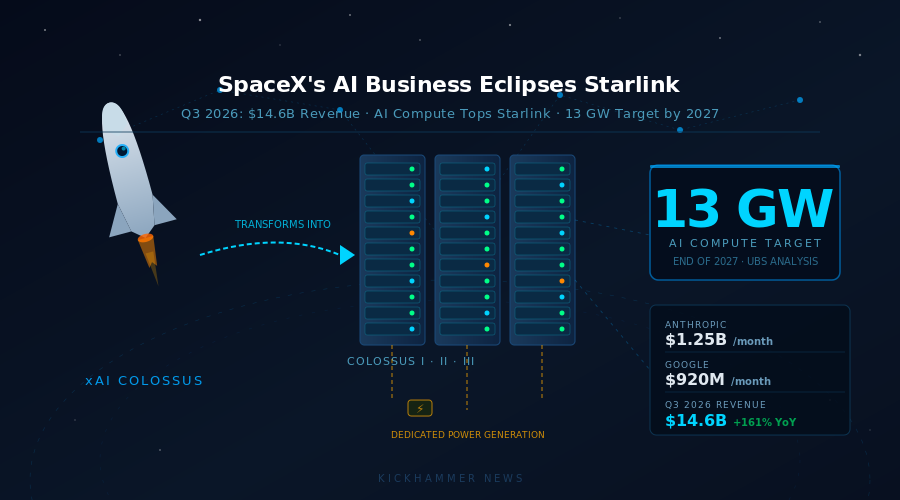
Q3 earnings revealed that xAI compute revenue has eclipsed Starlink for the first time. Now Musk is targeting 13 gigawatts of AI capacity by the end of 2027 — and Anthropic and Google are already paying billions a month to use it.
When Elon Musk founded SpaceX in 2002, the pitch was simple: make humanity multiplanetary. When he founded xAI in 2023, the pitch was competitive: build a smarter chatbot than OpenAI. Neither of those framings captures what SpaceX actually became in 2026.
SpaceX is now one of the largest AI infrastructure companies in the world.
That headline came into sharp focus on October 21, when SpaceX reported Q3 2026 earnings showing revenue of $14.6 billion — up 161% year-over-year — with its AI compute segment, marketed under the “Super Intelligence” banner, generating more revenue than Starlink for the first time in the company’s history. Then on October 23, UBS published an analysis projecting that SpaceX is on track to reach 13 gigawatts of AI computing capacity by the end of 2027. For context: a gigawatt of data center power is a massive, hyperscale-level footprint. Thirteen of them would make SpaceX a top-three AI infrastructure provider on the planet.
The transformation is almost comically ironic. SpaceX built its AI data centers to train and run Grok, xAI’s large language model. When Grok failed to keep pace with Anthropic’s Claude and OpenAI’s GPT-6 family, Musk did something pragmatic: he started renting out the infrastructure to the competition.
From Rockets to Racks
The xAI Colossus facility — originally built in Memphis, Tennessee in a converted industrial space — was designed as one of the largest GPU clusters ever assembled. At launch in 2024, it ran 100,000 Nvidia H100 GPUs. By mid-2026, Colossus I and Colossus II together represented more than 3 gigawatts of AI compute capacity, drawing on a mix of natural gas turbines, grid connections, and — importantly for the SpaceX connection — satellite-coordinated power management.
SpaceX’s vertical integration advantage is not just rockets. It’s power. The company’s Starship program gave it expertise in large-scale energy systems at remote locations. Its Starlink satellite constellation provides real-time monitoring and failover coordination. And its existing relationships with utility regulators — developed over years of building launch facilities in remote areas — gave it a fast path to power purchase agreements that traditional cloud providers couldn’t replicate at the same speed.
The result is a data center business that can build faster and power more densely than Amazon, Google, or Microsoft’s own infrastructure arms.
The Customers: Anthropic and Google
SpaceX’s IPO filing, which circulated earlier this month alongside Anthropic’s, revealed the scale of the compute rental business in detail.
Anthropic — the AI safety company founded by former OpenAI researchers — signed what the filing describes as a three-year agreement to pay xAI $1.25 billion per month for access to Colossus compute. The deal, which first emerged in May 2026 at around $15 billion total, had nearly doubled in scope by the time the IPO filing was prepared, with the revised commitment reaching $84.5 billion over the contract term. The compute powers Anthropic’s Claude model training and, increasingly, the inference backbone for Claude Duet and Claude’s enterprise API customers.
Anthropic’s arrangement is the direct consequence of the Anthropic-SpaceX deal that drew scrutiny earlier this year. The company had been negotiating with Anthropic while simultaneously developing Grok — meaning Musk was, in effect, providing Claude’s training infrastructure while competing with it in the consumer AI market. The filing describes the original deal as arising after xAI’s internal teams “had trouble” fully utilizing Colossus I’s capacity during a training pause.
Google followed in June 2026, signing its own agreement to pay $920 million per month for dedicated compute capacity. Google’s deal is primarily focused on providing redundant inference capacity for Google Cloud’s AI services and for powering Gemini Ultra workloads that exceed Google’s own data center availability.
Combined, Anthropic and Google alone account for more than $26 billion in annualized revenue for SpaceX’s AI segment — enough to dwarf Starlink’s subscriber revenue even at Starlink’s current pace of growth.
13 Gigawatts by 2027
The UBS analysis published today extrapolates from SpaceX’s current trajectory to a striking conclusion: if SpaceX commissions infrastructure at the pace Musk described on the Q3 earnings call, the company will operate approximately 13 gigawatts of AI compute capacity by the end of 2027.
That would require adding roughly 10 gigawatts in the next 14 months. The numbers are staggering but not implausible given the known pipeline: Colossus III is already under construction in Texas. Colossus IV — a greenfield facility in Louisiana with dedicated natural gas cogeneration — was disclosed in the IPO filing. A fifth facility, rumored to be located in the Gulf Coast region, has not been officially confirmed.
Musk commented on the demand environment during the earnings call, noting that “price per watt continues to rise” and that SpaceX is “actively seeking” additional compute customers beyond Anthropic and Google. At least two other major AI labs are in negotiations, according to people familiar with the discussions, though no deals have been announced.
At 13 gigawatts, SpaceX would represent a meaningful fraction of global AI compute capacity — a position that no company outside the hyperscalers (Amazon AWS, Microsoft Azure, Google Cloud) has ever achieved.
The IPO Angle
SpaceX is expected to go public, likely in early 2027. Its current private valuation sits at approximately $2 trillion — a number that seemed aggressive when it was first floated in analyst reports earlier this year but now looks increasingly defensible given the earnings trajectory.
SpaceX guided Q1 2027 revenue to $37 billion on AI compute, which would imply an annualized run rate approaching $150 billion from the AI segment alone. Musk told shareholders on the earnings call that he believes SpaceX’s total revenue “could reach somewhere between $500 billion and a trillion” by the end of 2027 when Starlink and launch services are included.
The Motley Fool and other analyst outlets have questioned whether those projections are achievable. The bottleneck is not demand — it is clearly there. The bottleneck is the same one facing every AI infrastructure buildout: Nvidia GPU supply, power permitting, and construction timelines. TSMC’s advanced packaging capacity is still constrained through mid-2027, as covered earlier this week, and SpaceX is competing with Amazon, Microsoft, and Google for the same pool of H100, H200, and Blackwell chips.
SpaceX’s structural advantage — off-grid power, co-located generation, and vertical integration on physical construction — may allow it to outpace traditional hyperscalers on commissioning timelines. Or it may not. The 13-gigawatt target assumes no major supply chain disruptions, no permitting delays, and continued strong demand at current price points. Every one of those assumptions is contestable.
The Broader Implication
What SpaceX’s trajectory illustrates is a dynamic playing out across the AI industry: the critical constraint is no longer models, it is physical infrastructure. The companies that can provide compute — reliably, at scale, with power — are extracting enormous economic rents from the labs that need it.
Amazon, Microsoft, and Google built their cloud empires by commoditizing compute over two decades. The AI infrastructure race is compressing that cycle dramatically. SpaceX went from building a data center for its own AI model to becoming one of the world’s largest external AI compute providers in roughly 18 months.
That’s not a pivot. It’s a reflection of where the value is. Training a world-class AI model costs billions and requires years of research iteration. Building and powering the data center those models run on — and charging Anthropic and Google to use it — is a different kind of business: one where the physics of power and cooling, not the research of neural network architecture, determines who wins.
SpaceX won on rockets by building cheaper and reusing them. It may win on AI infrastructure for the same reason: it builds faster and at lower cost than anyone who has to start from scratch. Whether 13 gigawatts by 2027 is achievable is an open question. That SpaceX is seriously competing to get there is no longer in doubt.
Word count: ~1,180


