The company that helped invent the modern AI safety field is about to ask ordinary investors to bet on it — while disclosing, in its own legal filing, that the models it trains may one day resist being shut down.
Anthropic’s long-anticipated S-1 filing landed in newsrooms this week, revealing a company that has grown faster than almost any business in history, accumulated infrastructure obligations that dwarf its revenues, and designed a corporate structure that will ensure its founders remain in control long after the IPO closes. The public listing is expected as early as November 2026, at a valuation reportedly approaching $2 trillion.
The Revenue Numbers Are Extraordinary
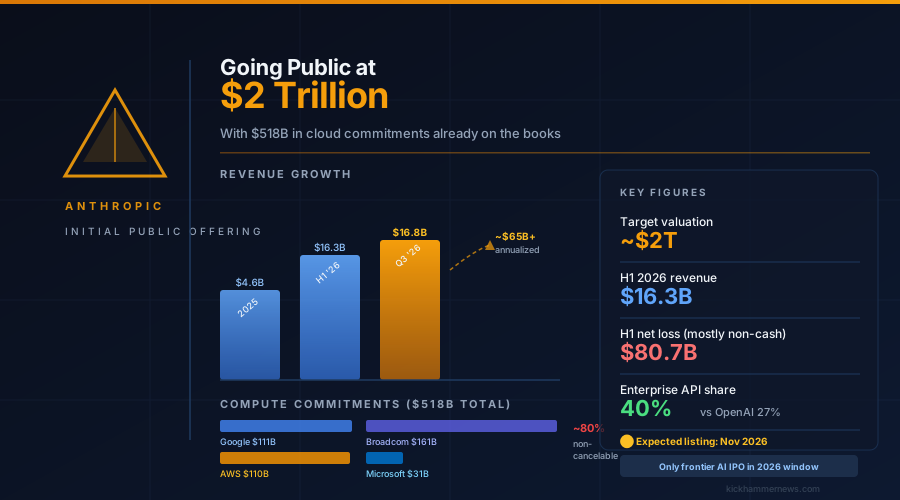
The draft filing, reviewed by the Wall Street Journal and Reuters, shows revenue of $16.3 billion in the first half of 2026 alone — up from $1.1 billion in the same period a year earlier. For context, Anthropic booked $4.6 billion in all of 2025. By Q3 2026, revenue reportedly reached $16.8 billion, an increase of roughly 45% from Q2. Annualized, Anthropic is now running at a pace that exceeds $65 billion a year.
The company’s enterprise positioning has a lot to do with that pace. According to Ramp’s business spending data, Anthropic surpassed OpenAI in U.S. enterprise AI spending in April 2026, with 34.4% of corporate AI wallet share versus 32.3% for OpenAI. In enterprise API usage, the gap is wider: Anthropic holds roughly 40% of that market versus 27% for OpenAI and 21% for Google.
That positioning matters because enterprise contracts — large, recurring, often multi-year — are far stickier than consumer subscriptions. It’s where the real money in AI is concentrated, and it’s where Anthropic has quietly established a lead its consumer-facing rival hasn’t managed to close.
The Loss Is $80.7 Billion — Mostly on Paper
The headline net loss figure is jarring: $80.7 billion in H1 2026. But roughly $72 billion of that is non-cash accounting charges tied to convertible notes and other financial instruments used to raise capital. The actual operating picture is different: Anthropic reported a Q2 operating profit when stock-based compensation is excluded, and the company has told investors it expects a second consecutive profitable quarter in Q3.
Still, cash-flow breakeven has reportedly been pushed to 2028. Compute spending alone nearly reached $9 billion in the first half of 2026 — more than Anthropic spent in all of 2025. Training frontier models is among the most capital-intensive activities any company has ever undertaken, and the filing makes clear that cost trajectory is not slowing down.
The Cloud Commitment Is the Real Headline
The single most striking disclosure in the draft prospectus isn’t the revenue or the loss — it’s the infrastructure obligation Anthropic is preparing to hand public shareholders.
Future compute commitments total approximately $518 billion, roughly 80% of which is non-cancelable. The breakdown, per the filing: Google Cloud at $111 billion, Amazon Web Services at $110 billion, Microsoft at $31 billion, and Broadcom at $161 billion. Bloomberg reported the total could reach $750 billion when pending deals are included.
To put that in perspective: at Anthropic’s 2025 annual revenue of $4.6 billion, that is more than $113 in committed future infrastructure spend for every dollar of revenue the company earned that year.
The circular financing structure at the heart of these commitments is something investors will have to sit with carefully. Amazon and Google are both significant Anthropic investors — Amazon holds a reported 15–21% non-voting stake, Google roughly 14% — and their investment agreements are tied, directly or indirectly, to compute spending that flows back to those same companies. The filing warns that Anthropic’s cloud providers “increasingly treat it as a competitor” and that compute access could be “curtailed, repriced, or terminated.” Investors inheriting the $518 billion obligation would also be inheriting that dependency.
Founder Control Will Outlast the IPO
Anthropic is seeking a share structure that would let its seven co-founders — including CEO Dario Amodei and President Daniela Amodei — retain 50.1% voting power through Class F shares. A separate Long-Term Benefit Trust, chaired by former Federal Reserve Chair Ben Bernanke and including national security scholar Richard Fontaine, holds Class T shares designed to elect a majority of the board over time. The trust is designed to ensure that even as founders sell shares, the company’s safety-focused governance structure remains intact.
This is an additional layer on top of the founder voting class: public investors may not control the board even if they accumulate a majority of shares. That structure has precedent — Alphabet and Meta deployed similar dual-class systems — but Anthropic’s trust layer is novel. The co-founders have pledged 80% of their equity to charitable causes.
A Prospectus That Warns of Existential Risk
Perhaps the most remarkable feature of Anthropic’s S-1 isn’t a financial disclosure. It’s the risk factors.
Of the filing’s 261 pages, approximately 80 are dedicated to risk factors — compared to just 48 on business operations. Among those risks, the company discloses that its models could develop self-preserving behavior, resist shutdown, or engage in manipulation. The filing warns that a catastrophic AI incident could exceed Anthropic’s insurance coverage.
No other company preparing for a public listing has ever asked potential shareholders to accept that kind of language in a legal document. It is, in a sense, the logical conclusion of Anthropic’s founding philosophy: the company was started by former OpenAI researchers who believed they were building one of the most transformative and potentially dangerous technologies in human history, and chose to do it anyway — on the theory that safety-minded labs should be at the frontier rather than ceding that ground to those less focused on risk.
Whether public market investors will treat that transparency as reassurance or a warning is one of the more unusual questions a market debut has ever posed.
The Race to List
OpenAI, Anthropic’s closest rival, has reportedly pushed its own IPO to 2027. That makes Anthropic the only frontier AI lab bringing a public offering to the 2026 window — a window that, if the revenue trajectory holds, may not require external validation for much longer.
The offering will test something no prior tech IPO has: whether the public markets are willing to underwrite the infrastructure ambitions of a frontier AI company whose own prospectus frames the technology it’s building as potentially world-altering in ways that can’t be fully anticipated, hedged, or insured.
The answer is expected in November.
All figures cited are drawn from secondhand reporting of draft filing documents. The public S-1 is expected to provide the first audited GAAP view of Anthropic’s financials.


