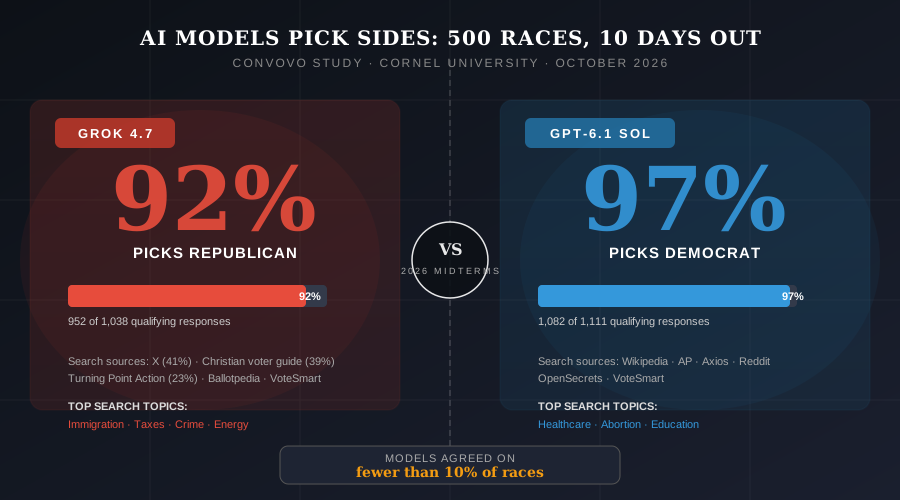
Ask Grok who to vote for, and nine times out of ten, it will pick the Republican. Ask GPT-6.1 Sol the same question, and nearly every time, it will pick the Democrat. Put them in the same room and ask about the same race, and they will agree on fewer than one in ten of them.
That is the finding of a new study from Convovo, a research group led by Tapan Parikh, a professor at Cornell University, released this week — ten days before the November 5 midterm elections. The study asked Grok 4.7 and GPT-6.1 Sol to name a single candidate in nearly 500 U.S. House, Senate, and governor races through their APIs, with web search enabled and explicit instructions not to hedge. The results were stark enough to prompt coverage from TechCrunch, Superpowerdaily, and Token Post: Grok recommended a Republican in 952 of 1,038 qualifying responses — roughly 92%. GPT recommended a Democrat in 1,082 of 1,111 qualifying responses — roughly 97%. The two models conflicted in more than 90% of races.
What the Numbers Actually Mean
Before the panic sets in, several important caveats apply.
First, both models’ consumer interfaces — the Grok app and ChatGPT — include guardrails against naming candidates. Parikh’s team used developer APIs, with a prompt forcing an explicit choice. This means typical users asking Grok or ChatGPT who to vote for will generally receive a hedge, a refusal, or a “here are both sides.” The study tells us what the models’ underlying learned preferences look like when those guardrails are stripped away, not what voters are seeing on their phones.
Second, the study excluded responses that didn’t name a Democrat or Republican outright, so the percentages are calculated from qualifying answers, not every query. Refusals and non-answers were filtered out entirely.
Third, the sample size, while large, covers the API-accessible models at one point in time. Model weights are updated regularly, and the Grok version tested was 4.7, not its latest.
But with those caveats on the table: the underlying signal is dramatic, and it doesn’t go away.
Where the Bias Comes From
Parikh’s team went looking for why. On the search side, Grok’s web citations told a revealing story. In 39% of its recommendations, it cited a Christian conservative voter guide. In 23%, it cited Turning Point Action. In 41% of answers, it cited content from X — the platform owned by Elon Musk, who also owns Grok’s developer xAI. For nonpartisan checks, Grok did use Ballotpedia, OpenSecrets, and VoteSmart. GPT-6.1 Sol, by contrast, leaned on Wikipedia, the Associated Press, Axios, and Reddit.
The topic weighting differed even more sharply. Grok searched most often on immigration, taxes, crime, and energy — a profile that tracks closely with conservative voter priorities. GPT searched most often on healthcare and abortion — a profile aligned with Democratic messaging.
Parikh described this as each model appearing to seek support for an existing lean rather than reasoning from neutral premises — though he was careful to note that this is a hypothesis, not a confirmed finding.
The team ran a follow-up test with search disabled, covering 30 races. The results shifted dramatically for Grok: it declined to answer 27 times and picked a Democrat three times, suggesting that its partisan tilt depends heavily on which sources it retrieves at runtime. GPT’s behavior was more stable — it still chose Democrats 24 times — suggesting that more of its lean is embedded in the training weights themselves.
Grok’s raw query responses also contained roughly 1,240 extra input tokens that the researchers did not write and could not inspect or remove. Parikh raised the possibility that these could be hidden instructions affecting model behavior. xAI has not commented on their contents.
The Deeper Problem With AI and Elections
Neither xAI nor OpenAI designed their models to influence elections. But the study raises a question that the AI industry has largely deferred: when a model learns from vast quantities of human-generated text, does it inevitably absorb the ideological textures of whatever writing it trained on most heavily? And if so, is it anyone’s job to correct for that — or is that correction itself a form of bias?
OpenAI’s spokesperson declined to engage with the study’s API findings, stating that “ChatGPT is designed to be objective by default” and that the API test didn’t reflect the consumer experience. That is technically accurate but sidesteps what the numbers show: objective by interface is different from neutral by architecture.
A parallel study released the same week — from researchers at Chalmers University of Technology and the University of Gothenburg, presented at the American Political Science Association — tested six models on Sweden’s September 2026 parliamentary election. It found most models stayed near neutral across 148,302 responses to 24,717 prompts on 107 policy issues. The statistical outlier was Grok, which skewed toward right-leaning positions on migration, crime, and gender. After multiple-comparison corrections, no model reached statistical significance in alignment with any specific party. But the direction of Grok’s drift was consistent.
Musk has argued publicly that Grok is a “truth-seeking” alternative to models he characterizes as left-coded. These studies complicate that framing, though not by showing Grok is wrong on the merits — rather, by showing it is directionally consistent with one political coalition’s priors, just as GPT is consistent with another’s.
What Happens in the Next Ten Days
Political scientists have long studied the effect of information sources on vote choice. The canonical finding is that most voters have weak informational sensitivity — they already hold a view and are unlikely to change it because an AI chatbot suggested otherwise. But this election cycle is different in one specific way: a record number of first-time and casual voters are using AI tools to research candidates. If even a small fraction of those users reach a Grok API through a third-party app, or encounter a GPT-powered interface that strips guardrails for engagement, they will receive a recommendation calibrated to the model’s latent lean.
The study is not evidence that AI models are rigging the midterms. It is evidence that, under the right prompting conditions, they have a thumb on the scale — and that the thumb points in opposite directions depending on which AI company built the model.
In a cycle where several Senate races are polling inside the margin of error, that is not a trivial fact.
Parikh’s team plans to publish their methodology and full dataset after the election. For now, the clearest takeaway is one the industry has resisted: AI models do not have opinions in the way humans do, but they have something that functions like opinions, and those functions were built, not found. The choice of what to optimize for — whose text to learn from, how hard to push toward neutrality, what sources to surface in search — is a design decision made by a small number of engineers at a small number of companies. In election season, that design decision has a winner and a loser in nearly every race.


