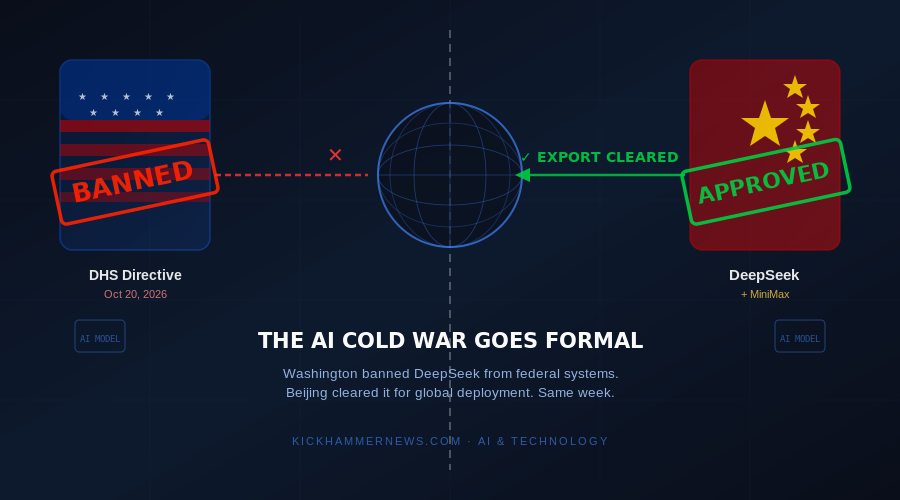
In a span of five days, the world’s two largest AI superpowers executed mirror moves that signal a new, formalized phase of the AI cold war. On October 20, the US Department of Homeland Security ordered every civilian federal agency to remove DeepSeek products from their systems. By October 23, Beijing had cleared DeepSeek as one of the first Chinese AI companies to complete the country’s new export registration process — officially greenlighting the model for global commercial deployment.
Same company, same week, opposite outcomes. The symmetry isn’t coincidence. It’s architecture.
What the US Did First
The DHS directive issued October 20 was expansive. It didn’t just ban DeepSeek from federal government devices — it extended to third-party contractors who touch government IT systems. In practice, that means every vendor with a federal contract who has employees using DeepSeek must either stop or risk losing their clearances and contracts.
The stated reasoning was national security. DeepSeek, a Hangzhou-based AI lab that stunned the industry in early 2025 with its open-weight R1 reasoning model, was flagged for potential data exposure to Chinese government entities under China’s national intelligence laws — the same legal framework that compelled TikTok’s prolonged American regulatory ordeal. DeepSeek’s privacy policy acknowledges that user data is stored on servers in China, and that it may be shared with Chinese authorities upon request.
The US had already seen early warning signs. In August 2026, researchers at Cisco and Carnegie Mellon published a study showing DeepSeek’s models could be jailbroken to produce harmful content at rates significantly higher than American competitors. In September, the Senate Commerce Committee held classified briefings on foreign AI models and critical infrastructure. The October DHS order was the enforcement conclusion of that process.
China’s Foreign Ministry rebuked the ban within 24 hours. Spokesperson Lin Jian called it “an act of unfair market suppression disguised as security policy,” and said China “firmly opposes the generalization of national security concepts to suppress normal business cooperation.”
What China Did Next
Beijing’s response wasn’t just rhetorical. It was structural.
China’s Ministry of Commerce had been working quietly since mid-2026 on a framework governing the overseas deployment of Chinese AI models. In mid-October, MOFCOM published a proposal to restrict the export of 23 categories of AI-related technologies — including large model weights, training algorithms, and inferencing software — under China’s Export Control Law and Catalogue of Technologies Prohibited and Restricted from Export.
Rather than simply blocking Chinese AI from leaving the country, the framework created a registration and licensing pathway: companies that complete the process can export their models and deploy them internationally. Companies that don’t complete it cannot.
DeepSeek and Shanghai-based MiniMax became the first two Chinese AI companies confirmed to have completed the registration process, according to CCID Consulting, a state-media-affiliated research entity. The announcement was carefully timed: it came just days after the US federal ban, and gave Beijing a ready-made counternarrative. The US is shutting Chinese AI out of its government systems; China is officially opening Chinese AI to the world.
MiniMax, which operates the Hailuo video generation platform and the Talkie AI companion app with hundreds of millions of global users, had substantial overseas revenue to protect. DeepSeek’s models — particularly R1 and its successor architectures — had been widely deployed in cloud APIs through services like AWS Bedrock, Azure, and Google Cloud. Both companies had strong economic incentives to clear the regulatory gate as quickly as possible.
The 23-item AI export catalog, notably, carves out a key exception: API-based access to large models is explicitly excluded from transfer rules. A foreign developer calling a Chinese AI model through an API endpoint is not considered an export under the draft framework. The restrictions apply to model weights, training data, and core algorithmic implementations — the underlying technology, not the interface to it.
The Mirror Problem
There is an uncomfortable symmetry at the center of this story, and both governments know it.
The US is imposing AI restrictions on China at the same moment China is imposing AI restrictions on everyone, including the US. Both governments are simultaneously using national security arguments to justify policies that also happen to benefit their domestic AI industries. Neither is being entirely disingenuous about the security concerns, and neither is being entirely honest about the commercial motivations.
For the US, the real question behind the DeepSeek federal ban is whether commercial restrictions will follow. A federal agency ban affects a relatively small number of users. What would move markets — and what Washington’s China hawks are pushing for — is a broader export control that prevents American cloud providers from offering DeepSeek models, restricts American companies from fine-tuning on DeepSeek weights, or prevents US-listed AI chip companies from selling to DeepSeek’s compute partners. None of those broader measures were in the October 20 directive, but the legislative infrastructure for them exists.
The BIOSAFE Act, introduced in the Senate in September, would authorize the Commerce Department to prohibit American enterprises from deploying AI models from “covered foreign adversaries” in critical infrastructure. It has bipartisan support. Whether it moves through the lame-duck session before January remains uncertain, but the direction of travel is clear.
For China, the export registration framework creates a different kind of leverage. By requiring Chinese AI companies to obtain government clearance before deploying overseas, Beijing gains visibility into which markets are being targeted, what model capabilities are being exported, and a legal mechanism to suspend approvals if a geopolitical situation requires it. It is, in effect, a kill switch the Chinese government can engage at the business level without invoking anything that looks like a hardware export ban.
What DeepSeek’s Position Actually Tells You
DeepSeek’s situation is worth examining on its own terms, separate from the geopolitics.
The company launched R1 in January 2025 as an open-weight model that matched or exceeded leading American models on standard benchmarks at a fraction of the reported training cost. That announcement destabilized AI market valuations, triggered urgent briefings inside the major US labs, and opened a serious policy debate about whether hardware export controls were actually slowing Chinese AI development. Eighteen months later, the answer appears to be: not as much as Washington hoped.
DeepSeek has continued releasing successive model generations. Its most recent architecture, according to technical benchmarks published this month, remains competitive with mid-tier models from OpenAI and Anthropic — not at the frontier, but not far from it. It has done this while operating under the constraint of restricted access to advanced Nvidia GPUs and while navigating an increasingly adversarial regulatory environment from both its own government and the United States.
The fact that DeepSeek moved quickly to complete China’s export registration — even under the simultaneous pressure of the US federal ban — suggests the company views its global commercial presence as worth defending and worth the compliance overhead. That is a different posture than simply being a national champion.
The Broader Stakes
Every major AI governance decision made in the next twelve months will be made in the shadow of this dynamic: two governments treating AI models as strategic national assets, simultaneously trying to protect their own ecosystems and expand their models’ global reach, writing regulatory frameworks that look like security policy but function like industrial policy.
The US midterms on November 5 will reshape the legislative landscape. A more hawkish Congress could accelerate the BIOSAFE Act and related measures. A more industry-friendly outcome might slow them. Either way, the DHS executive action is in place, and the precedent of treating foreign AI models as a national security issue is now established in US policy.
For the rest of the world — particularly the Global South countries that have been the most active adopters of Chinese AI tools — the regulatory divergence creates a difficult choice. Governments and enterprises that deploy DeepSeek or MiniMax models may find themselves increasingly navigating compliance obligations to both Washington and Beijing. The API carveout in China’s framework softens that somewhat, but it doesn’t eliminate it.
The AI cold war that industry observers have been describing as a looming possibility since 2023 now has formal policy mechanisms on both sides. It is no longer a metaphor. The same week makes that undeniable.
Sources: DHS directive (October 20, 2026); CNBC, TechCrunch (US federal agency ban coverage); Bloomberg, Reuters (DeepSeek/MiniMax export clearance); CCID Consulting announcement; MOFCOM draft AI export catalog; Cryptobriefing, Cryptopolitan (export registration details); AnalyticsInsight, StartupFortune (geopolitical context)


