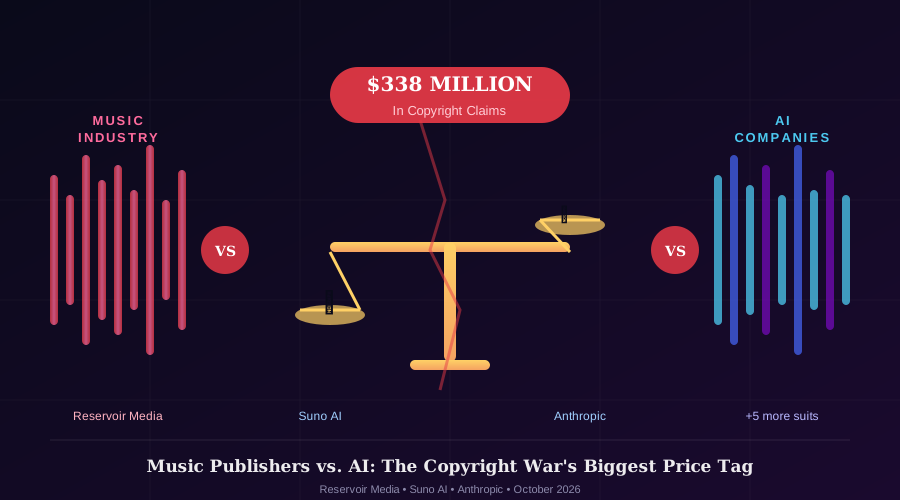
The week that Anthropic began circulating its S-1 prospectus with a $2 trillion IPO valuation, it also found itself in federal court defending against a new music copyright lawsuit that could cost it more than $150 million alone. Reservoir Media Management, one of the world’s largest independent music publishers, filed two separate suits on October 21, 2026 — one against AI music generator Suno, one against Anthropic — seeking a combined total of nearly $340 million in statutory damages and, more unusually, asking courts to order the deletion of its compositions from the defendants’ training datasets, model weights, and server infrastructure.
The suits mark the latest escalation in what has become the defining intellectual property battleground of the AI era: who owns the cultural output that large language models and AI music generators were trained on, and what remedy courts can fashion when that output has already been ingested, transformed, and commercialized at scale.
What Reservoir Is Claiming
The Suno case, filed in the Northern District of California, alleges that Suno copied 1,050 compositions to train its AI music generation models without authorization. The named works include Joni Mitchell’s “Both Sides Now,” Johnny Cash’s “Ring of Fire,” Madonna’s “Papa Don’t Preach,” Evanescence’s “Bring Me to Life,” Ben Harper’s “Diamonds on the Inside,” and Miles Davis’s “So What.” The complaint alleges Suno’s business was “built on infringement at a scale never seen before.”
The damages math is substantial. At the Copyright Act’s maximum of $150,000 per willfully infringed work across 1,050 compositions, the copyright claim alone reaches $157.5 million. Reservoir layers on two DMCA counts — circumvention of access controls and removal of copyright management information — adding another $2.625 million and $26.25 million, bringing the total against Suno to just over $186 million.
The Anthropic case is narrower in subject matter but broad in implication. Reservoir alleges Anthropic used the lyrics of 853 compositions to train Claude, and that Claude can reproduce those lyrics or generate derivative works from them on demand. The named works overlap with the Suno list, adding Joni Mitchell’s “Big Yellow Taxi,” Billy Strayhorn’s “Lush Life,” and an allegation that Claude can produce imitations that cross into derivative-work territory. Statutory damages on the copyright counts reach $127.95 million, plus DMCA claims totaling over $23 million. The total against Anthropic exceeds $151 million.
Combined, the two suits seek just under $338 million — the largest single-filing damages claim against an AI company in the music industry to date.
The Deletion Problem
What distinguishes Reservoir’s lawsuits from earlier music copyright suits is the explicit demand for what lawyers call “impoundment and destruction” — not just money, but court orders requiring defendants to delete the infringing copies wherever they reside: training datasets, internal repositories, model weights, and server infrastructure.
That request puts a fundamental tension at the center of the litigation. When a piece of music or its lyrics have been ingested into a neural network during training, the information is not stored as a discrete file that can be identified and deleted. It is distributed across billions of weighted parameters in a form that cannot be cleanly extracted. The practical meaning of “deletion from model weights” is not well-established in law, and no court has yet ordered it for a commercial AI product.
Reservoir CEO Golnar Khosrowshahi addressed this directly, arguing that “AI innovation must not rely on exploiting intellectual property.” The implication is deliberate: if courts cannot order the deletion of infringing training data from deployed models, then the only effective deterrent is a licensing framework that requires permission before training begins.
Suno, for its part, pushed back on one of the complaint’s central allegations. The suit points to leaked source code, reported by 404 Media, showing that Suno’s training pipeline used Bright Data proxy services to scrape songs and lyrics from YouTube Music, Deezer, and Genius, and that the code paired cover recordings with originals in a way that allegedly demonstrates direct copying. Suno said in a statement that the leaked code “is outdated source code that is no longer in use at Suno.” The company has not filed a substantive legal response. Anthropic has not commented publicly on the Reservoir lawsuit.
How This Fits the Broader Music Copyright War
Reservoir’s filings arrive at a complicated moment for Suno, which had appeared to be threading the needle between litigation exposure and commercial legitimacy. After Warner Music Group sued Suno and rival Udio in June 2024, Warner settled with Suno in November 2025 — the terms were not disclosed but were understood to include a licensing fee. BMG and Believe subsequently struck licensing deals with the company rather than litigating. Those negotiated agreements give Suno a partial claim to operating in good faith with rights holders.
But Reservoir explicitly cites those deals as evidence working against Suno, not for it. The existence of licensing agreements with Warner, BMG, and Believe proves that a functioning training-data licensing market exists, the complaint argues. Suno chose to use Reservoir’s catalog without seeking a license when one was commercially available.
The German music rights society GEMA delivered a more decisive blow in July 2026, when a Munich court ruled against Suno in a first-instance decision that treated AI training on protected works as infringement without fair-use shelter. Suno said it was “evaluating all available options, including an appeal.”
For Anthropic, the Reservoir suit is one of at least seven active music copyright cases. Universal Music Publishing Group, Concord, and ABKCO filed in 2023 and amended their complaint in January 2026 covering more than 20,000 works. BMG sued in March 2026 over 493 compositions. Sony Music Publishing and Warner Chappell filed on August 28, alleging “blatant theft.” Authentic Brands Group, which manages the Elvis Presley estate, sued separately over 274 songs. Across all pending music cases, the total statutory damages Anthropic faces in the music sector alone exceeds $3 billion by the claims on file.
That exposure comes after Anthropic reached a $1.5 billion settlement in September 2025 to resolve a class action brought by book authors over pirated training data — the largest AI copyright settlement to date. Judge William Alsup’s June 2025 ruling in that case contained a line that has become foundational across all the music litigation: the Copyright Act contains no carve-out for AI companies.
What the Suits Are Actually Testing
Reservoir’s complaints are doing more than pursuing damages. They are structured to resolve several questions that courts have not yet definitively answered.
The first is whether DMCA anti-circumvention claims apply to AI training. The complaints allege that Suno used proxy services to bypass access controls on streaming platforms — an allegation that, if it survives, could expose AI companies to statutory damages under a statute designed for software piracy, not training data collection.
The second is the scope of the fair-use defense. Suno and Anthropic will likely argue that transformative AI training is protected under the same principles that allowed Google to digitize books in Authors Guild v. Google. Reservoir is betting that judge-made law has moved since then — specifically, the Third Circuit’s 2025 decision in Thomson Reuters v. ROSS Intelligence, which rejected the transformative-use defense for a commercial AI trained on copyrighted legal materials. That decision is not binding on California courts but has significant persuasive weight.
The third, and most consequential, is the deletion remedy. If a court orders Suno or Anthropic to destroy copies of Reservoir’s catalog “in training datasets, model weights, and servers,” what does compliance actually look like? A ruling that orders deletion without a workable mechanism could either be ignored, or — more radically — require a defendant to retrain its entire model from scratch. No court has navigated this terrain yet.
For the AI industry, the outcome of the Reservoir cases will matter regardless of whether either defendant ultimately wins or settles. The trajectory of litigation has compressed the available options. Each settlement establishes a licensing floor; each adverse ruling narrows the fair-use runway. Suno has already spent several hundred million dollars raised at a $5.4 billion valuation on a business model whose legal underpinnings remain contested in at least four jurisdictions. Anthropic is entering a public offering process with music copyright exposure in the billions — a figure that will need to be priced by investors.
The week that Joni Mitchell sang “I’ve looked at clouds from both sides now,” she probably did not imagine the phrase ending up in a federal court complaint about AI training weights. But here we are — and the courts are only beginning to figure out what “both sides” means when one of them is a neural network.


