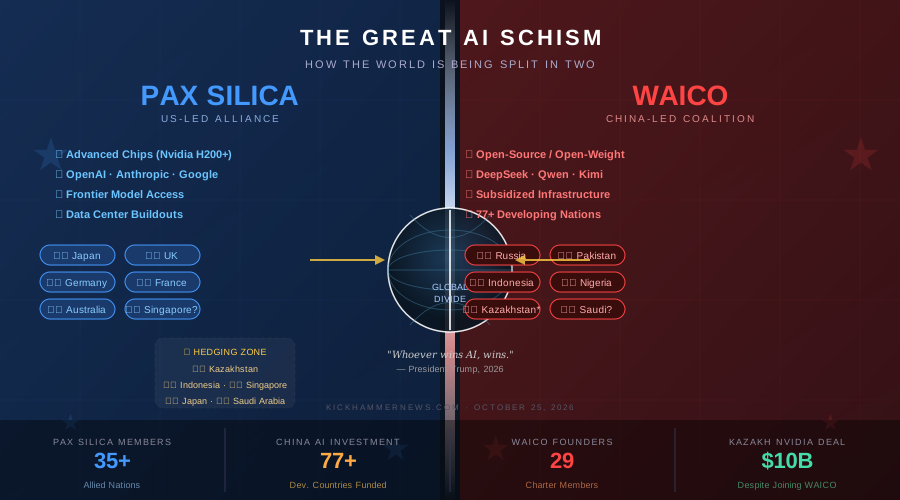
The world is fracturing along a new geopolitical fault line — not drawn in steel, oil, or uranium, but in silicon and code. As the United States and China each consolidate rival AI alliances, dozens of countries are finding themselves caught in an uncomfortable middle, forced to weigh economic opportunity against security risk as two superpowers race to make artificial intelligence the defining technology of the 21st century.
On one side: Pax Silica, the US-led framework that ties advanced Nvidia chips and American AI systems — from OpenAI and Anthropic to Google DeepMind — to a web of bilateral agreements requiring alignment with Washington’s vision for AI governance. On the other: the World AI Cooperation Organization (WAICO), a China-backed initiative that now counts 29 founding members including Pakistan, Russia, and several African and Southeast Asian nations, offering access to cheaper, open-weight Chinese AI models and a promise that “AI should not be owned by major countries.”
The result is a technology cold war with consequences that will ripple outward for decades.
Two Visions, One Planet
The US and China have long competed for global influence, but the AI race has accelerated this rivalry into something more existential. President Trump declared earlier this year that “whoever wins AI, wins” — framing the technology not merely as a commercial asset but as a strategic weapon. American officials and AI companies have accused Beijing of conducting large-scale “distillation” of US frontier models — feeding outputs from systems like GPT-6 Astra and Claude Mythos into Chinese training runs to bootstrap domestic capabilities at a fraction of the cost. China denies the allegations, calling them a pretext for monopolizing global AI infrastructure.
In response, the State Department has signaled that countries participating in Chinese AI initiatives cannot be trusted as Pax Silica partners, adding a diplomatic cost to technological hedging.
Yet “hedging” is precisely what most countries are doing.
Kazakhstan’s Tightrope Walk
Kazakhstan has become something of a case study in geopolitical gymnastics. When the Central Asian nation’s AI minister visited Washington in June, Kazakhstan signed onto Pax Silica, gaining access to a nearly $10 billion Nvidia deal to build what officials are calling a “data center valley.” Three weeks later, Kazakhstan was also announced as a founding member of WAICO.
“Everyone is hedging,” said Dana Masalimova, a former Kazakh diplomat, in an interview. “We don’t want this binary choice.” Kazakhstan also reported record Chinese foreign direct investment of $2.8 billion in 2025, making the economic entanglements difficult to untangle. The nation of 21 million people sits at the crossroads of Eurasia — and now, apparently, at the crossroads of the AI world order.
“We are in a very precarious spot,” Masalimova acknowledged.
Why the Global South Is Up for Grabs
China’s strategy in developing and middle-income countries is straightforward and potent: open-source. Where American frontier AI is tightly controlled, expensive, and often tied to compliance requirements, Chinese models like DeepSeek, Alibaba’s Qwen, Moonshot AI’s Kimi, and Tencent’s HY-series are either open-weight or made available at deeply subsidized rates. The Chinese government has provided official grants and loans for AI-related projects in at least 77 low- and middle-income countries, according to AidData, with top recipients including Nigeria, Zambia, Ghana, Bangladesh, Senegal, Cameroon, and Kenya.
“China’s open-source approach lets countries depend less on the US,” said Alberto Lemma, a researcher at ODI Global. “That’s a powerful pitch for countries that have historically been on the receiving end of technology extraction.”
Pew Research Center data shows that people in middle-income countries are growing more positive and trusting toward China on AI — a trend that has alarmed US policymakers who once assumed that the global appeal of Silicon Valley’s innovation culture would translate into permanent technological soft power.
Indonesia has joined WAICO while simultaneously expressing a desire to access both blocs — essentially auditioning each system for different use cases. Saudi Arabia offers another instructive example: Humain, the kingdom’s AI sovereign fund, launched a platform built on a Chinese open model even while negotiating a major Nvidia deal for advanced US chips.
The Advanced Nations’ Dilemma
For wealthier countries, the calculus is different but no less fraught. Japan aligns with the United States on security matters and chip access, yet Japanese companies quietly use cheaper Chinese models for lower-risk enterprise applications. The UK and Germany, deeply integrated into the Western alliance, are expected to align with Washington on data center and chip access — meaning their AI futures are partly being decided not in Berlin or London, but in Washington and Beijing.
Singapore finds itself in an unusually delicate position: Anthropic recently announced it would open its Asian headquarters there, deepening the city-state’s ties to American frontier AI. Yet Singapore is simultaneously exploring membership in WAICO, betting that its famed pragmatism can keep it useful to both sides.
France stands as a partial counterexample. Its homegrown AI startup Mistral has released models that outperform some Chinese systems on key benchmarks, demonstrating that a third path — European AI sovereignty — is at least theoretically possible. But few nations have France’s combination of research talent, capital access, and political will to pursue it.
The “Swing Country” Moment
Kyle Chan, a fellow at the Brookings Institution, sees an unexpected silver lining in the superpower standoff. “Beijing must court third countries to build its alternative coalition, while Washington already has a strong allied network,” he noted. “This actually gives ‘swing countries’ more leverage than they’ve had in decades.”
For once, being undecided has strategic value.
But experts caution that this window may be temporary. As AI systems become more deeply embedded in national infrastructure — powering healthcare diagnostics, financial systems, military logistics, and government services — the lock-in effects will grow. A country running its hospitals on one nation’s AI cloud will struggle to switch, just as it struggled to replace Huawei’s telecommunications infrastructure under political pressure.
“Most countries lack a good option,” said Aalok Mehta of the Center for Strategic and International Studies. “Few can build frontier models. But nearly every country is thinking about AI sovereignty — and that instinct is exactly right, even if the path isn’t clear.”
A Bifurcated Future
The emergence of Pax Silica and WAICO marks a structural shift in how AI power is being organized globally. Not since the nuclear age has a single technological domain generated this level of strategic anxiety — and unlike nuclear weapons, AI is embedded in civilian life, commercial products, and everyday government services for billions of people.
The world is not simply watching a tech rivalry unfold. It is being asked to take sides in a contest that will shape which values, which data governance models, and which economic relationships define the coming century. And as Kazakhstan’s balancing act shows, the cost of trying to stay on both sides may ultimately be unsustainable.
The AI Cold War has begun. The question is no longer whether countries will be forced to choose — but when.


