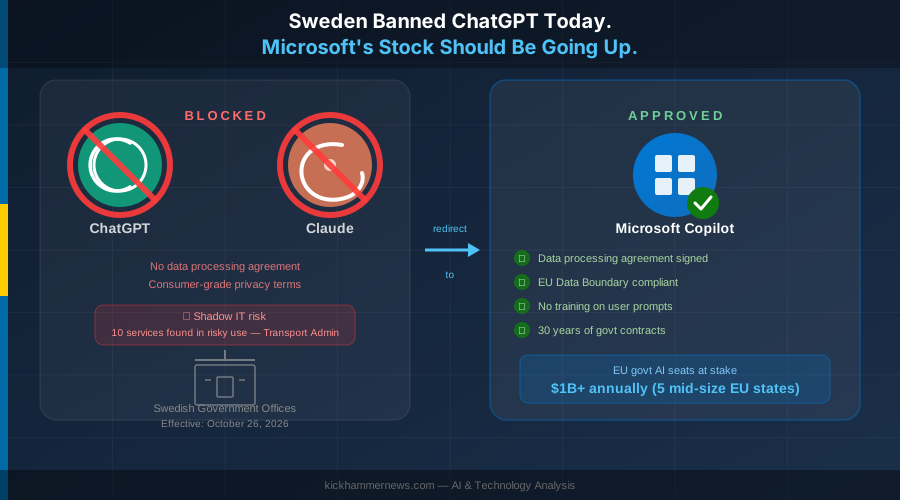
The Swedish government’s block of ChatGPT and Claude isn’t a privacy story. It’s a procurement story — and it’s the template Microsoft will spend the next decade replicating across every regulated sector on earth.
As of this morning, Swedish government employees can no longer open ChatGPT or Claude on their work computers. The Prime Minister’s Office, the ministries, the Swedish Tax Agency, the National Board of Institutional Care — one after another, they’ve blocked the consumer-facing versions of the two most popular AI tools in the world.
What they can still use: Microsoft Copilot.
I want to be precise about what’s happening here, because most of the coverage is framing this as a story about European privacy caution. It isn’t. Sweden’s Government Offices explicitly said staff can still access OpenAI’s and Anthropic’s models — through an internal platform called Intric, and through Microsoft Copilot, which routes to those same models. Claude is available inside Copilot for Microsoft 365 enterprise tenants in the EU; it’s just off by default, pending administrator approval.
The block isn’t on the model. It’s on the consumer interface — the version you access without a formal data-processing agreement. And that distinction is going to cost OpenAI and Anthropic a lot of money, in Sweden and everywhere else.
What a “Security Agreement” Actually Means — and Who Has One
The Swedish Government Offices’ digitalization director, Mikael Wettercrantz, explained it plainly: using AI services without a formal agreement “can affect information security.” Microsoft Copilot stayed because it passed a security screening and carries a binding data-processing agreement with Swedish authorities.
That agreement specifies four things that ChatGPT’s consumer terms do not:
- Where your data is processed (for EU governments: EU Data Boundary, in-country where available)
- Whether your prompts are retained (enterprise contracts guarantee no retention for training)
- Who can access your queries (contractually restricted, auditable)
- What happens in a breach (defined liability, defined notification timelines)
OpenAI and Anthropic both offer enterprise contracts with comparable protections — OpenAI Enterprise, Anthropic’s Claude for Business. But the Swedish government’s audit found roughly ten AI services in widespread, risky use at the Transport Administration alone. Shadow IT. Employees using personal ChatGPT Plus accounts or free tiers on government devices, feeding sensitive data into systems with no processing agreement.
The answer wasn’t to ban AI. It was to remove the uncontrolled version and mandate the contracted version. That’s not a privacy policy. That’s procurement policy.
The Math Microsoft Isn’t Saying Out Loud
Let me run the numbers on what this procurement shift means at scale.
Sweden’s government sector employs approximately 1.5 million people — about 14% of an 11-million-person workforce. If the Government Offices’ policy (roughly 4,600 employees in the ministries) cascades through the broader public sector, we’re looking at a meaningful seat count even in a country of 10 million people.
Assume 25% of Swedish public-sector workers adopt a managed AI tool under a new procurement mandate:
- 375,000 users × $30/month (Microsoft Copilot M365 add-on) = $11.25 million per year, just from Sweden.
Now scale this to the EU. The European Union has roughly 220 million employed workers; government and public administration accounts for approximately 20%, or about 44 million people. Several EU member states are watching Sweden’s move and face the same legal exposure — the European Parliament disabled AI features on work devices in February 2026 for exactly the same reason. If Sweden’s policy spreads to just five similarly-sized EU countries (Netherlands, Denmark, Finland, Austria, Portugal), you’re looking at:
- Combined government workforce: ~5.5 million
- 25% adoption at $30/seat/month = $165 million per year
Add Germany, France, and Italy and you’re above $1 billion annually in EU government AI seats — virtually all flowing to Microsoft, because Microsoft is the only AI vendor that has spent three decades building government-grade data-processing agreements with every EU member state.
OpenAI can close this gap. Anthropic can close this gap. But right now, today, with Sweden’s policy live, Microsoft is the only company with the paperwork already signed.
A Decision Framework for IT Administrators
If you’re responsible for AI tool policy at an organization that handles personal data under GDPR, here’s how to think about this:
Choose enterprise-contracted AI (Copilot, Claude for Business, ChatGPT Enterprise) if:
- You process EU personal data in any volume
- Your employees number more than 50 and handle any client, patient, or government data
- Your industry is healthcare, finance, legal, or government
- You’ve had any audit finding related to shadow IT in the last two years
The cost-benefit math is stark: the average enterprise data breach costs $4.88 million (IBM Cost of a Data Breach Report 2024). Microsoft 365 Copilot costs $30/user/month. For a 200-person team, that’s $72,000/year in Copilot licensing versus $4.88M in average breach exposure. The breakeven point — where the AI licensing cost equals the breach risk reduction — is at approximately 0.015 data-breach incidents per year per 200 users. In regulated sectors, that number is not hypothetical.
Stay on consumer plans if:
- Your team is fewer than 10 people
- You use AI exclusively for non-sensitive tasks: ideation, editing drafts, personal productivity
- No EU personal data ever enters your prompts
- You’ve verified your employees understand what data *not* to input
The threshold rule: If you’re above 50 users in any regulated sector, the licensing question is not a cost question. It’s a liability question. Treat it accordingly.
The Contrarian Take: This Isn’t About Privacy. It’s About Microsoft’s Oldest Trick.
Here’s what almost no one is saying: Microsoft engineered this outcome.
Not through lobbying directly for bans on competitors — they didn’t need to. They did it by building exactly the kind of contractual infrastructure that government procurement officers require, then waiting for a government body to notice what was missing from OpenAI and Anthropic’s consumer offerings.
Microsoft has been doing this for 30 years. Microsoft Office didn’t win government procurement by being the best word processor. It won by being the word processor that had an enterprise agreement with every IT department in every ministry in every country that needed one. The features were almost incidental. The contract was everything.
Copilot is following the exact same playbook. Microsoft spent two years before ChatGPT’s launch building out its EU Data Boundary — in-country data processing for EU customers. It signed data-processing agreements with national governments. It published detailed documentation on retention settings, audit logs, and administrator controls. And it deployed its existing enterprise sales relationships to educate government IT departments about exactly what questions to ask when evaluating AI tools.
When Swedish officials audited their Transport Administration and found ten AI services in risky, uncontrolled use, the framing was “shadow IT problem.” But the natural solution to a shadow IT problem is to mandate an approved alternative. And the approved alternative, almost always, is whoever had the enterprise agreement already signed.
OpenAI released its government-tier enterprise product in late 2025. Anthropic released Claude for Government in early 2026. Both are legitimate, capable, and contractually compliant. Neither has 30 years of EU public-sector relationship infrastructure. That gap is not closed by a better model.
Most coverage of Sweden’s move frames it as “Europe’s cautious approach to AI.” The more likely outcome: this is the first instance of a playbook that will be run in every OECD country, in every regulated sector, for the next decade — and Microsoft has a structural first-mover advantage that no language model quality advantage will overcome on its own.
Your Dated Action Checklist
If you manage AI tools in an organization that operates in the EU or handles regulated data, here’s what to do and when:
By November 8, 2026: Audit your organization’s AI tool usage. Use network traffic analysis or endpoint software to identify consumer-tier AI tools in use on work devices. If you find them, you have a Sweden-style shadow IT problem — and you’re one audit away from a forced policy.
By November 30, 2026: Decide your approved AI stack. If you’re above 50 users in a regulated sector, evaluate Copilot (Microsoft 365 E3/E5 + Copilot add-on), ChatGPT Enterprise, or Anthropic’s Claude for Business. Request data-processing agreements from each vendor. Read them.
By December 31, 2026: Watch for Netherlands, Denmark, and Finland to publish their own AI tool guidance for public-sector employees. Sweden is rarely alone in Scandinavian tech policy; Finland’s Digital and Population Data Services Agency and Denmark’s Agency for Digital Government have both been tracking this issue. Their announcements will signal whether this is becoming an EU-wide policy norm.
By Q1 2027: Watch for OpenAI’s and Anthropic’s government-specific sales motions to accelerate. Both companies understand what just happened. Expect new EU-specific data residency tiers, dedicated government customer success teams, and renewed lobbying for inclusion on national government approved-vendor lists. Microsoft’s window of exclusive advantage in this channel is probably 18–24 months before the field levels.
Ongoing: If you’re a Copilot customer, track Microsoft’s EU Data Boundary rollout. Not all services are yet covered by full in-country processing; the roadmap matters for your compliance posture.
What This Actually Means
I’ve watched technology companies win regulated-sector markets for two decades, and the pattern is always the same: the best product doesn’t win. The most compliant product wins — and “compliant” is defined by whoever writes the procurement requirements, which are almost always written by the incumbent.
Sweden didn’t ban AI today. They issued a procurement clarification. And that clarification, multiplied across 27 EU member states and eventually across every OECD government, is worth billions of dollars in recurring revenue — essentially all of it captured by Microsoft in the near term.
If you’re an OpenAI investor or an Anthropic watcher, the right response to Sweden’s announcement isn’t to worry about model capability. It’s to worry about procurement relationships. The contract layer is now as important as the model layer. That’s the real story of what happened in Stockholm this morning.
Sources used in this article: Euronews, Notebookcheck, Swedish Government Offices statement via multiple outlets, IBM Cost of a Data Breach Report 2024, Microsoft EU Data Boundary documentation, Goldman Sachs AI Labor Disruption research note (October 2026), Eurostat government employment data.


