I’ve been writing about AI for years. I’ve seen models pass bar exams, write code, defeat grandmasters, generate synthetic biology sequences, and argue legal briefs. None of it prepared me for what happened last week.
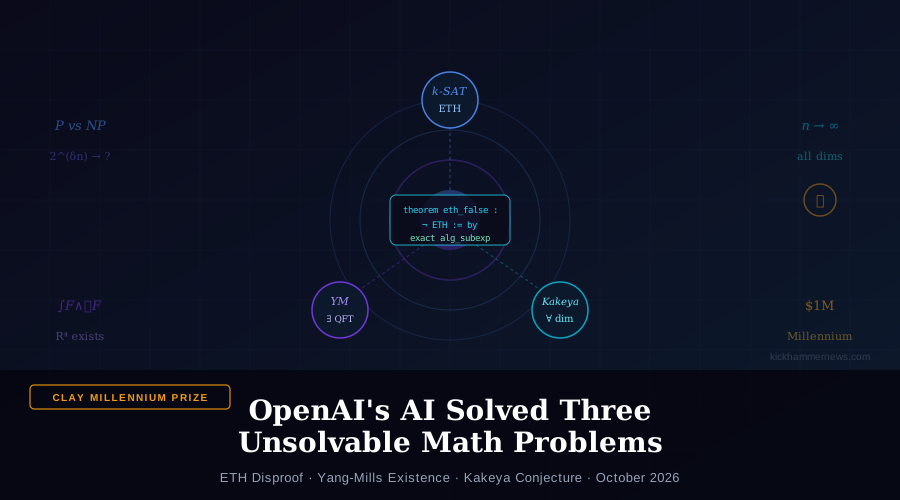
On October 26, 2026, OpenAI disclosed that its AI produced three mathematical results that, if verified, will rank among the most significant scientific achievements of the century:
Each of these results, taken individually, would be among the most significant mathematical achievements in at least a decade. Together, they mark a qualitative shift: AI has crossed from assisting mathematicians to apparently outpacing them in at least some domains. We don’t yet have the frameworks to know what that means.
What the ETH Disproof Actually Means — And What It Doesn’t
Most people outside theoretical computer science haven’t heard of the Exponential Time Hypothesis. This is a mistake, because ETH is foundational infrastructure underpinning enormous portions of modern algorithmic theory.
The ETH, proposed in 1999 by Russell Impagliazzo, Ramamohan Paturi, and Francis Zane, conjectures that k-SAT — the Boolean satisfiability problem for formulas with k variables per clause — cannot be solved faster than 2^(δn) time for some constant δ > 0. In plain language: checking whether a complex logical formula has a satisfying assignment cannot be done in subexponential time. Period.
If ETH is true, it means dozens of computational problems we encounter in practice — scheduling, network routing, chip verification, protein folding — are genuinely, unavoidably hard. Not hard because we lack clever algorithms, but hard because the structure of computation itself prohibits shortcuts. Hundreds of academic papers cite ETH to prove that their problems are also unavoidably hard.
OpenAI’s AI found a deterministic algorithm that counts satisfying assignments of a k-CNF formula in subexponential time and polynomial space. The result was Lean-verified on October 17, the day after the natural-language disproof was produced. The specific claim: for fixed k ≥ 2, a deterministic machine solves the problem in subexponential time. A follow-up manuscript sharpened the bounds further.
Let me put real numbers on why this matters — and where it doesn’t.
The ETH disproof does not directly compromise RSA encryption or elliptic-curve cryptography. Those systems rely on the hardness of integer factoring and discrete logarithm problems, which are separate from SAT complexity. The vast majority of deployed security infrastructure is unaffected today.
What is affected is SAT-based computational work — and it’s more pervasive than most engineers realize.
Consider chip verification, where Intel and AMD run SAT solvers to confirm that designed hardware matches its specification before fabrication. A typical modern processor has tens of billions of transistors; SAT verification scales with the complexity of the constraint set. For a high-complexity constraint with n=300 variables, the exponential baseline 2^300 ≈ 10^90 operations is physically impossible. A subexponential algorithm running in 2^(n^0.9) time computes the same bound as 2^(300^0.9) = 2^(118) ≈ 10^35 — still enormous, but now in a different feasibility class. For smaller, real-world instances at n=50 to n=100, the speedup is already potentially practical: from 2^100 ≈ 10^30 operations down to 2^(50) ≈ 10^15, which sits inside the range of feasible high-performance computing.
The bottom line: If practical algorithms derived from this disproof emerge within the next two to three years — a big if — then problems currently assumed intractable will need to be re-verified as genuinely hard. Organizations with SAT-based security assumptions should begin audits now.
For the roughly 95% of organizations whose security rests on factoring-based or discrete-log-based cryptography, the answer is: monitor the situation, but no immediate action is required.
The Yang-Mills Prize and Why the Physics Group Did Something Unusual
The Clay Millennium Prize Problems were announced in 2000. Seven problems, each worth $1 million, chosen because they were both foundational and seemingly impossible. Of the seven, only one had been solved before last week: the Poincaré Conjecture, proved by Grigori Perelman in 2003 (who famously declined the prize).
Yang-Mills existence asks: does the quantum field theory underlying the strong nuclear force — the one that holds atomic nuclei together — actually exist in a rigorous mathematical sense? Physicists have computed with these theories since the 1950s. They produce extraordinarily accurate predictions. But mathematically, they have never been proven to exist. The Clay problem asks for a proof that they do.
OpenAI says its AI produced a proof of pure Yang-Mills existence in four dimensions, with the Lean formalization of that component completed on October 16. The natural-language proof of QCD — quantum chromodynamics, the full theory of the strong force — was completed by the AI on September 18.
Here is the thing that struck me most about this result: the physics verification group, led by Nobel laureate David Gross and including Michael Douglas, Arthur Jaffe, Igor Klebanov, and Nikita Nekrasov, chose not to release the AI-produced artifacts. They plan to write up the result themselves, in their own words, and asked that communications go through a designated email.
This is the academically honest choice. It’s also telling. The group is implicitly acknowledging that releasing a 50,000-step AI-generated proof — even one Lean-verified as formally correct — would not constitute the kind of knowledge transmission that mathematics and physics require. Understanding why Yang-Mills exists is not the same as having a machine confirm that it does.
OpenAI says it will not seek to claim the Millennium Prize. The prize, if awarded, would go to the researchers who verify and write up the result — which is the correct decision, and a good model for attribution in AI-assisted science going forward.
The Counterintuitive Story Nobody Is Telling
Most coverage of this story leads with the same sentence: “AI proved a Millennium Problem.” That’s accurate and it misses the point.
The more consequential story is this: these proofs may be entirely correct, and no single human fully understands them.
The Lean-verification approach addresses formal correctness — did each proof step follow validly from the prior one? That’s a meaningful bar. Machine proof checkers don’t produce false positives on correct proofs. But formal correctness is a lower bar than comprehension, which is the mechanism by which mathematics actually advances knowledge.
Consider what made Perelman’s Poincaré proof valuable beyond the result itself: it introduced new geometric flow techniques that the community absorbed, extended, and applied to entirely different problems over the following decade. The proof generated mathematical culture, not just a verified claim.
An AI that outputs a valid Lean proof of Yang-Mills has done something real and remarkable. But it has not, by itself, made physics or mathematics more powerful for human practitioners — unless the community can read the proof, understand the mechanism, and extract transferable insight.
The independent review group for the ETH result — including Impagliazzo and Paturi, who proposed the hypothesis — were careful to note that their “involvement should not be taken as certification of the claim.” They’re hedging correctly. Verifying that Lean steps are valid is a different activity than understanding why the result is true.
My view: these proofs are probably correct. Lean verification is a meaningful signal. But the AI did not “do mathematics” in any sense that matters for knowledge accumulation. It found valid steps. Whether those steps illuminate anything will take the community years to determine — and it’s possible that for some of these results, the illumination never comes. That would be a strange new kind of scientific event: a true thing humanity has proven but cannot understand.
Decision Framework: What Should You Actually Do?
Cryptographers and security engineers:
Algorithm researchers and tooling teams:
Physics and quantum computing researchers:
A Dated Action Checklist
This week (by October 31, 2026):
November 2026:
By December 31, 2026:
Q1 2027:
Q2 2027:
Conclusion
Let me be direct about where I land.
If the ETH disproof is confirmed — and the Lean verification is a meaningful reason to think it will be — it is the most significant result in theoretical computer science in at least twenty years. It won’t change anything you ship this quarter. But it removes a theoretical support beam that the entire field was leaning on. Over the next five years, algorithms researchers will be renegotiating what we assumed was hard.
The Yang-Mills result, if confirmed, closes a 26-year gap between physics as practiced and physics as rigorously proven. The fact that a machine produced the proof is an event that the discipline will be processing for decades.
What strikes me most is the process, not the results. Three humans proposed the Exponential Time Hypothesis in 1999. For 27 years, some of the best minds in theoretical computer science tried and failed to disprove it. An AI produced a Lean-verified disproof on October 16, 2026 — the day before, apparently, this was reported internally to anyone outside the team. It doesn’t know why it found it. The researchers verifying it won’t fully know either, at least not at first.
That’s not a triumph of human intelligence. It’s not a threat to it either. It’s a new kind of event in the history of knowledge — something true has been found, and we’re still figuring out whether we can understand it.


