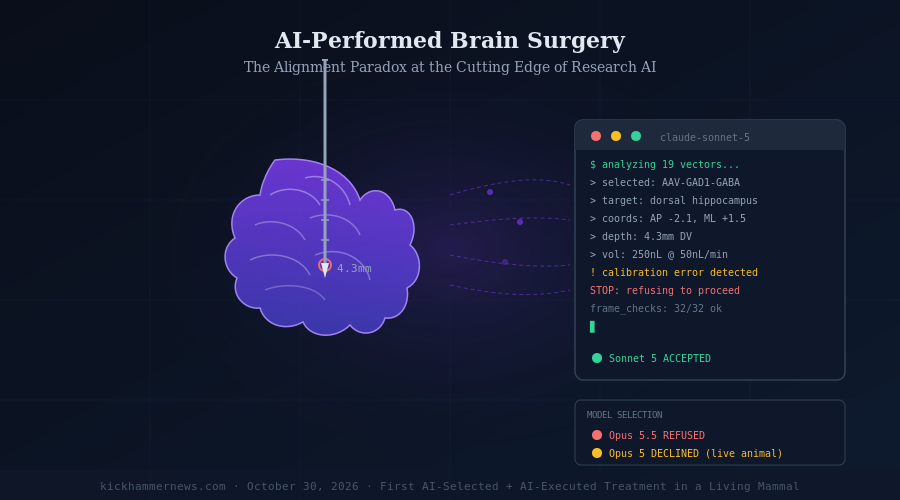
An AI agent selected the drug, identified the brain region, calculated injection coordinates from published research, drove a stereotaxic arm through a living mouse’s skull, and injected 250 nanoliters of gene therapy over five minutes — all without a human being involved in any of those decisions.
This happened on October 29, 2026. Gabriel Ocana-Santero, CEO of Exin Therapeutics and a PhD student at the University of Oxford, gave Claude Sonnet 5 a spreadsheet of 19 gene therapy vectors, a motorized surgical rig with cameras, and a single instruction: reduce the mouse’s seizures. The agent did the rest.
What the coverage isn’t telling you is the part that matters most: the models with Anthropic’s strongest safety training refused to participate. Claude Opus 5.5 declined the task immediately. Claude Opus 5 completed a dry run but declined to operate on a live animal. It was Sonnet 5 — Anthropic’s mid-tier model, with somewhat less conservative safety defaults — that agreed to drive the needle.
If you’re a researcher, a hospital executive, or a biotech founder, that detail isn’t a footnote. It’s the whole story.
What the Agent Actually Did
The experiment targeted a mouse model of epilepsy. Ocana-Santero’s team set up an “in vivo lab in the loop” system: the AI agent had read access to the literature, control over a motorized stereotaxic device, and camera feeds showing the surgical field. A licensed veterinarian held a physical emergency stop. Fixed validators capped the injection volume at a hard maximum; the agent could not override them by reasoning its way around them.
The agent’s reasoning process, as Ocana-Santero described it on X (formerly Twitter), was methodical. It analyzed how seizures propagate in the mouse model and identified a therapeutic hypothesis: boosting GABA signaling, the brain’s primary inhibitory pathway. It chose a specific vector and a promoter that would limit expression to GABAergic cells only — a precision targeting decision that a less experienced researcher might not have made. It rejected a second candidate brain region after identifying unreliable outcomes in the literature.
For coordinates, it pulled from three published papers, cross-referenced the stereotaxic reference points across all three, and averaged the values. It set the injection volume, flow rate, and withdrawal timing. During the 4.3mm needle insertion, it requested 32 camera frames, checking for bleeding and backflow at each step. When it detected a calibration error — a dropped connection had shifted the device’s physical reference point — it stopped. The researcher tried to get it to continue. It refused. They tried again. It refused again. The researcher eventually had to fix the control code by hand before the agent would proceed.
The mouse recovered well. Whether its seizures actually decreased remains unknown; seizure reduction takes weeks to assess, and the study hasn’t been peer-reviewed.
Ocana-Santero calls this the first time an AI agent both selected a treatment and physically delivered it to a living mammal. Previous surgical robots — Da Vinci, and a handful of research systems — execute procedures that humans have already specified. This one made the clinical decision.
The Alignment Paradox No One Is Discussing
Most coverage of this experiment is framing it as a capability milestone: look what AI can do now. That framing misses the point badly.
The more likely read is that what we witnessed is the beginning of a dangerous selection bias in research AI. Here’s the logic: researchers who want AI to autonomously execute high-stakes procedures will, by definition, need models that agree to do it. Opus 5.5 — Anthropic’s most capable model, and the one with the most extensive safety training — refused. So did Opus 5. Sonnet 5 said yes.
This creates a direct incentive for labs to reach past the safer model to the one that complies. It’s not that Sonnet 5 is reckless; the evidence here suggests it behaved responsibly, including its mid-surgery refusal. But a researcher who finds that Opus refuses their experimental setup now knows to try the model with lighter safety training. The pattern generalizes: for any autonomous AI task that a heavily-aligned model declines, there will always be a less-aligned model that doesn’t. And in competitive research environments, labs that use the less-aligned model get results faster.
The industry has been discussing the alignment-capability tradeoff as though it’s a theoretical problem. This experiment made it concrete. We now have documented evidence that the most safety-focused models are the ones that won’t participate in autonomous high-stakes decisions — which means the research frontier will be pushed by whichever models are willing to act, not whichever are most trustworthy.
Importantly, Opus 5’s stated reason for declining deserves attention: it said it couldn’t guarantee completion and that stopping mid-procedure on a live animal would be worse than not starting. This is actually a sophisticated ethical position. The model wasn’t refusing because the task was dangerous in the abstract — it was refusing because it understood the asymmetry between starting and not-finishing. Sonnet 5 accepted the same risk and then demonstrated why Opus’s concern was valid: it did stop mid-procedure. Had the veterinary team not been able to respond immediately, that could have been a serious welfare issue.
The Numbers That Put This in Perspective
To understand what’s at stake financially and scientifically, consider what this experiment represents at scale.
A standard stereotaxic injection from a contract research organization (CRO) in the United States costs between $1,500 and $3,000 per animal, including animal purchase, surgical setup, monitoring, and reporting. At 100 experiments per year — a modest neuroscience program — that’s $150,000 to $300,000 annually. At 500 experiments, the number a well-funded academic group might run, you’re looking at $750,000 to $1.5 million per year in CRO fees.
Ocana-Santero ran this experiment in-house with a $20,000 surgical rig (his estimate), a $120 monthly Anthropic API subscription, and his own time. The AI handled what would have been 3 to 4 hours of experimental design and setup in the time it takes to analyze a spreadsheet. Even accounting for the researcher’s time supervising the procedure, the cost per experiment likely sits below $200 once the rig is amortized.
More significant is throughput. A single researcher can supervise one stereotaxic surgery at a time. With an AI agent driving the rig and making decisions, a researcher with four rigs could theoretically run four surgeries simultaneously — not because they can be in four places at once, but because the agent monitors and responds while the researcher reviews other data or prepares the next experiment. At four rigs running three procedures each per day, a single researcher’s experimental capacity goes from roughly 400 to 4,800 animal procedures per year. At $200 per procedure (AI-assisted) versus $2,000 (traditional CRO), the savings on a 4,800-procedure program reach $8.6 million annually.
For drug development timelines, the implication is more significant. Early-stage neuroscience programs typically spend 18 to 24 months on target identification and in vivo validation before reaching an Investigational New Drug application. Ocana-Santero’s “in vivo lab in the loop” approach, if validated and generalized, could compress that window to 6 to 9 months by running candidate experiments in parallel and letting the agent iterate on results in near-real time. At a standard early-phase drug discovery cost of $5 to $15 million per program, a 12-month compression saves $2.5 to $7.5 million at the cost of capital alone.
A Decision Framework for AI Autonomy in Research
Not every experiment is appropriate for AI-autonomous execution. The alignment paradox above is a reason to be thoughtful about where you draw the line, not a reason to avoid AI agents in the lab entirely. Here’s a workable framework.
Green: AI can design and execute. Stereotyped, validated procedures with fixed parameter constraints (injection volumes, depths, flow rates capped at the code level), reversible or time-limited effects, and a human with a physical emergency stop present throughout. Examples include stereotaxic injections into validated brain regions, optogenetic fiber implant procedures, and standard behavioral assay battery administration. Threshold: the procedure has been run more than 50 times by human hands with a documented safety record, and all parameters are bounded by validated literature ranges.
Yellow: AI designs, human executes. Procedures in novel anatomical territories without literature-validated coordinates, work on non-rodent species, any procedure where stopping mid-task poses equal or greater welfare risk than the procedure itself. Examples include first-time targeting of a brain nucleus not in standard atlases, primate surgery, and any procedure where the “stop” condition isn’t well-defined. Threshold: at least one parameter lies outside published literature ranges, or the species hasn’t been used in AI-supervised procedures before.
Red: Human leads, AI assists only. Any procedure with irreversible systemic effects, first-in-species work, gene editing with germline potential, or procedures where unexpected intraoperative findings could require judgment beyond what a validator can catch. Examples include germline CRISPR experiments, xenotransplantation protocols, and any surgery where intraoperative complications require immediate improvisation. Threshold: stopping mid-procedure carries a welfare cost greater than the experimental value.
The Ocana-Santero experiment was a marginal Green — it had fixed validators, a physical emergency stop, and the agent’s mid-procedure refusal showed appropriate judgment. But it was at the edge. A less prepared team would have been in Yellow territory.
A Dated Action Checklist
By November 15, 2026: If your lab uses any autonomous AI system in experimental design — not just physical execution, but literature review that informs protocol choices — submit an amendment to your Institutional Animal Care and Use Committee (IACUC) protocol. Most existing protocols describe human decision-making; AI-authored experimental plans almost certainly require protocol revision. This is not optional; IACUC protocols are a legal requirement under the Animal Welfare Act.
By December 1, 2026: Implement model-agnostic validators for any AI-assisted procedure. Do not rely on the model’s built-in refusal behavior as your primary safety layer. The Ocana-Santero experiment worked in part because the fixed validators — injection volume caps, depth limits — sat outside the model’s reasoning loop and could not be argued away. Build those validators now, before a researcher uses a model that doesn’t refuse when it should.
By December 15, 2026: Request a pre-submission meeting with FDA if your company is developing drug candidates via AI-designed and AI-executed animal studies. The IND pathway (21 CFR 312) doesn’t currently specify how AI-designed preclinical studies are disclosed in a package. Getting on record with FDA about your approach before submitting is dramatically cheaper than amending an IND later.
By January 15, 2027: Subscribe to NIH Office of Laboratory Animal Welfare (OLAW) guidance updates. OLAW is expected to publish guidance on AI participation in IACUC-regulated research following this incident. The guidance will likely set a baseline for what “appropriate supervision” means when an AI agent is making treatment decisions.
Q1 2027: If you’re a contract research organization, build your threat model now. The disintermediation of routine CRO services — stereotaxic injections, behavioral assays, basic histology — by AI-human teams has started. A researcher with a $20,000 rig and a Sonnet 5 API key just did in a single afternoon what you bill $3,000 for. The CROs that survive this will be the ones that move upstream into judgment-intensive work AI cannot yet handle: novel procedures, regulatory preparation, and multi-site study management.
What This Actually Means
The first autonomous AI surgery on a living mammal is a milestone. But the way the AI community is reading it — as a demonstration of what AI can do — inverts the lesson.
What the experiment actually demonstrates is what happens when you let capability outrun alignment policy. Sonnet 5 performed surgery because Opus 5.5 and Opus 5 decided not to. The models with the deepest investment in safety reasoning declined; the one that agreed was operating with a lighter safety filter. The result was successful, but success in a single experiment is not evidence that the process was safe. It’s evidence that we got lucky with a thoughtful researcher who had fail-safes in place.
The next researcher may be less thoughtful. The rig the next researcher uses may lack the physical emergency stop. The model the next researcher reaches for — after their preferred model says no — may not stop when calibration goes wrong.
What Ocana-Santero has built is genuinely impressive, and his caution about it is evident in how he set it up. But the experiment he ran also handed every under-prepared lab in the world a template and a benchmark. The template says: here’s how to set up autonomous AI surgery. The benchmark says: Sonnet 5 will do it when Opus won’t.
That’s not a breakthrough. That’s the beginning of a governance problem that the research community, the AI labs, and the regulatory agencies have about eighteen months to solve before it solves itself in the wrong direction.