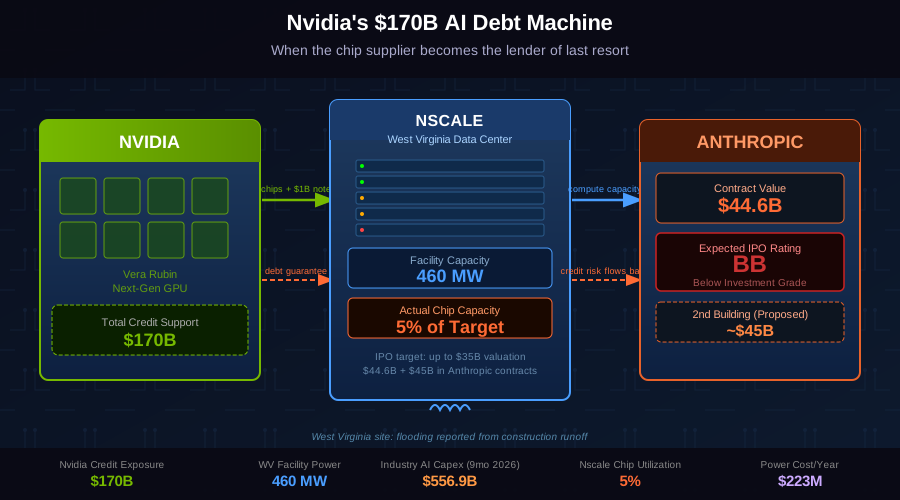
The most revealing sentence in this week’s AI news wasn’t about a new model, a new benchmark, or a new CEO. It was a single disclosure buried in reporting on a construction project: Nvidia is in advanced talks to guarantee billions of dollars in debt for Nscale’s 460-megawatt data center in West Virginia — the one Anthropic has contracted to fill for $44.6 billion.
Let that sit for a moment. The world’s most valuable semiconductor company is considering cosigning a construction loan for a cloud startup so that a large language model company with a likely junk credit rating can get its data center built. When you trace what’s happening here, it is either the most bullish thing you’ll hear all year or a five-alarm warning that the AI infrastructure boom has finally outrun the ability of real capital to fund it.
This analysis takes the second view.
What the Deal Actually Is
Nvidia isn’t writing a check. The structure being discussed is what’s called a “residual value guarantee”: if Nscale — the London-based neocloud building and operating the West Virginia facility — were to default on its construction payments, Nvidia would step in, temporarily take ownership of the building, and help find a buyer or new tenant. In effect, Nvidia becomes the backstop lender, not the primary one.
This matters because it represents a fundamental shift in Nvidia’s business model. By last count, Nvidia has extended approximately $170 billion in investments and credit support to neoclouds and large customers across its ecosystem. That includes a $1 billion convertible note committed to Nscale in September, just before the West Virginia site received state certification after months of negotiations. The Anthropic facility alone represents $44.6 billion for the first 460-megawatt building, with a second building deal worth roughly $45 billion under discussion. If both contracts close, Nscale’s Anthropic commitments approach $90 billion — more than double Nscale’s own planned IPO valuation of up to $35 billion.
Running the Numbers Nvidia Doesn’t Want You to Think About
Start with the facility itself. A 460-megawatt hyperscale data center is not a modest undertaking. At current construction costs of $8 to $12 million per megawatt for a state-of-the-art AI facility requiring redundant power delivery and liquid cooling, you’re looking at $3.7 to $5.5 billion just for the building and power infrastructure — before a single Vera Rubin chip is installed. The West Virginia site has already experienced flooding from construction runoff, a detail that does not reduce that estimate.
Layering in operating economics: at an industrial electricity rate of $0.065 per kilowatt-hour — roughly what large industrial consumers in West Virginia pay — a fully-loaded 460-megawatt facility running at 85% utilization consumes approximately 3.43 billion kilowatt-hours per year. That is $223 million per year in power costs alone, before staffing, networking, cooling systems, or amortized hardware replacement.
Here is where it gets interesting. Nscale’s $44.6 billion contract with Anthropic covers some multi-year period. If structured as a ten-year agreement — consistent with how hyperscale compute contracts are typically written — the annual revenue from the first building alone is approximately $4.46 billion. Against $223 million in power plus $400 to $600 million in annualized capex and financing costs, the unit economics look defensible on paper.
The problem is execution. As of August 2026, Nscale had approximately 25,000 advanced AI chips running against a target of roughly 500,000. That is 5% of planned capacity. You cannot service a $44.6 billion commitment at 5% utilization. The revenue model only works at full scale, the scale only arrives with the chips, and the chips only arrive when the building is complete and powered. Nvidia guaranteeing the construction debt is not a sign of strength — it is Nvidia threading a needle to keep the sequence from collapsing on itself.
The Anthropic Credit Problem Is the Actual Story
Here is the detail most coverage glossed over: Blackstone has reportedly told investors that Anthropic will likely receive a below-investment-grade credit rating — double-B — after its IPO. That is junk. A company that Nvidia’s debt-guarantee math depends on, a company that signed a $44.6 billion compute contract, is expected by sophisticated credit professionals to be rated below investment grade.
This matters for Nvidia’s exposure in a specific way. The residual value guarantee only triggers if Nscale defaults. Nscale defaults if it cannot fund construction or cannot collect Anthropic’s payments. Anthropic’s ability to pay depends on its revenue growth and its own fundraising pipeline. If Anthropic emerges from its IPO with a junk rating and credit markets tighten — as they historically do in periods of repricing — the chain from “Anthropic struggles” to “Nscale struggles” to “Nvidia backstops a 460-megawatt facility in West Virginia” is shorter than the headline coverage implies.
Put another way: Nvidia’s $170 billion in total credit support represents roughly 4 to 5% of its current market capitalization, depending on how you mark the shares. That is a manageable number in normal times. In a scenario where AI revenue growth disappoints — where enterprise adoption curves are slower than the $556.9 billion in AI capital expenditure the industry has already deployed in the first nine months of 2026 would require — Nvidia’s guarantee exposure becomes the most important line item almost nobody is modeling.
The Contrarian Read Most Analysis Is Missing
Most coverage frames Nvidia’s debt guarantee as a sign of AI infrastructure maturity: the ecosystem is scaling, financing is deepening, the biggest players are locking in long-term positions. The more likely read is the opposite.
When the primary supplier of a product starts guaranteeing the construction loans for the buildings where its products will be installed, it means the traditional finance world has looked at the deal and decided the risk does not justify the yield available at conventional terms. Infrastructure funds and construction lenders are not unsophisticated. They do not need a chip company as cosigner unless the underlying credit is genuinely uncertain at the rates they need to charge.
Amazon’s disclosure this week of an $80 billion supplier loan facility for AI infrastructure reinforces the pattern. Big Tech is lending money directly to its own supply chain because external capital will not move fast enough at the terms required. That is not a sign of a healthy capital market finding its footing — it is the early signature of a closed loop, where AI companies fund AI infrastructure companies that buy AI chips that generate AI revenues that justify more AI infrastructure. The loop works spectacularly until something in the middle misses a number.
The number most likely to miss is enterprise adoption at the implied price point. AWS CEO Andy Jassy said this week that high AI costs remain a meaningful barrier to enterprise adoption, even as inference already accounts for more than half of AWS AI revenue. If inference costs are the adoption barrier, and the industry is building 460-megawatt data centers on the assumption that barrier disappears on a timeline that justifies the debt service, the mismatch is where the financial engineering gets tested.
The data suggests that test is coming sooner than the capex commitments assume.
Decision Framework: What This Means for Enterprise Compute Buyers
For organizations procuring AI compute in 2026 and 2027, Nvidia’s new role as infrastructure underwriter changes the calculus in three specific ways, depending on scale.
Under $50 million per year in AI compute spend: This story is largely noise for your procurement decisions. You are buying from established cloud providers on pay-as-you-go or one-to-three-year reserved terms. The capital structure of hyperscale construction facilities does not materially affect your SLA exposure.
Between $50 million and $500 million per year: You are in the range where multi-year reserved capacity agreements with neoclouds — Nscale, CoreWeave, Lambda Labs, and their peers — start to offer meaningful cost advantages over hyperscaler list pricing, typically 20 to 40% below equivalent AWS or Azure rates. Before signing any agreement in this range, verify the primary financing structure of the facility. A facility that depends on Nvidia credit support for its construction completion is a facility where your SLA continuity depends on Nvidia’s continued willingness to maintain that support. That is not a disqualifier, but it is a counterparty risk your legal team probably has not modeled.
Above $500 million per year: At this level, you are buying enough compute that you should be demanding direct contractual access to the power and construction agreements underpinning the facility, not just an SLA from the neocloud operator. Sovereign wealth funds and pension funds investing in AI infrastructure are already requiring this. Enterprise compute buyers at this scale should too.
Dated Action Checklist
By November 14, 2026: Review any multi-year reserved compute agreements with neoclouds signed in the past 18 months. Request current capacity utilization data as a condition of renewal or extension. Nscale’s reported 5% of planned chip capacity is an industry data point worth benchmarking against your provider’s figures before committing additional spend.
By November 28, 2026: If your organization is an Anthropic enterprise customer, request written confirmation of service continuity commitments from your account team. Anthropic’s IPO roadshow is expected in Q1 2027. The period immediately before a junk-rated IPO is when infrastructure investment priorities can shift without public disclosure.
By December 15, 2026: Obtain from any neocloud provider a copy of their primary construction or lease financing documentation before committing to new capacity agreements. This is standard counterparty diligence that the pace of AI procurement has caused most enterprise teams to bypass. It should not be bypassed.
By January 31, 2027: Map Nvidia credit support dependency across your entire AI infrastructure stack. If more than 30% of your reserved compute capacity runs in facilities backed by Nvidia guarantees or convertible financing, you have concentrated single-counterparty risk that warrants explicit disclosure in your own risk registers and potentially in your regulatory filings.
Q1 2027: Track Anthropic’s IPO credit rating outcome closely. A confirmed double-B rating from S&P or Moody’s at IPO will be the clearest market signal yet that the traditional finance world’s assessment of AI infrastructure economics diverges sharply from the industry’s own narrative — and that the gap has begun to price.
What It Means
The Nvidia debt guarantee story is being read as infrastructure news. It is actually credit news. The question it answers is not “how fast will AI data centers be built?” but “who ultimately bears the risk if AI adoption doesn’t grow fast enough to service the debt?”
Right now, the answer is Nvidia. And Nvidia’s willingness to accept that role — backed by $170 billion in extended commitments against a construction project already experiencing flooding and running at 5% of intended chip capacity — is either the most confident bet in technology history, or an early sign that the alternative was a supply chain collapse the company simply could not afford to allow.
Given the credit signals coming out of Blackstone, the execution gap at Nscale, and the $556.9 billion in capex the industry has already deployed on an adoption curve that even Andy Jassy describes as cost-constrained, the second explanation deserves considerably more attention than it is currently receiving.
The chips are the easy part. The debt is the story.