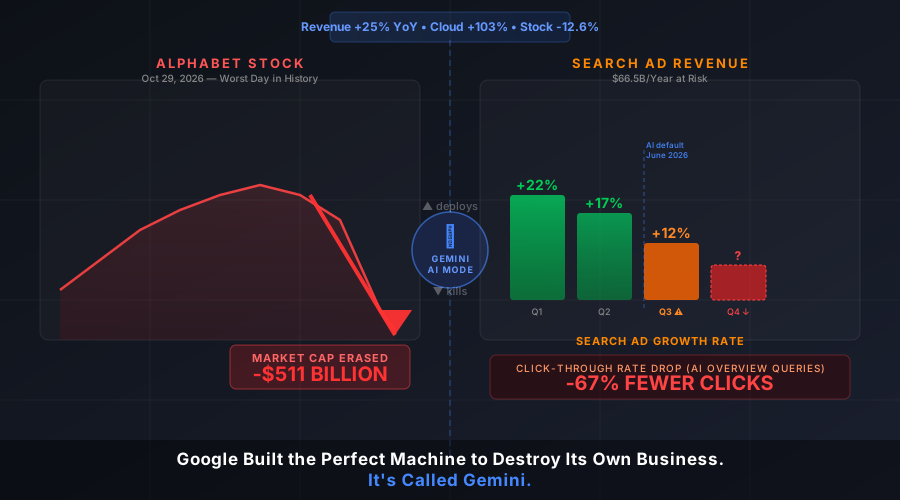
Alphabet reported $127.6 billion in Q3 2026 revenue last week — a 25% year-over-year increase that beat revenue expectations. Its cloud business more than doubled. Its AI assistant crossed one billion users. By every operational metric, the company is thriving.
Then the stock lost $511 billion in a single day.
That number — $511 billion erased in one session on October 29 — is the second-largest single-day market value destruction in stock market history, behind only Nvidia’s January 2025 wipeout. Alphabet shares closed at $283.82, down 12.64%. Goldman Sachs, Morgan Stanley, and JPMorgan all downgraded the stock. Chief Business Officer Philipp Schindler was left to explain on the earnings call that AI Mode queries “currently generate less advertising revenue than traditional searches.”
That sentence, buried in an investor call, is the most consequential admission in Alphabet’s history. Google’s own AI is eating Google.
What the Numbers Actually Say
Let’s work through what happened to the advertising business.
Google’s search revenue growth slowed to 12% in Q3 2026, down from 17% the prior quarter — a five-point deceleration in a single quarter. That sounds manageable until you apply it to the size of the underlying business.
Google’s annualized search revenue, based on the Q3 Google Services figure of $96.3 billion and historical search-to-services ratios (~75%), runs at approximately $289 billion per year. A five-point quarterly deceleration implies roughly $14.5 billion in forgone annual revenue compared to the prior quarter’s growth trajectory ($289B × 0.17 = $49B at the old rate; $289B × 0.12 = $34.7B at the new rate; difference: $14.3B per year). That is not a rounding error.
But the structural concern is worse. Internal data, first reported by search industry analysts, showed that AI Overviews — Google’s AI-generated answer summaries — produce 67% fewer clicks on both organic and paid results for queries where they appear. Ad click-through rates fell 23% after AI search overviews became the default experience in June 2026 (they launched as opt-in in January). Some major retailers reported up to an 80% decline in Google search traffic while maintaining ad spend — meaning they’re paying the same but getting a fraction of the clicks.
If that 23% click-through decline is applied to the full $289 billion annual search ad business, the structural revenue at risk is approximately $66.5 billion per year — not an accounting anomaly, but a permanent repricing of what Google search is worth.
For context: Apple’s entire annual revenue is about $400 billion. The number on the table is a Costco-sized revenue hole that Google’s own product decision opened.
The Subscription Math That Doesn’t Add Up
Google is now reportedly exploring two responses: inserting sponsored content directly into AI answers, and offering an ad-free subscription tier. Analysts estimate Google would need 400 million subscribers at $10 per month to replace the ad revenue at risk.
Let’s check that math: 400 million × $10 × 12 months = $48 billion per year. That is 72% of the $66.5 billion at risk, even at full enrollment. Google’s current subscriber base across YouTube Premium, Google One, and other paid services is roughly 150 million — meaning it would need to nearly triple its paid user count, at a higher price point, among users who have never paid for search and have been conditioned to expect it free for 25 years.
The sponsored-content-in-AI-answers approach faces a different wall. Early user testing reportedly showed trust scores dropping sharply when sponsored content appeared in AI-generated answers. Users have been trained to scroll past traditional display ads but appear significantly more sensitive to perceived deception in an AI answer they’re treating as authoritative. If the trust hit reduces query volume on AI Mode, Google ends up cannibalizing both ad revenue and the AI product designed to replace it.
There is no easy math path here.
A Decision Framework for Google Advertisers
The slowdown in Google’s search ad monetization creates a real, near-term decision for companies spending on search. Here is how to think about your exposure:
Tier 1 — Low urgency (<$50,000/year Google search spend): At this scale, the click-through compression is likely net-neutral or even beneficial. Fewer competitors are willing to bid; your cost-per-click may actually fall. Continue current allocations, monitor conversion rates quarterly.
Tier 2 — Active diversification needed ($50,000–$2 million/year): This is where the structural risk bites. If your current campaigns depend on click-through volume to drive top-of-funnel traffic, you should immediately audit which keywords are now returning AI Overview results (use Google Search Console’s “AI Mode presence” filter, now available in beta). For every high-traffic keyword where AI Overviews now appear, model a 50–70% traffic reduction and see whether your CAC math still holds. Reallocate up to 25% of budget to Bing/Copilot Search and direct-channel strategies by December 1, 2026.
Tier 3 — Immediate structural review (>$2 million/year): Companies at this scale were among the first to experience the retailer-level 80% traffic declines. If you have not already commissioned a channel attribution audit specifically modeled on AI search traffic, start one this week. The risk isn’t that Google becomes irrelevant — it won’t — but that your existing ROI models are priced on click-through rates that no longer exist. Run a parallel channel test with two to three non-Google platforms at meaningful spend ($200K minimum per channel) through Q1 2027 before Q2 budget decisions lock.
The Counterintuitive Read Most Coverage Is Missing
Most analysis frames this as: Google is under threat because AI is replacing search. That framing is wrong, and the correction matters for how you plan.
The more accurate read is this: Google is succeeding brilliantly at AI deployment — 1 billion Gemini users in under twelve months is an extraordinary product achievement — and that success is precisely what is destroying the business model. AI Overviews work. They answer questions so completely that users don’t need to click. Google hasn’t lost to a competitor. It has built the perfect click-eliminator, and it was their own product.
This distinction matters strategically. A company under competitive threat can out-invest or out-execute. A company whose own product is structurally incompatible with its revenue model faces a category-level problem that more investment only accelerates. Every dollar Google puts into making Gemini better is another dollar that makes AI Overviews more comprehensive and further reduces the need to click on a search result.
The Morgan Stanley analyst summary — “Google has created the perfect competitor to its own business model” — is accurate, but it understates the situation. This isn’t a competitor Google can outmaneuver. It’s the company’s own strategic intent, executed successfully.
What Google’s Balance Sheet Says About the Timeline
Alphabet’s Q3 2026 free cash flow was -$9.1 billion — negative, in a quarter where revenue grew 25%. Capital expenditures hit $51.4 billion in a single quarter, and the company guided 2026 capex to $195–205 billion, with spending “projected to rise significantly in 2027.”
Annualized, that capex guidance puts Alphabet spending approximately $200 billion per year — roughly 39% of its trailing annual revenue run rate ($127.6B × 4 = $510.4B). No company can run a 39% capex-to-revenue ratio indefinitely without either revenue growing to absorb it or costs compressing dramatically. The bet implicit in those numbers is that cloud revenue — which doubled to $30.7 billion this quarter and beat expectations — will grow fast enough to offset the structural decline in search advertising.
That’s plausible over three to five years. It’s a genuinely dangerous bet over the next eighteen months, when the ad model will continue to reprice downward and the subscription model hasn’t yet launched at scale.
Alphabet’s CFO Anat Ashkenazi added an additional caution: Google Cloud may face near-term margin pressure because the company is relying on external computing capacity to meet demand, paying third-party rates while building its own infrastructure. Cloud is growing, but the margins on that growth are compressed precisely when the company needs them most.
The Dated Action Checklist
If you are managing corporate Google search strategy, advertising spend, or investment exposure to Alphabet, here is what to do and when:
– November 14, 2026: Pull your last 90 days of Google Search Console data and filter for queries where AI Overviews now appear. Flag the top 20 by traffic volume — those are your highest-risk keywords.
– November 21, 2026: Model your current CAC on the assumption that those flagged keywords deliver 50% of their current click volume. If your CAC exceeds your LTV at 50% traffic, those campaigns need restructuring now.
– December 1, 2026: Set a live test on Bing/Copilot Search at a minimum of 15% of your current Google brand search budget. This isn’t a replacement; it’s a hedge. The goal is a comparable CAC data point by Q1.
– December 15, 2026: Watch for Google’s formal announcement on sponsored content in AI answers. If it launches, test it immediately — first-mover advantage in a new ad format is historically significant (early Google Shopping adopters saw 40–60% lower CPAs than late entrants).
– January 15, 2027: Alphabet’s Q4 earnings will be the first full quarter of data showing whether the AI Mode monetization gap is narrowing or widening. If search growth decelerates below 10%, the structural repricing is accelerating. If it holds or recovers above 14%, the Q3 quarter was an adjustment period.
– Q1 2027: If you are an institutional investor in Alphabet, the thesis to watch is whether Google Cloud can sustain 100%+ growth for two more quarters. At $30.7B quarterly, it needs to reach approximately $65B per quarter within 18 months to fully offset the advertising model’s structural decline. That math requires sustained hyperscaler demand that has not yet materialized at the scale needed.
What This Means
The question isn’t whether Google survives — it will, for the same reason it’s in trouble: its AI is genuinely excellent, and both enterprises and consumers are adopting it at remarkable speed. The question is whether the transition from an ad-funded search model to a cloud-and-subscription model can happen fast enough to prevent two to three years of genuine earnings pain.
My read is that it cannot. The timeline for subscription revenue to scale — even under optimistic assumptions — runs 24 to 36 months. The timeline for AI search to continue reducing click-through rates is now. Alphabet’s stock may well recover as cloud growth compounds, but the near-term earnings multiple compression is likely underway, and the Q3 earnings call essentially confirmed it.
For the broader tech sector, Google’s situation is an early warning: every major AI deployment decision being made in 2026 carries a hidden cannibalization question. When the AI works, it replaces the revenue model that funded the AI. That’s not a bug in Google’s strategy. It’s the structural logic of the transition — and it will show up on more balance sheets before it’s resolved.