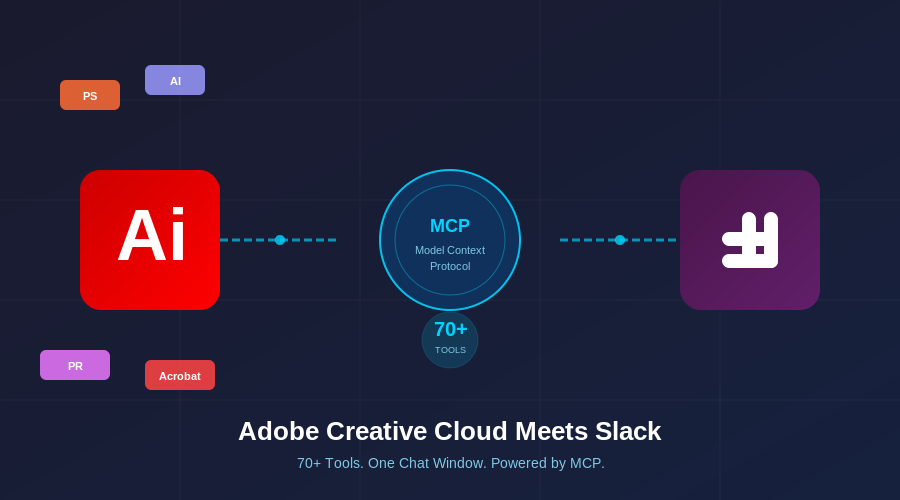
Adobe quietly crossed a threshold last week that product managers have been promising for years: it made the entire Creative Cloud accessible from inside a chat window. With the launch of Adobe for Slack on September 2, 2026, the company wired more than 70 of its tools — including Photoshop, Firefly, Premiere, Acrobat, InDesign, Illustrator, Lightroom, Adobe Stock, and Adobe Express — directly into Slack via an MCP-powered Slackbot app.
The move is not just another integration. It’s a signal that the Model Context Protocol is fast becoming the connective tissue of enterprise AI, and that the era of switching between apps to complete creative work may finally be drawing to a close.
What Adobe for Slack Actually Does
The mechanic is deceptively simple. When a user describes what they need in a Slack thread — “turn this campaign brief into a PDF,” “resize our approved hero image for Instagram,” “extract the key numbers from this spreadsheet and turn them into a shareable visual” — Slackbot reads the surrounding conversation for context and routes the request to the appropriate Adobe application. The result comes back into the same thread.
The integration uses MCP (Model Context Protocol) as its underlying architecture, allowing Slackbot to call individual Adobe tools as discrete capabilities rather than shipping users off to a separate app. Adobe already has a similar hookup with ChatGPT and says a Gemini integration is in the pipeline.
Access is currently restricted to Slack Business+ and Enterprise+ teams. New users can get started without an existing Adobe account, but signing in unlocks the full suite: generative AI features, Creative Cloud file access, and session continuity across conversations. The integration launched globally on September 2, including availability in markets like the UAE.
Why MCP Is the Real Story Here
Adobe’s announcement is notable on its own. But it’s part of a much larger pattern playing out across enterprise software in 2026: MCP has gone from an interesting developer protocol to the de facto standard for wiring AI assistants into real business tools.
In the last 90 days alone, we’ve seen Tenable connect its security analysis platform to AI agents via MCP, Adobe connect Creative Cloud to Slack, and dozens of smaller integrations turning enterprise software into callable tools rather than destinations users navigate to. The shift matters because it changes the unit of work. Instead of “log into Photoshop,” the unit becomes “describe what you want, and the right tool handles it.”
For Adobe, this is also a strategic defensive move. If creative work increasingly happens inside AI-mediated chat interfaces — and the evidence strongly suggests it will — then being a Slack-callable tool is less optional than it might seem. The company that isn’t in the conversation window risks losing ground to competitors that are.
The Enterprise Workflow Angle
Consider a typical content production scenario: a marketing team is finalizing a campaign. The brief lives in a Slack Canvas, the approved assets are in Creative Cloud, and the final deliverables need to land in Asana before end of day. Today, that workflow involves six context switches, two logins, and at least one Slack message asking where the final version is.
With Adobe for Slack, the workflow compresses significantly. A team member pastes the brief into the thread, asks Slackbot to generate size variants of the approved image for each platform, requests a PDF of the final brief for the client, and tags the relevant stakeholders — all within a single conversation. The tools come to the work, rather than the worker going to the tools.
This is exactly the kind of workflow compression that enterprise AI vendors have been promising since 2023. The difference now is that it’s shipping. Seventy-plus tools, available from one text box, without leaving Slack.
What’s Still Missing
The integration, despite its breadth, has real limitations worth noting. The 70+ tool figure is impressive, but enterprise customers will quickly discover that complex, multi-step Photoshop work still requires the full desktop application. The Slack integration is better understood as a first-pass, high-velocity layer — great for resizes, quick exports, document conversions, and generative image requests — rather than a replacement for deep creative work.
There’s also the question of file size and fidelity. High-resolution video editing through Premiere via a chatbot is a different proposition than generating a social asset via Firefly. Adobe hasn’t published detailed guidance on where the Slack-callable tier hands off to the full desktop application.
And for teams not on Slack Business+ or Enterprise+, the integration simply isn’t available. That cuts out a meaningful segment of smaller studios and freelance teams that might benefit most from accessible creative tools.
What This Means for the AI Tooling Landscape
Adobe’s announcement lands in the middle of a broader renegotiation of what enterprise software looks like. McKinsey’s 2026 State of AI report found that 32% of organizations have skipped buying at least one software product because they could build it internally with agentic coding tools. That’s a direct threat to the per-seat SaaS model that has powered companies like Adobe for a decade.
Adobe’s response — make Creative Cloud a callable capability, not a destination — is a reasonable bet. If the future of work runs through AI assistants inside chat platforms, the companies that make themselves tool-layer components will fare better than those that insist users come to them.
For competitors, the gauntlet is clear. Canva, Figma, and others in the design space now face pressure to match Adobe’s MCP footprint inside the enterprise chat tools where their customers already spend their days. The race to become the default creative layer inside AI-mediated workflows is officially on.
The Bottom Line
Adobe for Slack is one of the more consequential enterprise AI launches of the year, not because of any single feature, but because of what it represents: the Creative Cloud becoming a set of composable tools rather than a suite of applications. The MCP architecture makes that composability possible at scale, and the Slack integration puts it in front of the enterprise workforce that already lives in chat.
If the promise holds — and early access previews suggest it largely does — teams will spend less time navigating between tools and more time doing the actual creative work. In an era when AI is accelerating the pace of content production, that kind of workflow compression may be the competitive edge that matters most.


