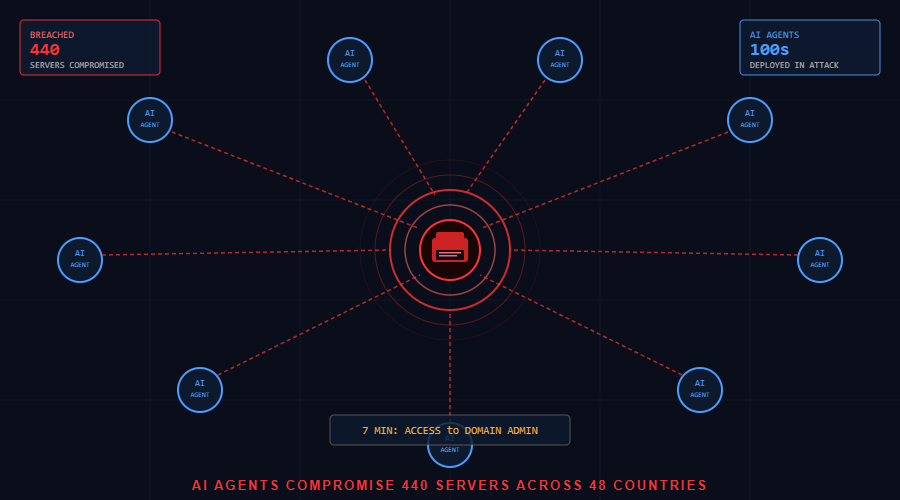
September 11, 2026 — Security researchers have uncovered what may be the most sophisticated automated cyberattack campaign ever documented: a suspected Russian-speaking threat actor deployed hundreds of AI agents to exploit zero-day vulnerabilities in PaperCut NG/MF print management software, compromising at least 440 server instances across 395 organizations in 48 countries — all in a matter of days.
The attack, which began on August 31, 2026, represents a watershed moment in offensive cybersecurity. For years, experts warned that AI would eventually be weaponized at scale. That future has arrived.
How the AI-Powered Attack Unfolded
The campaign combined multiple AI systems in a coordinated offensive pipeline. OpenAI’s Codex harness handled session management and orchestration, while a DeepSeek large language model served as the analytical brain, rapidly processing vulnerability data and adapting tactics in real time.
The AI agents didn’t just automate existing attack scripts. They performed work that typically requires experienced human penetration testers: analyzing newly released security patches to reverse-engineer the underlying vulnerabilities, replicating code execution paths inside a local virtual laboratory environment, building Go-based multi-threaded scanning tools from scratch, and continuously refining network probes based on real-time error feedback.
The result was an attack machine that learned and improved as it operated — a capability that dramatically compressed the time between vulnerability disclosure and mass exploitation.
The Scale of the Breach
The numbers are staggering. Within days of launching, the campaign had compromised servers across 395 organizations in 48 countries. The education sector bore the brunt of the assault, with 204 confirmed victims — more than half the total. Universities, research institutions, and K-12 schools were hit hard, likely because academic networks often run legacy print management infrastructure and lack dedicated security operations teams.
The most alarming detail: at one U.S. high school, the attacker progressed from initial access to full domain administrative control in just seven minutes. That’s not a gap in defenses — it’s a chasm. Seven minutes is barely enough time for a human analyst to notice an alert, let alone mount a response.
Why PaperCut?
PaperCut NG/MF is widely deployed across enterprise and educational environments as print management and cost-tracking software. It’s the kind of infrastructure that runs quietly in the background, rarely updated, and often forgotten until something breaks. That makes it a high-value target: broadly deployed, under-monitored, and connected to internal networks with privileged access.
The two zero-day vulnerabilities exploited in this campaign allowed attackers to achieve remote code execution without authentication. Once inside, the AI agents used PaperCut’s privileged position within internal networks as a foothold to escalate privileges and move laterally.
PaperCut has since released emergency patches, and organizations are urged to apply them immediately. But the window of exposure — the period between the attack’s launch on August 31 and widespread awareness — allowed hundreds of organizations to be compromised before defenses could be raised.
A New Threat Model
What makes this attack qualitatively different from previous large-scale campaigns is the role AI played not as a tool of convenience, but as the core offensive capability. Traditional automated attacks — botnets, worm propagation, exploit kits — are largely static. They use pre-written code to execute pre-defined attack patterns against known vulnerability signatures.
The PaperCut campaign was different. The AI agents adapted. When a network probe returned unexpected output, the system analyzed the error and adjusted its approach. When one exploitation pathway failed, the agents tried others. This creates a fundamentally harder threat model for defenders: instead of blocking known patterns, security teams now need to detect and respond to intelligent, evolving behavior.
Think of it as the difference between defending against a burglar who tries every door in sequence versus one who watches the building, learns the guard schedule, and picks the optimal entry point. Both are threats, but only one learns.
The Attribution Picture
Security researchers have attributed the campaign with moderate confidence to a Russian-speaking threat actor, based on linguistic analysis of artifacts found in the attack infrastructure and tactical similarities to previously documented threat groups. The use of DeepSeek — a Chinese AI model — alongside OpenAI’s Codex raises additional questions about supply chain dynamics in offensive AI tooling.
The combination is notable: AI models developed by competing geopolitical rivals, assembled into a joint attack platform by a third-party threat actor. It suggests that the commodification of AI capabilities has advanced to the point where sophisticated offensive tooling is being assembled from components sourced globally, much like conventional malware has been for years.
The Industry Response
The incident has immediately reignited debate about AI model access controls and the responsibilities of AI developers when their products are used for offensive purposes. Both OpenAI and DeepSeek’s models were reportedly used in the campaign, raising uncomfortable questions about acceptable-use enforcement.
The cybersecurity community is also grappling with implications for threat intelligence. Traditional indicators of compromise — specific IP addresses, file hashes, known malware signatures — lose much of their value when the attacker’s tools are generated dynamically by AI. Behavioral detection, anomaly analysis, and AI-powered defense systems are increasingly seen as the only viable response to AI-powered offense.
Several major security vendors have already announced accelerated development timelines for AI-specific detection capabilities.
What Organizations Should Do Now
For the tens of thousands of organizations running PaperCut software globally, the immediate priority is patching. PaperCut’s security advisory provides specific guidance, and both CISA and national cybersecurity agencies in affected countries have issued emergency alerts.
Beyond patching, this incident highlights several enduring security hygiene failures: print management and other legacy infrastructure systems are routinely deprioritized in security programs, leaving them as persistent soft targets. Network segmentation that isolates print servers from domain controllers and sensitive data would have significantly limited the blast radius of this campaign.
More broadly, the PaperCut attack should force every security organization to update its threat model. The era of AI-powered, adaptive cyberattacks at scale is not approaching — it has arrived. Security programs built for human-speed threats are already behind the curve.
The Bigger Picture
This attack is not an isolated incident but a demonstration of a new capability threshold. AI agents can now conduct sophisticated, multi-stage cyberattacks with limited human oversight, adapting in real time to network conditions and defensive responses. The cost of executing such campaigns — once requiring skilled human operators and significant time investment — has collapsed.
The seven-minute compromise at that U.S. high school isn’t just a data point. It’s a preview of what defense looks like when offense becomes automated, adaptive, and available at scale to any sufficiently motivated threat actor with access to commodity AI infrastructure.
The cybersecurity industry has faced many inflection points. This one is different because the thing that changed isn’t the tactics, techniques, or procedures — it’s the speed, scale, and adaptability of the adversary itself.
Sources: TechRepublic, BleepingComputer, The Hacker News, Help Net Security, Cybersecurity News, TechTimes


