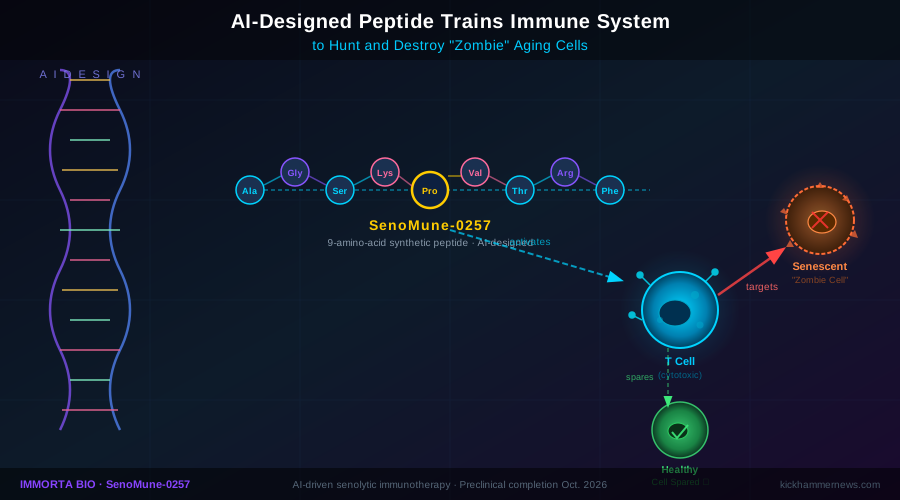
A small Miami biotech has announced that it used artificial intelligence to design a synthetic peptide — just nine amino acids long — that it says can stimulate the immune system to hunt down and destroy the cells that accumulate as humans age, driving disease and decline. If it works in people, it could represent one of the first practical weapons in the war on biological aging. And if the timeline holds, it could enter human trials before the end of 2026.
The compound is called SenoMune-0257, and it was developed by Immorta Bio Inc. The company announced in mid-October that it had completed planned preclinical studies and was preparing for initial human evaluation. The announcement drew attention not only because of what the peptide does, but because of how it was found: using AI-assisted computational analysis to screen through dozens of candidate molecules, and then narrowing the field in the laboratory.
The Problem: Zombie Cells That Won’t Die
To understand what SenoMune-0257 is designed to do, you have to understand senescent cells — and why scientists sometimes call them “zombie cells.”
Senescence is a biological state that cells enter when they sustain damage, experience stress, or simply reach the end of their replicative life. Rather than dying cleanly (a process called apoptosis), they stop dividing but remain metabolically active. They linger in tissues, secreting a cocktail of inflammatory molecules and signaling proteins known collectively as the senescence-associated secretory phenotype, or SASP.
In small numbers, senescent cells are actually useful. They play roles in wound healing, tumor suppression, and embryonic development. But as humans age, they accumulate. The immune system’s ability to clear them declines. And when they build up in significant quantities, they become a source of chronic, low-grade inflammation that has been linked to cardiovascular disease, pulmonary fibrosis, neurodegeneration, diabetes, and a range of other age-related conditions.
The scientific case for targeting senescent cells has been building for over a decade. In a landmark 2015 study, researchers showed that transplanting a small number of senescent cells into young mice was sufficient to induce physical frailty, suggesting that these cells are not merely passengers in aging but active contributors to it. Clearing them, the same research suggested, could potentially reverse some of those effects.
A class of drugs called senolytics has emerged to test that hypothesis. The most well-studied combination — dasatinib, a leukemia drug, combined with quercetin, a plant-derived compound — has been through small human trials in conditions including idiopathic pulmonary fibrosis and diabetic kidney disease. The results have shown acceptable safety and some intriguing signals, but no large, blinded, adequately powered trial has yet proven that senolytics meaningfully change the course of any disease in humans.
That gap between preclinical promise and clinical proof is the central challenge of the entire field.
How AI Found the Molecule
Immorta Bio’s approach is different from the small-molecule drugs that have dominated the senolytic field so far. Rather than directly killing senescent cells with a chemical agent — an approach that can affect non-target cells and carry toxicity risks — SenoMune-0257 works by recruiting the immune system to do the job.
Specifically, it is designed to stimulate cytotoxic T cells — the immune system’s killer cells — to recognize and destroy senescent cells while leaving healthy tissue intact. In laboratory tests, the company reported that T cells activated by the peptide selectively eliminated senescent cells under the conditions tested. The company also claims the approach could generate durable immunological memory, meaning the immune system could be trained once and remain primed to clear senescent cells over time.
The AI’s role was in discovery. Identifying a biologically active nine-amino-acid sequence from the virtually limitless universe of possible peptide configurations is an enormous search problem — one that would be impractical to tackle entirely through conventional laboratory methods. Immorta Bio used computational analysis to identify dozens of candidate peptides, then narrowed the field through laboratory validation.
The result, the company says, is a molecule that is not only biologically promising but potentially easier to manufacture at scale than the personalized cell therapies that have become a staple of cancer immunotherapy. Where CAR-T therapy requires extracting a patient’s own immune cells, engineering them, and reinfusing them — a process that can take weeks and cost hundreds of thousands of dollars — a synthetic peptide can, in principle, be manufactured as a standard pharmaceutical product.
“Honored to announce we have discovered the first cancer immunotherapy that fights aging !” wrote Thomas Ichim, PhD, President and Chief Scientific Officer of Immorta Bio, on social media when the company made the announcement earlier this month.
Important Caveats
Before declaring victory over zombie cells, it is worth being precise about what has actually been shown.
The company’s announcement is based on preclinical laboratory studies — experiments conducted in cell cultures and animal models, not in human patients. The statement that SenoMune-0257 eliminates senescent cells while sparing healthy ones comes from the company’s own laboratory, under the conditions it chose to test, and has not been independently verified or published in a peer-reviewed journal.
Human safety and efficacy have not been established. The company says it plans to enter clinical trials before the end of 2026, but no trial location, participant numbers, regulatory filing status, or institutional review board clearance have been publicly confirmed as of this writing.
The broader senolytic field also faces a technical problem that no drug has yet solved: there is no validated blood test to measure a person’s senescent cell burden. Without such a biomarker, it is difficult to select trial participants most likely to respond, measure whether treatment is working, and compare results across trials.
Immorta Bio’s ties to academic institutions — the company lists collaborations with the Buck Institute for Research on Aging, Cedars-Sinai, UC San Diego, and the University of Miami — lend it some credibility, but collaborative relationships are not the same as independent peer review of a specific compound.
None of this means the approach is wrong. It means it is early.
The Bigger Picture: AI and Longevity
What makes the Immorta Bio story notable beyond the compound itself is the role that AI played in finding it — and what that suggests about where the longevity field is headed.
Drug discovery has historically been one of the most expensive and slow processes in all of human endeavor. The average new drug takes over a decade and more than $2 billion to bring to market, with the vast majority of candidates failing somewhere along the way. AI is beginning to change that calculus, not by guaranteeing success, but by dramatically accelerating the search.
In the senolytic space alone, AI has been used by multiple research groups to screen existing compound libraries for senolytic activity, identify new scaffolds, and predict which molecular configurations are likely to be both effective and nontoxic. The approach that produced SenoMune-0257 — using AI to sort through peptide candidates and then validate the most promising hits in the lab — is becoming a standard workflow in computational drug discovery.
The longevity medicine pipeline is crowded right now. Unity Biotechnology is advancing UBX1325 in diabetic macular edema. Rubedo Life Sciences is testing RLS-1496 through a ferroptosis-based mechanism. Multiple academic groups are pursuing partial cellular reprogramming. The projected timeline for the first FDA-approved longevity drug runs somewhere between 2028 and 2030 by most estimates.
SenoMune-0257 may or may not reach that milestone. Nine-amino-acid peptides have a long road from a company press release to an approved therapy. But the fact that AI can now identify biologically active molecules from a computational search — molecules specific enough to recruit the immune system against one category of cell while leaving others untouched — represents a genuine shift in what’s possible.
For decades, the idea of programming the immune system to selectively clean up the cellular debris of aging was largely theoretical. What’s different now is that the tools to attempt it — computational power, AI-driven design, immunotherapy platforms built on decades of cancer research — have arrived at roughly the same moment.
The question isn’t whether AI will contribute to solving biological aging. It already is. The question is how quickly those contributions will translate from the laboratory into the clinic — and whether the immune system, trained by a synthetic peptide found by a machine, will actually deliver on what decades of aging research have promised.


