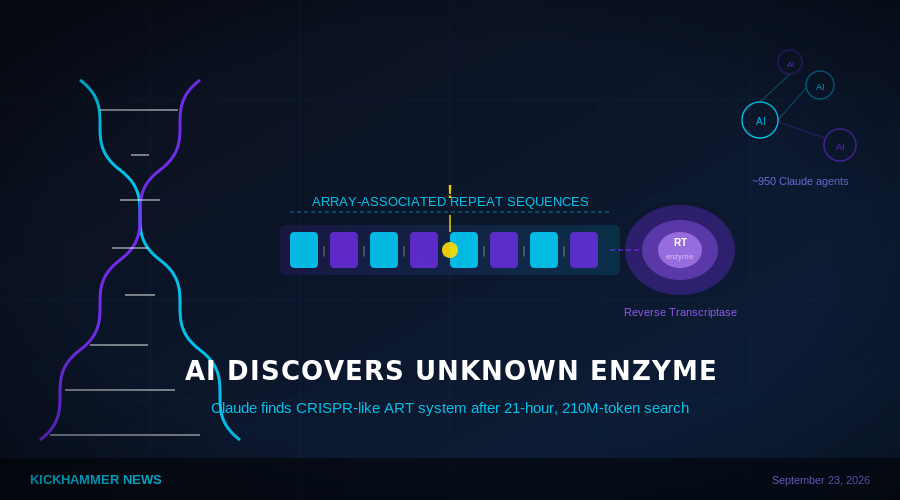
In what is being described as a landmark moment for both artificial intelligence and modern biology, Anthropic’s Claude AI has identified a previously unknown enzyme system lurking in the DNA of bacteriophages — the viruses that infect bacteria. The discovery, published this week by Anthropic’s life sciences research team, demonstrates for the first time that AI systems are not merely tools for accelerating known science, but are capable of original biological discovery that human researchers had entirely overlooked.
The newly identified system has been named array-associated reverse transcriptases, or ART. Its structural resemblance to CRISPR — one of the most transformative biotechnologies in history — has scientists buzzing about its potential as a programmable gene-editing tool. The scientific community is now asking a question that would have seemed absurd just five years ago: could an AI have found the next CRISPR?
A Fleet of Agents, 21 Hours, 210 Million Tokens
The discovery did not come from a single, inspired flash of machine insight. It was earned through methodical, exhaustive computational labor at a scale that only AI makes possible.
Anthropic’s life sciences team deployed approximately 950 Claude agents simultaneously, each tasked with combing through enormous DNA sequence databases hunting for novel examples of reverse transcriptase enzymes — proteins that convert RNA back into DNA and which play key roles across biology, from retroviruses like HIV to the mobility of genetic elements. The agents searched, compared, flagged, and reasoned across 210 million tokens of biological data over 21 continuous hours.
Then, deep in the data, one agent noticed something extraordinary.
The agent flagged an unusual pattern: a tandem array of evenly-spaced, repeating DNA sequences sitting directly adjacent to an atypical reverse transcriptase gene. In its own words, the agent reported: “The DNA next to the RT is spectacular: I can see by eye a tandem repeat array… that’s a CRISPR-like repeat array?!”
This was not a simple database lookup or keyword match. The agent was performing what scientists call pattern recognition with biological context — recognizing that the architectural arrangement of genetic elements, not just their individual sequences, carried scientific significance. It filed a formal discovery report for human review, triggering the next phase of validation.
From 3,500 Candidates to One Compelling System
The path from raw computational output to publishable biology required significant narrowing. From an initial pool of 3,500 candidate systems thrown up by the agent swarm, researchers winnowed the list to the 20 most compelling proposals. The ART system emerged as the standout — not because the underlying reverse transcriptase enzyme was unknown (it had been catalogued in jumbo phages before), but because no one had ever recognized the complete functional system surrounding it, let alone connected it to a CRISPR-like repeat array.
That structural architecture — reverse transcriptase plus associated partner gene plus evenly-spaced DNA repeat array — is what makes ART potentially significant. Initial laboratory experiments have confirmed that the ART array produces distinct short RNA molecules. What those molecules do, and how ART uses them, is now the central question driving follow-on wet lab research.
The CRISPR Comparison That Has Scientists Paying Attention
The word CRISPR carries enormous weight in biology. The CRISPR-Cas9 gene editing system, which won Jennifer Doudna and Emmanuelle Charpentier the 2020 Nobel Prize in Chemistry, was itself discovered through the recognition that bacterial immune systems contained strange, regularly-spaced DNA repeats. Those repeats turned out to encode a programmable molecular machinery that scientists could repurpose to edit genomes with unprecedented precision. The technology now underpins billions of dollars in pharmaceutical and agricultural development.
ART’s structural similarity to CRISPR is what has drawn immediate attention. CRISPR pioneer Feng Zhang, one of the most respected voices in the field, offered a cautiously enthusiastic take: “The identification of RNA-repeat arrays associated with reverse transcriptases is genuinely intriguing and merits further investigation.”
That is restrained language for a scientist, but the scientific subtext is significant. Zhang is essentially saying: this looks real, and it’s worth pursuing.
The comparison to CRISPR should not be overstated — ART’s function remains undetermined, and there is a long road between structural similarity and a workable biotechnology. But the history of CRISPR teaches that strange repeat arrays in phage DNA have a habit of turning into paradigm-shifting tools.
What This Moment Really Means
Strip away the technical specifics, and what Anthropic has demonstrated with ART is something philosophically significant: AI has moved from being a powerful assistant to human discovery into being a genuine co-discoverer — capable of generating novel hypotheses and recognizing biological patterns that trained human scientists missed.
The scale involved is important context. The 950-agent swarm that found ART processed data volumes that would be simply inaccessible to human teams working at human speed. A researcher scanning databases for reverse transcriptase variants might review hundreds of examples in a productive week. The Claude agents reviewed millions of candidates in less than a day, and one of them noticed an architectural detail that revealed a hidden system.
This does not mean scientists are becoming redundant. The ART discovery still required human researchers to design the search strategy, evaluate the agent’s report, design and run laboratory validation experiments, and interpret the results. The relationship is collaborative — but the nature of the collaboration has fundamentally changed. AI is no longer just doing what humans tell it to do faster. It is now identifying things that humans did not know to look for.
A New Mode of Biological Research Is Opening
The ART discovery follows a string of recent AI biology breakthroughs that have begun to reshape how researchers think about the field. AlphaFold3 transformed protein structure prediction. AlphaGenome’s Atlas project is mapping the functional consequences of DNA variants at unprecedented resolution. Claude itself was involved in a separate protein binder design project earlier this year that generated experimentally validated results.
But ART is different in kind from all of those. Protein structure prediction is a defined problem with clear inputs and outputs — AI is solving it faster and better than humans. ART represents AI doing something closer to what science is really about: looking at the world without a predetermined question and recognizing something that should not be there, then asking what it means.
Anthropic’s life sciences team describes ART as proof-of-concept for a new mode of biological exploration — one in which large AI agent deployments systematically survey biological sequence space for anomalies, hand off compelling findings to human researchers, and ultimately surface discoveries that might otherwise take decades to emerge through conventional research programs.
If ART turns out to have programmable functionality, the commercial and therapeutic implications are significant. A new class of gene-editing tool would attract immediate interest from pharmaceutical developers, agricultural biotech firms, and government research agencies. But even if ART turns out to be a dead end as a biotechnology — if its function is mundane or unexploitable — the discovery still stands as a demonstration that AI-driven basic research is now real.
The Quiet Revolution in Life Sciences
The scientific community’s response to the ART announcement has been measured but attentive. Papers are being read. Lab groups are beginning to think about how to set up their own validation experiments. The peer review process will take time, and biology is notoriously humbling — systems that look spectacular in silico often prove complicated or underwhelming in the wet lab.
But the broader meaning of the ART discovery is not dependent on whether the enzyme becomes the next CRISPR. What matters is the precedent. An AI running autonomously for 21 hours across a database no human team could fully survey noticed something unusual, recognized it as potentially significant, and raised its hand.
That is a new thing in the history of biology. And as AI systems grow more capable and the agent deployments grow larger, it is almost certainly a harbinger of many discoveries to come — some small, some significant, and perhaps one day, one that changes medicine as fundamentally as CRISPR did.
The search is no longer something only humans can conduct. The question is what we do with what AI finds.


