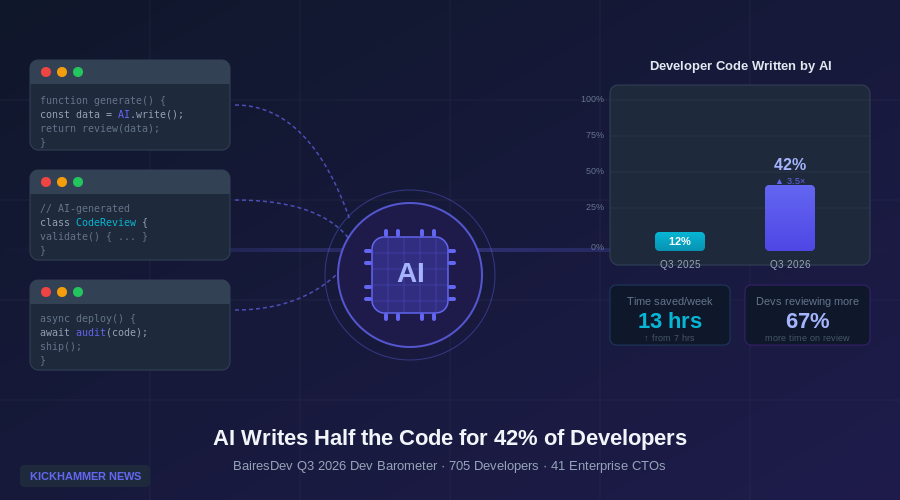
Something seismic is happening inside the world’s engineering teams, and a sweeping new survey is putting precise numbers to it for the first time. According to BairesDev’s Q3 2026 Dev Barometer—the most extensive longitudinal study of AI’s impact on software development yet conducted—42% of professional developers now say artificial intelligence writes at least half of the code they ship. One year ago, that number was 12%.
That three-and-a-half-fold jump is staggering on its own. But the more revealing finding is what happens to all that time AI is supposedly saving. The short answer: it doesn’t come back. It immediately gets redirected into reviewing, debugging, and learning to manage the very AI that freed it up in the first place.
“Developers nearly doubled the time AI saves them in coding, to 13 hours a week,” BairesDev CEO Darren Shimkus said in announcing the findings. “Not one of those hours came back.”
The Numbers Behind the Shift
The Q3 2026 Dev Barometer surveyed 705 developers across more than 60 countries and 41 enterprise chief technology officers. The breadth of the sample—spanning startups to Fortune 500s across six continents—gives the results unusual authority.
Among the most striking statistics: developers now report AI saves them 13 hours of coding time per week, nearly double the seven hours they reported in the same survey a year ago. That sounds like a windfall. But dig deeper and the picture complicates immediately.
Only 21% of developers now spend more than half their workweek writing new code from scratch. Meanwhile, 67% say they are spending more time reviewing AI-generated output than they did a year ago. Another 52% report spending more time debugging problems introduced by AI. And developers are now dedicating an average of nine hours per week to learning AI tools and new technologies—more than double the four hours they reported in Q3 2025.
The math works out to something counterintuitive: the more AI handles raw code production, the more cognitively demanding the surrounding work becomes. The cognitive burden hasn’t decreased—it’s shifted.
The Accountability Gap
At the heart of this transformation is a question the industry is only beginning to grapple with seriously: when AI writes the code, who is responsible for it?
BairesDev’s data suggests the answer remains, overwhelmingly, the human developer. Just 7% of surveyed developers said code deployment decisions had been fully delegated to AI without their input. The other 93% are still in the loop—and enterprises, it appears, intend to keep them there.
Among the 41 CTOs surveyed, 78% said they had increased spending on code review, quality assurance, and validation specifically to support AI-generated work. The investment in oversight is growing in lockstep with the volume of AI-generated output.
Shimkus frames this as a new accountability architecture. “In a world where we don’t have AI explainability, I need developer explainability,” he told VentureBeat. The standard he hears from sophisticated enterprise customers is unambiguous: if an engineer cannot explain what AI-generated code does and why it works that way, the organization will not permit that engineer to check it in.
The implication is that developers are becoming something closer to auditors of a complex, high-throughput machine than authors of software in the traditional sense.
Fulfillment Is Rising, Not Falling
Amid all the disruption, there is a counterintuitive thread of optimism running through the data: developers say they like their jobs more than they did a year ago. Eighty-six percent of surveyed developers report that AI makes their role more fulfilling, up from 76% in Q3 2025.
That tracks with a broader pattern emerging across the industry. Rather than feeling replaced, many developers describe the shift as an elevation—from writing boilerplate to designing systems, from debugging syntax to thinking about architecture, security, and business logic.
Shimkus draws the analogy to computer-aided design and architecture. CAD didn’t eliminate architects; it automated the drafting and freed designers to spend more time on creative and structural problem-solving. “The job hasn’t gotten smaller; it’s moving up a level,” he told VentureBeat.
For software engineers, that higher level encompasses architecture, problem definition, code review, security, compliance, and understanding how generated code interacts with larger systems. The proportion of developers spending time on those activities is rising rapidly.
A New Skills Hierarchy
The survey also offers a window into how compensation is shifting in response. Among developers who received raises in 2026, 29% identified AI tool fluency as the primary driver. System design and architecture came next at 20%, followed by human skills—communication, mentorship, cross-functional collaboration—at 15%.
The demand for these higher-order capabilities is clear. The supply, however, may be lagging. Only one in four CTOs said they were actively investing in human-skills development for their engineering teams. That gap between what the market is rewarding and what organizations are building toward may prove costly.
Shimkus has a specific recommendation for individual developers navigating the transition: don’t try to master every AI tool. Pick one and go deep. And wherever possible, shift your learning investments toward security.
“If I had to advise anybody, should you go even deeper in your code development infrastructure, or to go deeper in security—go deeper in security,” he said. The reasoning is straightforward: as AI agents move beyond code generation toward executing actions in production environments, the gap between what systems can do and what organizations have put around them is growing. Security is where human expertise remains most critically differentiated.
The Broader Picture
BairesDev’s findings slot into a larger body of evidence suggesting AI adoption in software development has crossed a threshold in 2026. JetBrains’ 2026 Developer Ecosystem Survey, based on responses from more than 15,000 professional developers, found that 90% were using AI coding agents at work at least weekly, with 68% using them daily. Stack Overflow’s 2025 survey had found 80% using AI tools while only 29% trusted their accuracy—a trust gap that makes intensive human review not optional but necessary.
The synthesis of all this data points to a profession in deep structural transition. Code generation is becoming a commodity. The scarce, valuable resource is the human judgment to know whether a given piece of generated code should ship: whether it is secure, correct, maintainable, and aligned with business goals that AI does not inherently understand.
As Shimkus put it, companies can purchase AI tools. What they cannot purchase off the shelf is “the judgment to be able to apply that in a way that accomplishes the business goal but keeps the company safe.”
For the 42% of developers whose AI already writes half their code, that judgment is no longer just a nice-to-have. It is the job.


