When Airbnb’s CEO Brian Chesky dropped a bombshell figure on last week’s Q1 2026 earnings call, the tech world barely blinked. It should have.
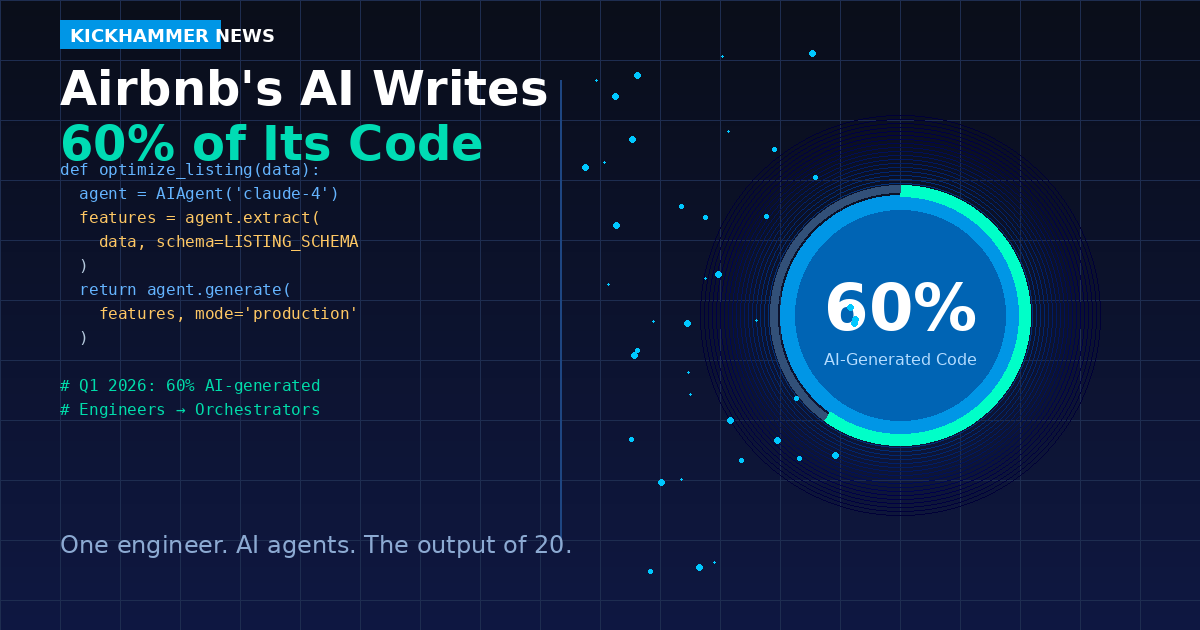
Sixty percent. That’s how much of Airbnb’s new code in the first quarter of 2026 was generated by artificial intelligence. Not drafted with AI assistance. Not reviewed with AI tools. Written — by autonomous agents working under the supervision of human engineers, who have effectively become orchestrators of a software factory they no longer manually operate.
If that number sounds like a rounding error or a marketing flourish, consider what it implies about the rest of the industry — and what it means for the millions of software developers who have spent the last decade learning to code their way into financial security.
From Scrappy Startup to AI-First Engineering Lab
Airbnb was founded on the idea that two guys with air mattresses could disrupt the hotel industry. Seventeen years later, the company is disrupting something arguably more consequential: the traditional software engineering team.
Chesky didn’t bury the 60% figure in a footnote. He put it front and center. “One engineer can now deploy AI agents to handle significant portions of the work,” he told analysts, “whereas a project might once have required a dedicated team of 20 engineers.”
That’s not a marginal productivity bump. That’s a 20-to-1 compression of the human capital required to ship software at scale.
Airbnb’s Q1 results underscore that this isn’t happening at the expense of business performance. Revenue grew 18% year-over-year to $2.7 billion, beating analyst expectations. Gross booking value surged 19% to $29.2 billion. Nights booked via Airbnb’s app grew 22% and now account for 62% of all bookings. The business is firing on all cylinders — and doing it with a leaner engineering footprint than would have been imaginable even 18 months ago.
The Customer Service Machine
Code generation is only half the story. Airbnb’s AI ambitions extend to every layer of the customer experience.
The company’s AI-powered customer support agent — deployed to handle first-line inquiries in English-speaking North American markets — now resolves 40% of all customer issues without ever escalating to a human agent. That figure has jumped from roughly 33% earlier this year, a rapid improvement that suggests the system is getting meaningfully better, not just plateauing at a comfortable automation floor.
Voice-based AI support is in development, with a global rollout planned for later in 2026. If Airbnb can match its text-based resolution rate across voice channels and international markets, the customer support transformation will dwarf what most hospitality companies have achieved in decades of call center optimization.
The CTO Who Built Llama
Airbnb isn’t leaving any of this to chance or off-the-shelf integrations. In a signal of how seriously the company is treating AI as core infrastructure, Chesky hired Ahmad Al-Dahle — the engineer who led the development of Meta’s Llama family of open-source large language models — as Chief Technology Officer.
Al-Dahle’s appointment is a statement. Llama models have been among the most consequential releases in AI history, seeding thousands of fine-tuned variants and forming the backbone of open-source AI adoption globally. Bringing him in-house means Airbnb isn’t just building on top of other people’s AI; it’s bringing the people who built foundational AI into its own tent.
It also signals that Airbnb’s AI strategy is likely to become increasingly proprietary over time — custom-trained models tuned on Airbnb-specific data, optimized for the company’s unique workflows in ways that a general-purpose API simply can’t match.
You’re Not Alone — But That’s the Problem
Airbnb is emphatically not alone in this. Google, Microsoft, and Spotify have all made similar disclosures in recent quarters, each citing AI as a force multiplier for their engineering organizations. What makes Airbnb’s 60% figure striking isn’t its novelty — it’s the speed at which the industry is converging on a new normal.
Twelve months ago, a 10% AI code contribution would have been a headline. Now 60% is mentioned in passing during an earnings call about hotel bookings.
The trajectory is not subtle. And for software developers watching these numbers accumulate, the implications are uncomfortable. The industry has long operated on the premise that more products require more engineers. If AI inverts that relationship — if you can ship 20x as much software with the same headcount — the demand signal for junior and mid-level developers could weaken significantly, even as the overall software market grows.
That’s not a certainty. Productivity tools historically expand the size of the market rather than simply replacing workers. The personal computer didn’t end accounting; it created an explosion of accounting. But the speed of the current AI adoption cycle is qualitatively different from prior technology transitions, and anyone betting that history will repeat cleanly is taking on real risk.
What the 60% Number Actually Means
Industry observers have been quick to note — correctly — that the 60% figure requires context. Companies measure AI-generated code differently. Some count accepted autocomplete suggestions. Others count entire functions or files drafted by a model before human review. The denominator matters too: 60% of new code added in a quarter may represent a different workload than 60% of all code changes including refactors, bug fixes, and test coverage.
None of those caveats change the directional story. Airbnb is operating at a level of AI-assisted development that would have seemed like science fiction to most engineering teams in 2023. And the company isn’t reporting productivity losses, quality collapses, or security crises as a result. It’s reporting 18% revenue growth and rising margins.
The cautious reading is that this is one company’s experience, in one quarter, under one executive’s framing. The less cautious reading is that Airbnb just showed everyone else what’s possible — and the rest of Silicon Valley is watching.
What Comes Next
Chesky has telegraphed that AI will become more central to Airbnb’s product experience over the course of 2026, not just its engineering workflow. The company is actively testing AI-driven search, which could eventually replace the traditional filter-and-browse interface with something more conversational — a planning agent that understands your travel style, budget, and preferences and surfaces options you didn’t know to ask for.
If Airbnb can crack that experience at scale, it won’t just be an AI-assisted company. It will be an AI-native travel platform in a way that none of its direct competitors currently are.
The 60% code figure was a data point in an earnings call. But it may also be a preview of what the company — and the industry — is becoming.
Airbnb reported its Q1 2026 results on May 7, 2026. CEO Brian Chesky discussed the company’s AI strategy during the earnings call.


