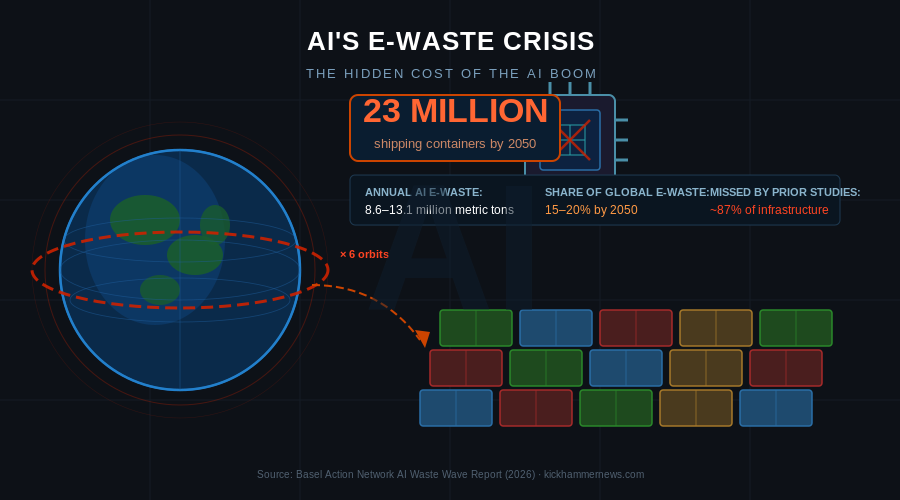
The artificial intelligence revolution is generating far more than breakthrough capabilities—it’s quietly building toward an environmental crisis of staggering proportions. A new report from the Basel Action Network (BAN) projects that AI data center infrastructure could generate enough electronic waste by 2050 to fill 23 million standard shipping containers. Line those 40-foot containers up end-to-end, and they’d encircle the Earth six times.
The report, released this week, arrives as the tech industry races to build out the infrastructure backbone for the AI age. Microsoft, Google, Amazon, and a growing list of challengers are spending hundreds of billions of dollars constructing data centers at a pace the world has never seen. Behind the headline numbers—model benchmarks, GPU clusters, inference speeds—lies a quieter reckoning: every chip, power unit, and cooling system has a lifespan, and when that lifespan ends, it becomes waste.
Why Previous Estimates Fell Short
What makes the Basel Action Network’s findings particularly alarming is the methodology that got the industry here. Prior research into AI e-waste focused almost entirely on servers and GPU accelerators—the visible, headline-grabbing hardware. By that narrow accounting, the e-waste picture looked manageable.
But those earlier models missed roughly 87 percent of a data center’s physical footprint. The BAN report takes a broader view, accounting for the complete ecosystem required to keep AI servers operational around the clock: power distribution units, cooling infrastructure, backup generation systems, networking equipment, fire suppression hardware, and environmental monitoring systems. Each server rack in an AI data center requires an estimated 10 to 15 supporting systems. Factor those in, and the projections change dramatically.
Under BAN’s full-system accounting, AI-related e-waste could total between 395 million and 617 million metric tons by 2050, generated at an annual rate of 8.6 to 13.1 million metric tons. That puts AI infrastructure alone at 15 to 20 percent of global e-waste expected annually by 2050—a share that would have seemed implausible from forecasts made even five years ago.
The Hardware Replacement Cycle Problem
At the heart of the crisis is a fundamental tension between the pace of AI development and the lifecycle economics of the hardware supporting it. AI chips and the systems around them don’t just wear out—they become obsolete. A GPU cluster purpose-built to train a large language model in 2024 may be wholly inadequate for 2027’s frontier models. Data center operators, under competitive pressure to maintain state-of-the-art capabilities, cycle through hardware at intervals of three to five years.
Unlike consumer electronics that sit idle for hours each day, AI data center hardware runs continuously. That unrelenting operational load accelerates wear patterns and compresses replacement cycles further. The combination of planned obsolescence and punishing utilization rates creates what researchers describe as a churn rate without precedent in the history of enterprise computing.
The scale of current construction amplifies the future waste problem. Microsoft alone has committed to spending $80 billion on AI data center infrastructure through 2025 and 2026. Globally, data center capital expenditure has grown at double-digit rates for three consecutive years. Each dollar invested in new infrastructure is, in part, a future e-waste liability.
The Geography of AI Waste
The environmental burden of the AI boom is not evenly distributed—and that asymmetry raises serious equity concerns. Most AI research and deployment is concentrated in North America, Europe, and parts of East Asia, where regulatory frameworks, capital markets, and engineering talent are clustered. But a significant portion of the resulting electronic waste is exported, legally and illegally, to developing nations in West Africa, South Asia, and Southeast Asia.
Countries like Ghana, Nigeria, and Pakistan have become informal processing hubs where workers—often without protective equipment—dismantle electronics to recover valuable materials like copper and gold. Toxic components including lead, mercury, cadmium, and flame retardants leach into soil and water. The benefits of AI flow primarily to wealthy economies while the physical costs are increasingly borne by communities with the least capacity to manage them.
The Basel Action Network, which has spent decades documenting this dynamic in consumer electronics, argues that AI hardware is accelerating a pattern already well-established in smartphones and laptops. The organization is pushing for international treaties that would restrict e-waste exports and require wealthier nations to process their own technology waste domestically.
Regulatory Pressure Builds
Governments are beginning to respond, though the pace of policy has yet to match the scale of the problem. The European Union is advancing extended producer responsibility (EPR) frameworks that would require data center equipment manufacturers to fund end-of-life collection and recycling programs. Under these proposals, companies would face financial incentives to design for recyclability from the outset—modular components, standardized connectors, materials that can be cleanly separated and recovered.
Several U.S. states, including California and New York, are exploring targeted e-waste mandates for large-scale tech facilities. The challenge is jurisdictional: data centers often straddle multiple regulatory environments, and the hardware supply chains that feed them are global. A GPU manufactured in Taiwan, assembled in Malaysia, operated in Texas, and scrapped in West Africa crosses multiple legal frameworks at each step.
The Basel Action Network is advocating for a global framework modeled on existing chemical and hazardous materials treaties—one that would track AI hardware through its full lifecycle, from manufacturing through disposal. Critics of the current voluntary approach point out that most corporate sustainability commitments are not legally binding and carry no penalties for non-compliance.
What the Industry Is Doing—and What It Isn’t
Some of the largest AI infrastructure operators have made substantial commitments on environmental sustainability. Microsoft has pledged to become carbon negative by 2030, with provisions specifically addressing responsible hardware disposal. Google has invested in circular economy initiatives aimed at extending component lifecycles and recovering materials at higher purity levels. Meta has committed to net zero emissions across its value chain by 2030.
These efforts are real, and researchers acknowledge them as meaningful steps. But they come with a critical caveat: the scale of AI infrastructure investment is growing far faster than the efficiency gains being realized. A data center that is 20 percent more energy efficient but twice as large generates more total energy consumption—and more eventual waste. The same math applies to e-waste: incremental improvements in hardware longevity are being swamped by the sheer velocity of expansion.
There is also a gap between what companies measure and what they disclose. Carbon emissions have become a standard ESG metric with established accounting frameworks. E-waste has not. Many data center operators cannot say with precision how much hardware they decommission annually, where it goes, or what fraction is meaningfully recycled versus landfilled or exported. The absence of standardized disclosure makes it difficult for investors, regulators, and the public to hold companies accountable.
The Path Forward
The 23 million container figure in the Basel Action Network report is a projection, not a destiny. What happens to AI e-waste between now and 2050 will depend on decisions made in the next few years—in boardrooms, legislatures, and design labs.
Technical progress offers some genuine hope. Neuromorphic chips and analog computing architectures promise dramatically lower power consumption and could reduce the hardware turnover driving e-waste accumulation. Advances in liquid cooling are extending the operational life of existing installations. Some researchers are exploring biodegradable substrates for electronic components, though commercially viable versions remain years away.
Policy is ultimately likely to matter more than any single technology. The history of environmental regulation suggests that voluntary industry action reaches a ceiling and that meaningful change typically requires binding frameworks with real consequences for non-compliance. Extended producer responsibility has worked in the European consumer electronics market; there is no obvious reason it couldn’t work for data center hardware if extended with sufficient ambition.
For the AI industry, the e-waste crisis poses a distinctive challenge: the most transformative technology of the generation may also be accumulating one of the largest environmental debts. The companies building AI systems that can write code, design drugs, and model climate change have the analytical capacity to address their own physical footprint. Whether they bring the same urgency to that problem as they do to the next model release is a question the next decade will answer.
The Basel Action Network’s report makes one thing clear: the question is no longer whether AI has an e-waste problem. It is whether the industry and its regulators will act before 23 million containers’ worth of electronics scatter across the planet.


