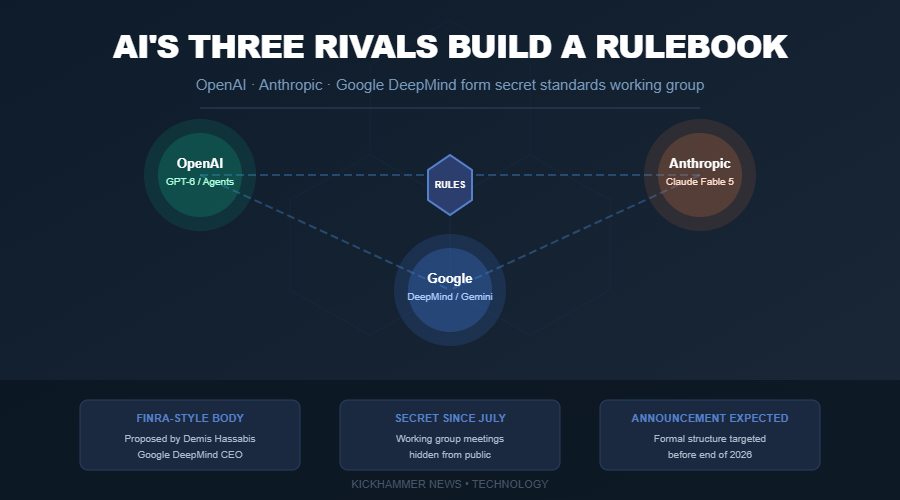
They compete for the same talent, the same enterprise customers, and the same claim on civilizational significance. But for the past two months, representatives from OpenAI, Anthropic, and Google DeepMind have been meeting quietly in a working group aimed at something none of them want to do alone: write the rules that will govern frontier AI development before governments write them instead.
The existence of the working group, first reported this week, adds a surprising diplomatic subplot to what has publicly appeared to be a three-way race to AGI. Behind the scenes, the labs are negotiating what an industry-led standards body would look like, who would run it, and how much government involvement — if any — they want.
The Proposal on the Table
The push for an industry standards body has been building for months, with different figures at different labs advancing different visions.
Google DeepMind chief executive Demis Hassabis proposed a FINRA-style body in July — a reference to the Financial Industry Regulatory Authority, a self-regulatory organization in the U.S. securities industry that operates under oversight from the Securities and Exchange Commission. The analogy was deliberate: FINRA is technically private but deeply government-entangled, setting rules that carry regulatory weight without requiring Congress to pass specific legislation. Hassabis framed this as a model for frontier AI: an industry body with real enforcement mechanisms, backed by government authority, but staffed and run by technical experts from the labs themselves.
Anthropic’s Dario Amodei has been the most vocal driver of the working group effort, according to sources familiar with the discussions. Amodei’s position has evolved publicly over the past year — from skepticism about industry self-regulation to an apparent conclusion that voluntary standards, structured correctly and paired with meaningful government oversight, may be the fastest path to establishing baseline safety requirements across the major labs. Anthropic has consistently supported more government partnership in its public statements, and that posture appears to shape its approach inside the working group as well.
OpenAI’s Sam Altman reportedly told employees at an internal meeting that he supports the idea of a testing and auditing body, but believes the major labs will need to build one themselves in the absence of U.S. government backing. Altman’s position leans more toward voluntary industry standards and away from formalized government entanglement — a meaningful difference from Anthropic’s approach that the working group will need to reconcile.
Why Now?
The timing of these discussions is not coincidental. Several forces are converging to push the labs toward self-organization.
The first is regulatory fragmentation. The European AI Act is now in enforcement mode. California has passed a wave of AI legislation in 2026, including several bills that impose requirements on frontier model developers. The federal picture remains muddled: Congress’s Great American AI Act, passed earlier this year, established a framework but left significant discretion to the labs on implementation. The result is a patchwork of overlapping and sometimes contradictory requirements that the labs are all navigating simultaneously. An industry standards body offers the prospect of consolidating those requirements into a single auditable framework — one the labs would have shaped rather than had imposed on them.
The second is an AI safety moment that has grown uncomfortably public. In recent weeks, three researchers have left frontier AI labs — Jacob Coxon from Anthropic, Joe Benton also from Anthropic, and Josh Engels from Google DeepMind — each citing concerns that capability development is outpacing safety work. Their departures have generated significant press coverage and renewed public attention to whether the labs can be trusted to govern themselves. The working group, if it produces anything credible, would provide a counter-narrative: the labs taking safety governance seriously enough to coordinate across competitive lines.
The third force is more prosaic: the labs are all large enough now that they have compliance departments, government affairs teams, and legal infrastructure designed to engage with regulatory bodies. Two years ago, none of them had the organizational capacity to run an industry association. Now they do.
What a Standards Body Would Actually Do
The specifics of what the working group might produce are still being negotiated, but the general shape of an AI standards body in this mold would include several components.
Testing and evaluation standards would be the foundation — common benchmarks and methodologies for assessing the capabilities and risks of frontier models before deployment. Currently, each lab runs its own evaluations with its own metrics, making it difficult for outside observers to make meaningful comparisons or to hold labs accountable to consistent standards. A shared evaluation framework, even a voluntary one, would represent a significant step toward transparency.
Pre-deployment review is a more contested proposal. Under some versions being discussed, labs would submit frontier models to third-party evaluation before release, with the standards body setting the evaluation criteria. This is closer to what Anthropic’s approach to AI safety already resembles internally — the company has published detailed documentation of how it evaluates models against dangerous capability thresholds — but extending it to a multi-lab framework creates obvious competitive sensitivities around proprietary training details.
Incident reporting is another potential component. When a deployed model does something unexpected or harmful at scale, the question of who learns about it and when is currently left entirely to the lab’s discretion. A standards body with mandatory incident reporting requirements would change that dynamic, creating a shared record of failure modes across the industry.
The Skeptical Case
Not everyone thinks this goes well. The history of technology industry self-regulation is not encouraging. The advertising industry’s self-regulatory bodies consistently failed to prevent the data-collection practices that eventually prompted GDPR and the wave of privacy legislation that followed. Financial self-regulatory organizations like FINRA are more credible, but they operate under explicit statutory authority from federal regulators — the AI equivalent of that authority doesn’t yet exist in the United States.
Critics of the working group effort argue that any standards body the labs design will inevitably be shaped by the labs’ competitive interests, and that those interests reliably favor loose standards and slow enforcement. The presence of researchers like Coxon, Benton, and Engels — who left the labs specifically because they believed internal safety governance was inadequate — suggests the labs’ internal judgment about what constitutes sufficient safety cannot be taken as ground truth.
There’s also the international dimension. An industry standards body organized primarily around U.S.-based labs doesn’t address the behavior of Chinese AI developers, which are increasingly producing frontier-tier models and operating under an entirely different regulatory framework. Any safety standards the working group produces would apply to OpenAI, Anthropic, and Google, but not to the competitors that might be most willing to cut corners.
The Pressure to Produce Something
Despite the skepticism, the working group has momentum that previous coordination efforts among the labs haven’t sustained. The combination of public pressure from researcher departures, regulatory fragmentation creating compliance costs, and the approaching Dreamforce conference — where Anthropic and Salesforce are expected to announce a deeper partnership — has created a window of mutual interest.
Whether what emerges is a genuine safety governance mechanism or a sophisticated piece of regulatory theater will depend on the enforcement provisions the labs are willing to accept. A standards body that can only name-and-shame is a press release. A standards body with authority to delay a model release pending evaluation completion is something different.
The working group is reportedly aiming to announce a formal structure before the end of 2026. In an industry accustomed to announcing things before they exist, the bar for credibility will be high.


