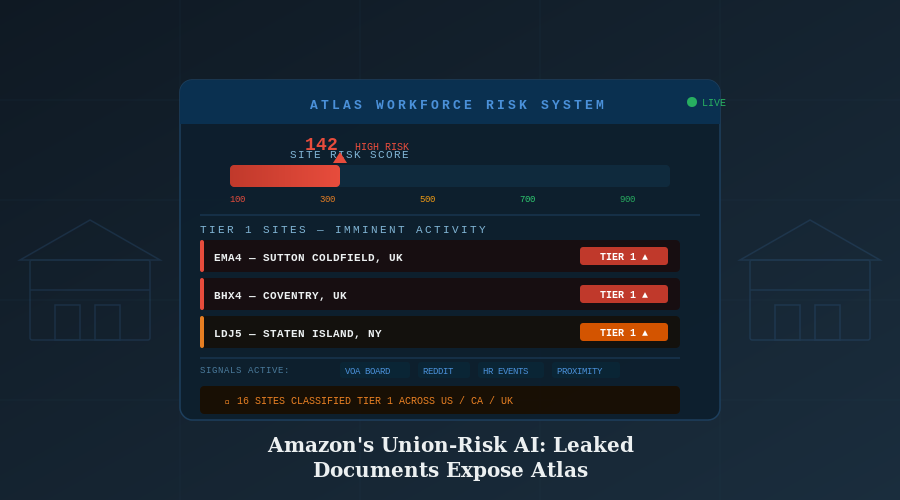
Internal documents surfaced in a Canadian court case reveal that Amazon has deployed an AI system called Atlas to score each of its warehouses on a scale from 100 to 900 — the lower the score, the more likely workers are to organize. Sixteen warehouses are currently flagged as Tier 1: union activity is “imminent.”
For years, Amazon’s response to union organizing has looked reactive — a campaign of town halls, manager briefings, and leaflets that materializes whenever workers begin collecting signatures. But internal documents released during a Canadian labour dispute reveal something more systematic underneath that response: an AI-powered scoring system called Atlas that quietly evaluates every Amazon warehouse in the US, Canada, and the UK, predicts where unionization attempts are most likely to succeed, and tells management where to focus its defenses before workers ever file for a vote.
The documents, which emerged from proceedings at the British Columbia Labour Board in a dispute between Amazon and the Canadian union Unifor, are training materials aimed at managers in Canada. They describe a system that aggregates “hundreds of data points” from across Amazon’s operations and produces a numerical score for each warehouse, ranging from 100 to 900. A low score means Atlas judges the site to be at high risk of organizing. A high score, the materials note, is “better for leadership.”
That scoring range maps onto five tiers. Tier 5 means “no immediate perceived risk.” Tier 1 means “future activity is imminent.” Sixteen warehouses across three countries currently sit at Tier 1.
Two of them are in England.
What Atlas Watches
The scope of data Atlas ingests is remarkable. According to the documents, the system draws on worker activity across Amazon’s internal “Voice of the Associate” (VOA) bulletin board — a channel meant to surface feedback to management — as well as external platforms like Reddit. AI is used to flag keywords and phrases, track upvotes, and monitor how workers respond to particular posts.
But Atlas does not stop at employee communications. It folds in a wide range of signals: health and safety incidents, worker tenure and turnover, completed employee training, local minimum wage rates, the number of appeals or internal investigations at a site, and proximity to other warehouses where union activity has already emerged. Organized labor actions — protests, sickouts, work stoppages — are categorized as “employee relations events” and rated by severity. Signing union cards and approaching management with collective demands are also flagged as high-severity events.
The system, in other words, is not simply counting who talks about unions. It is building a predictive model: synthesizing sentiment data, labor market signals, organizational health metrics, and social network proximity to estimate where discontent is most likely to crystallize into formal organizing — and how soon.
Amazon insists the system operates only at the level of sites, not individuals. “This isn’t surveillance,” the company told openDemocracy, adding that Atlas is designed “to help us understand where staff need support.” Amazon also says it does not track individual employees’ opinions, affiliations, union membership, or personal data.
But in the same statement, Amazon acknowledged that it no longer uses the name “Atlas” — while declining to say whether a system with equivalent functionality exists under a different name. Asked specifically whether Atlas is in active use in the UK, the company said it is “not currently used in the UK.” It did not address whether a replacement has been deployed at its British warehouses.
Two Sites, One Story
Among the 16 Tier 1 warehouses, two UK locations stand out: EMA4, a £500 million robotic fulfilment centre in Sutton Coldfield, on the north-east edge of Birmingham, and BHX4, located near Coventry. Both warehouses have been organizing with the GMB union. Both are rated as facing imminent union activity.
For workers at those sites, the Atlas revelations have a particular sting: in July 2024, GMB came within 28 votes of winning formal union recognition at the Coventry warehouse. The union and the legal charity Foxglove have since alleged a campaign of “dirty tricks” during the pre-ballot period. The Atlas documents have now given them new material to examine.
Garfield Hylton, a 62-year-old GMB member who works at the Coventry site, put it plainly: “It’s not right in a democracy… the employer should not be interfering.”
Rachel Fagan, a GMB organiser, went further. Amazon, she said, uses this technology “to outwit or manoeuvre workers” who want to organize, describing Atlas as a tool that lets Amazon act before workers even know their efforts are being tracked.
GMB has written to UK minister Kate Dearden and Liam Byrne, chair of the Business, Innovation, Science and Trade Committee, demanding answers about whether Atlas or a similar system is active at British sites. Rosa Curling, co-executive director of Foxglove, called the surveillance “highly intrusive,” and said her organization is reviewing the documents to assess whether they support additional legal claims, including unlawful inducement and breach of workers’ rights to organize.
The Legal Landscape
The UK’s data protection framework adds a specific layer of concern. Under GDPR, trade union membership and trade union-related activities constitute “special category data” — information that requires explicit legal justification to process. Employment lawyer Jonathan Armstrong, commenting on the case, said that if Atlas or a functionally equivalent system processes data at Amazon’s UK warehouses, the company would face heightened obligations around transparency, lawfulness, and employee rights.
The 2022 precedent is not encouraging for Amazon. France’s data regulator, CNIL, fined the company €32 million that year after finding that its monitoring system triggered alerts for workers who were inactive for as little as one to ten minutes — a level of surveillance CNIL found to breach workers’ dignity and GDPR. The Atlas documents suggest a system operating at a fundamentally different scale, one that does not merely track productivity but attempts to model workers’ political inclinations before they express them in any formal way.
In British Columbia, the Labour Board has already ruled that Amazon violated local labour laws in the Unifor dispute that produced the Atlas documents. An earlier ruling found that Amazon had unlawfully imposed a wage freeze on workers at a unionized warehouse near Vancouver. The Atlas revelations have not yet resulted in formal enforcement action, but Leigh Day solicitor Michael Newman has indicated he intends to press Amazon for specifics on what data the UK system uses and how scores are produced.
The UK government’s response, through a spokesperson, was measured: “We expect all employers to respect workers’ rights to take part in lawful trade union activity.”
A Broader Pattern
The Amazon Atlas story lands in the context of a rapidly expanding use of AI in labour management — a category of software sometimes called “worker analytics,” “workforce intelligence,” or, more candidly, “employee relations risk management.” Amazon is far from the only large employer deploying AI to monitor workforce sentiment, but the scale of its operation and the explicitness of the leaked training materials make it among the most documented.
What makes Atlas noteworthy is not just that it exists but what its design reveals about its purpose. A system that tracks Reddit alongside internal surveys, that rates union card signings as high-severity events, and that explicitly tells management which sites to prioritize for intervention is not a neutral HR tool. It is, by any straightforward reading, a system engineered to give Amazon a structural advantage in the one arena where workers have historically been able to exercise collective leverage.
Amazon’s position is that it respects workers’ legal right to organise or not, and that Atlas is about understanding where staff need support. But the documents tell a different story: a story in which a site’s risk score can guide staffing decisions and resource allocations, and in which the management training guide runs to more than 100 pages of instruction on how to identify and respond to workers who discuss organising among themselves.
For workers at the 16 Tier 1 warehouses — in Sutton Coldfield, in Coventry, in Staten Island — that framing may be difficult to accept. The machine has already decided they are a risk. The question is what comes next.


