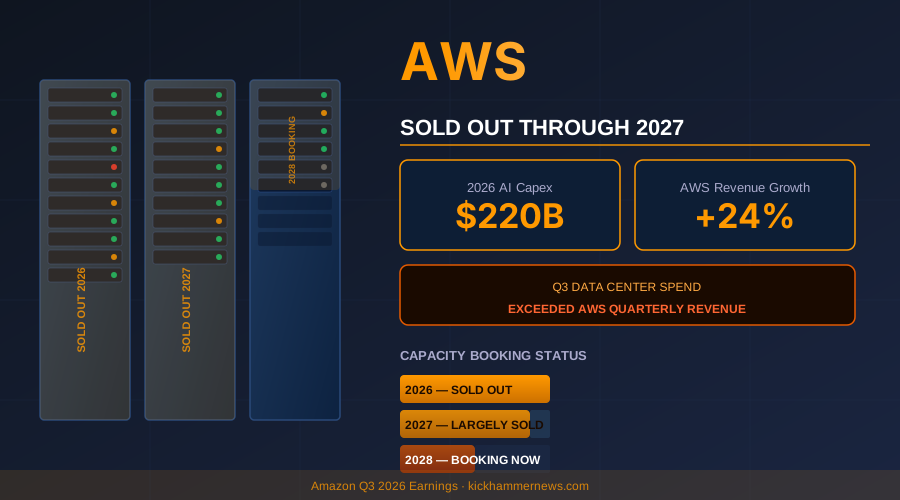
When Amazon reported its third-quarter 2026 earnings on Thursday, analysts expected strong numbers from AWS. They got them. What they did not entirely expect was the scale of what Andy Jassy said next: AWS is completely sold out through the end of 2026, the vast majority of 2027 capacity is already spoken for, and the company has already booked “a good chunk” of 2028. Oh — and in the most recent quarter alone, Amazon spent more building data centers than AWS took in as revenue.
That last point is the one that should stop people cold.
The Numbers That Matter
AWS revenue grew roughly 24 percent year-over-year in Q3 2026, continuing an acceleration that began when AI workloads started colonizing enterprise cloud budgets in earnest in early 2025. But Amazon simultaneously raised its full-year 2026 capital expenditure guidance to approximately $220 billion — a figure so large it bears comparison to the GDP of medium-sized countries. The majority of that spending is going toward AI infrastructure: data centers, custom silicon, fiber, and the power grid connections needed to keep it all running.
The startling disclosure came in the quarterly earnings commentary: for the third quarter, Amazon’s data center build-out cost more than the revenue AWS generated during those same three months. The company’s free cash flow turned negative as a result. Amazon has not been shy about this trade-off. Jassy has consistently told investors that the demand signal is so clear, and so durable, that under-investing would be the costlier mistake. But the arithmetic still deserves attention: the world’s largest cloud computing business is currently running at a structural spend-more-than-you-earn pace on the one category that defines its future.
Everything Is Already Booked
The capacity constraint story is arguably more significant than the spending number. AWS is not simply busy — it is sold out in a way that is reshaping how its largest customers plan their technology roadmaps.
Jassy confirmed on the earnings call that AWS has no meaningful unallocated capacity for 2026. He went further, saying that demand for 2027 has already been largely committed through long-term agreements. And the 2028 booking window — which would have been considered an implausibly long planning horizon for cloud computing just two years ago — is already generating signed contracts. “A good chunk of 2028,” was how Jassy phrased it in post-call commentary, a line that circulated quickly through Wall Street notes and technology news alerts.
The practical consequence for any company that has not already locked in multi-year capacity agreements with AWS, Microsoft Azure, or Google Cloud is sobering: if you want significant GPU or AI-optimized compute in the next two years, you may be negotiating for a slot that effectively does not exist yet. Wait lists for high-capacity AI instances have become a standard part of enterprise technology planning in a way they were not eighteen months ago.
Why Is This Happening?
The proximate answer is that the major AI frontier labs — OpenAI, Anthropic, Google DeepMind, Meta, xAI — are consuming compute at a rate that was considered implausible even at the peak of the pre-2026 AI hype cycle. Training runs for the current generation of frontier models require sustained access to tens of thousands of high-end GPUs for months at a time. Inference, once dismissed as a relatively modest computing task, has emerged as a comparable consumption driver as AI-powered products reach hundreds of millions of daily users.
The secondary driver is enterprise AI deployment. The pattern that began in 2024 with cautious pilot programs has matured into large-scale rollouts. Companies running AI agents across their operations — in customer service, software development, supply chain, finance — are consuming cloud compute at a rate their IT departments did not model in their annual budgets. Gartner had estimated that 40 percent of enterprise applications would feature task-specific AI agents by 2026; the actual adoption pace appears to have exceeded that projection.
The tertiary driver is sovereignty and redundancy. Governments and large regulated industries are building out their own AI capacity reservations, partly for security reasons and partly because they have learned from the 2025 GPU shortage that waiting until you need the capacity means not getting it.
The Paradox at the Heart of Amazon’s Bet
Amazon’s situation illustrates the peculiar economics of the current AI infrastructure moment. AWS is genuinely booming — 24 percent year-over-year growth at the scale AWS now operates is an enormous amount of incremental revenue. The business is healthy by every normal measure. And yet the company is investing so aggressively that it cannot generate positive free cash flow from that booming business.
This is not evidence of a problem. It is evidence of a bet. Amazon is making the calculation — as is Microsoft, Google, and to varying degrees every major cloud provider — that the AI infrastructure buildout is not a speculative bubble but a structural demand shift. If that calculation is correct, the companies that built the most capacity at the lowest per-unit cost will capture a disproportionate share of a market that will be substantially larger in 2028 than it is today. The capital expenditure of 2026 is the inventory of 2028.
The risk is that the calculation is wrong, or that it is right on the demand side but wrong on the timing, and that the multi-hundred-billion-dollar infrastructure commitments mature into capacity that arrives faster than the market can absorb it at the margins that justify the investment. Amazon’s free cash flow going negative is a leading indicator of what happens if that scenario materializes.
What Comes Next
Jassy acknowledged that supply constraints are actively limiting AWS growth — the limitation on revenue is not customer demand but the pace at which Amazon can build, equip, and power new facilities. The company has been accelerating construction timelines, acquiring power purchase agreements, and investing in custom AI chips (the Trainium and Inferentia lines) to reduce its dependence on NVIDIA’s supply-constrained GPU allocations.
With 2027 effectively sold and 2028 booking already open, the next meaningful benchmark will be whether Amazon can bring capacity online fast enough to start converting its backlog into revenue — and whether the demand curve holds long enough for the math to work out the way Jassy is telling investors it will.
The $220 billion bet says he thinks it will. The sold-out reservation books suggest he is not alone in that belief.


