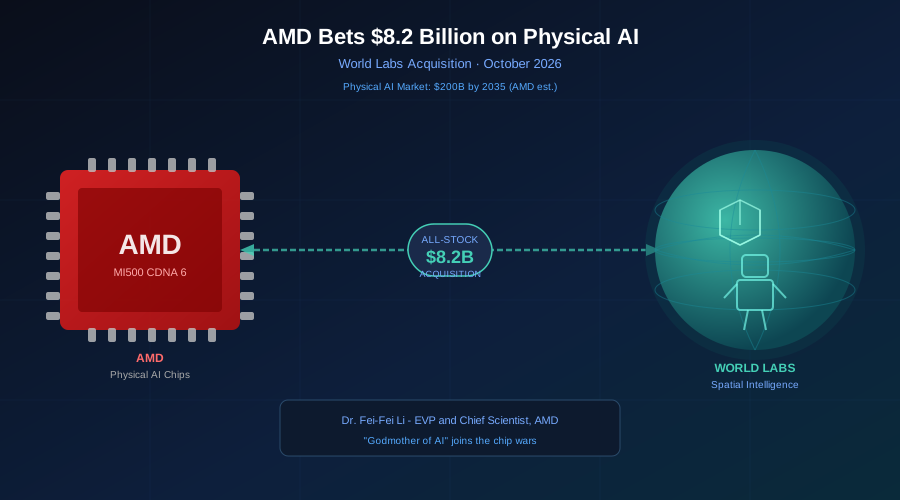
I’ve been watching AMD’s moves in AI infrastructure for the past two years, and the World Labs acquisition is the first one that made me stop and think: this isn’t about chips. Not primarily, anyway. AMD agreed last month to buy Fei-Fei Li’s two-year-old startup for $8.2 billion in all stock — the company’s second-largest acquisition ever, behind its $49 billion Xilinx deal in 2022. Li will become AMD’s executive vice president and chief scientist, reporting to CEO Lisa Su.
Most coverage frames this as AMD closing the gap with Nvidia. That’s the wrong frame. AMD already lost the AI training race. This is a bet on not losing the next one.
What AMD Actually Bought
World Labs has, by most accounts, one product: Marble. It turns a handful of still images into navigable, interactive 3D environments. The pitch is entertainment and robot training simulation. The company raised $1 billion across its two years of existence. It sells, by one analyst’s description, “almost nothing yet.”
So what does $8.2 billion buy?
It buys Li herself — the computer vision pioneer behind ImageNet, the dataset that triggered the deep learning revolution. It buys a team of researchers focused on “spatial intelligence”: AI that doesn’t just process text and images but understands three-dimensional space, physics, and object persistence over time. And it buys the right to co-design AMD’s next chip generations against frontier model architecture rather than behind it.
The transaction converts a “deep technical partnership” — AMD’s words, from their prior collaboration — into an org chart. That’s not a throwaway detail. It means Li’s team now has budget authority and can influence silicon roadmaps starting with the MI500, AMD’s next-generation accelerator due in 2027 on CDNA 6 architecture. AMD’s stated claim: 1,000x the performance of the MI300X from 2023.
The Calculations Most Coverage Is Skipping
Let me run the numbers from a few angles, because the acquisition price looks very different depending on the scenario you’re modeling.
Scenario 1: This is a talent acquisition. World Labs raised $1 billion; AMD paid $8.2 billion. That’s an 8.2x multiple on capital raised, with essentially no revenue. AMD’s stock dilution is under 1% on a company worth approximately $1 trillion — so in absolute terms, AMD is paying roughly $8.2 billion for ~$8.2 billion of dilution. Stockholders barely moved (the stock rose 2% on announcement day). If the deal is purely a talent play, AMD spent roughly $41 million per key researcher assuming a team of 200. For comparison, top ML researchers at Google DeepMind command $5–10 million total compensation packages. This math works if — and only if — the team stays.
Scenario 2: This is a market positioning bet. AMD estimates the physical AI market — covering robotics, autonomous vehicles, industrial automation, and simulation — at $200 billion by 2035. If AMD captures just 15% of that market through superior hardware-software integration, that’s $30 billion in annual revenue. At AMD’s current trailing price-to-sales multiple of roughly 8x, that’s $240 billion in market cap creation — or about 30x the acquisition cost. The bet makes sense here, but only if AMD can translate World Labs’ research into chip designs that become the default platform for robotics developers.
Scenario 3: The breakeven calculation. AMD’s data center GPU segment generated approximately $5.1 billion in the first three quarters of 2026. At that pace, the World Labs deal costs roughly 16 months of GPU segment revenue. For the acquisition to pay back in hardware sales alone — assuming 40% gross margins and no multiple expansion — AMD needs to attribute approximately $20 billion in incremental GPU sales to the World Labs integration over the next five years. That requires winning roughly one-third of Nvidia’s current addressable robotics and physical AI GPU spend. Aggressive, but not absurd.
A Decision Framework: When Should You Care About AMD vs. Nvidia?
For teams making AI infrastructure decisions, the AMD-versus-Nvidia question looks different depending on your workload.
Choose Nvidia (specifically H200/B300/Vera Rubin) when: your primary workloads are frontier LLM training or fine-tuning; your team’s ML engineers have existing CUDA code they won’t rewrite; you’re working with vendors like NVIDIA NIM who have Nvidia-first support agreements; or your compute budget exceeds $50 million per year and you need the vendor relationship that size buys.
Take a serious look at AMD (MI400/MI455X or the coming MI500) when: your inference workloads represent more than 60% of total GPU spend (AMD’s price-performance advantage is strongest here); you’re deploying in sovereign cloud environments that can’t buy Nvidia on political or export-control grounds; your team is already running open-source models on ROCm and finds it adequate; or you’re building robotics simulation pipelines that will run at the edge and need AMD’s embedded Ryzen AI chips alongside data center GPUs in the same ecosystem.
Wait and watch (re-evaluate in mid-2027) when: your primary workload is world models, physical simulation, or embodied AI training — which is exactly the category AMD is now trying to design hardware around. If World Labs’ research influences MI500 memory architecture or ROCm’s primitives for 3D spatial computation, AMD could end up with purpose-built advantages Nvidia has to scramble to match.
The threshold: if more than 20% of your projected AI compute in 2027–2028 will be physical AI workloads (simulation, robotics, autonomous systems), the AMD ecosystem deserves serious evaluation even if it means rewriting some CUDA code.
The Contrarian Take: AMD Isn’t Trying to Beat Nvidia at Today’s Game
Here’s what most coverage of this deal gets wrong. The narrative is: “AMD has been losing the AI chip war; this acquisition closes some gap; AMD can now better compete.” But that framing assumes the competition is for LLM training and inference workloads, where Nvidia has roughly 80% market share, a trillion-dollar ecosystem, and a decade of CUDA lock-in.
The more likely truth is that AMD’s leadership has concluded — correctly, I think — that competing for that market is a losing game. The war for the data-center training chip is essentially over. What’s not decided is who will power the physical AI economy: the humanoid robots, autonomous vehicles, industrial automation systems, and mixed-reality platforms that will define the decade after this one.
Nvidia isn’t asleep here. Its Cosmos world models are open-weight and designed to drive demand toward Nvidia GPUs. Its Project GR00T and Isaac platforms are already being adopted by robot manufacturers. Nvidia has a head start.
But — and this is the key point — Nvidia’s software moat in physical AI is far thinner than its moat in LLM training. The CUDA ecosystem doesn’t lock in robotics developers the same way it locks in ML researchers with millions of lines of PyTorch code. Physical AI developers are still writing their stacks largely from scratch. That’s the opening AMD is trying to exploit, and World Labs is the wedge.
Lisa Su and Fei-Fei Li are betting that whoever co-designs the hardware and the spatial intelligence model architecture together will define the platform the next generation of physical AI runs on — the same way the combination of CUDA and the Transformer architecture defined the current era. Whether they’re right is a $8.2 billion question.
The Risks Nobody Is Leading With
Three bear cases deserve more attention than they’re getting.
First, the retention problem. This is a founder-led research lab. The acquisition terms don’t say how long Li’s team is locked up. If the key researchers leave within two years — which happens in acquisitions more often than it doesn’t — AMD paid for brand recognition and IP without the creative engine.
Second, the timeline mismatch. Chip design cycles run three to five years. A world model architecture designed today informs chips that ship in 2028 or 2029. If the approach is wrong, there’s no correction until the next generation. Research and silicon roadmaps are notoriously hard to synchronize.
Third, the open-weights question. AMD’s moat only materializes if World Labs releases its models as open weights that pull developers toward AMD hardware — the way open-source ROCm support is supposed to broaden the ecosystem. If AMD keeps the models closed, competitors can train their own spatial intelligence models and AMD ends up with an internal research lab that can’t win the network effects battle.
Your Dated Action Checklist
Here’s what I’ll be watching, and when:
- **November–December 2026:** Watch for FTC/DOJ second request. If regulators flag the deal as an AI market concentration concern, closing could push into Q1 2027. A second request would be the market’s first signal that antitrust scrutiny is expanding from cloud AI into physical AI infrastructure.
- **Q4 2026 (deal close):** The first post-close signal matters: does AMD keep the World Labs brand and blog, or does it fold it silently into corporate communications? Keeping it visible signals that AMD is using Li’s name for ecosystem building, not just internal research. Check AMD’s investor materials and World Labs’ GitHub/blog in January 2027.
- **Q1 2027:** Look for World Labs’ first open-weight model release. If AMD announces an open spatial intelligence model on Hugging Face within six months of closing, the strategy is working as described. If nothing ships publicly, the integration is hitting friction. Open weights by March 2027 are the “pass” signal for this bet.
- **Q2 2027 (MI500 architecture preview):** AMD traditionally previews the next generation at its Data Center and AI Tech Premiere. Watch for any mention of memory architecture or interconnect specs that are unusual for LLM workloads but match the demands of 3D simulation — very high memory bandwidth, deterministic latency, and geometric compute primitives. That’s the fingerprint of World Labs’ influence.
- **By January 2028:** If AMD has captured a meaningful share (5%+) of robotics simulation platform deals — with companies like Figure AI, Physical Intelligence, or the major automotive OEMs naming AMD as their preferred training hardware — the thesis is validated. If it’s still a paper story, the acquisition will be written off as an expensive talent grab.
What This Means Right Now
For most technology organizations, the AMD-World Labs deal is background noise today. It becomes relevant the moment your roadmap has a physical AI component — a robotics project, a simulation environment, an autonomous system of any kind.
My read: AMD made the right strategic call, but they’re making it in second position and betting on a research timeline that’s longer than most investors will be patient for. Nvidia has a two-year head start in physical AI go-to-market, and world models are still being defined as a category. AMD is betting that Fei-Fei Li can shape what “spatial intelligence” means before Nvidia gets to define it alone.
That’s worth $8.2 billion. Whether AMD can execute on it — keeping the team, shipping the chips, building the developer ecosystem — is the bet. We’ll know the first chapter of the answer by the middle of next year.