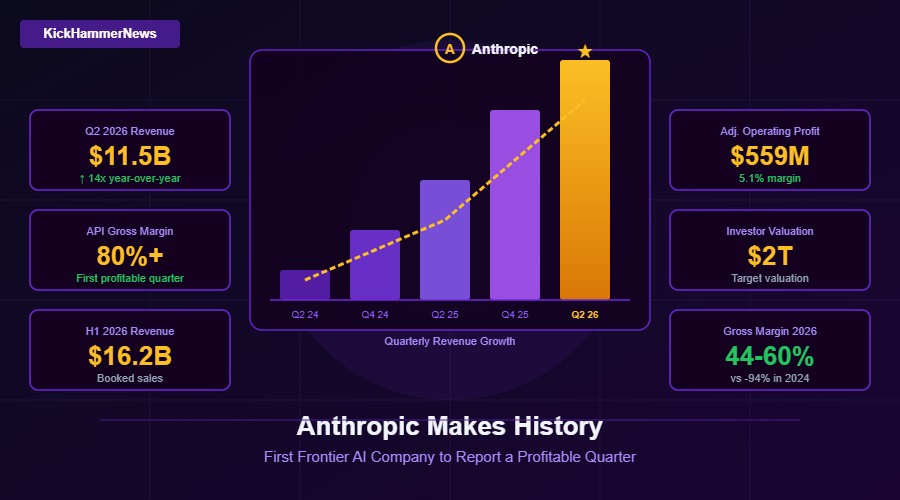
It was the milestone that many in the AI industry had privately doubted would arrive this soon. Anthropic, the AI safety company founded in 2021 by Dario Amodei, Daniela Amodei, and a team of former OpenAI researchers, has reported its first profitable quarter — a development that is reshaping how investors, competitors, and the broader technology industry think about the economics of frontier artificial intelligence.
The numbers are remarkable by any measure. Anthropic posted $11.5 billion in revenue for Q2 2026, a fourteen-fold increase compared to the $787 million it recorded in the same period last year. First-half revenue totaled $16.2 billion. Most significantly, the company reported positive adjusted operating income for the quarter — projected at approximately $559 million on $10.9 billion in revenue, representing an operating margin of roughly 5.1 percent.
For context: two years ago, Anthropic was burning through cash at a rate that made even its enthusiastic investors nervous. Its gross margin had been deeply negative. The transformation to profitability has been one of the most dramatic financial turnarounds in recent technology history.
The API Business That Changed Everything
The engine of Anthropic’s profitability is its API business, which serves enterprise customers, developers, and technology companies building products on top of Claude models. According to the company’s investor communications, this segment now operates at gross margins exceeding 80 percent — a figure that draws favorable comparisons to the best software businesses in history.
The economics of AI inference have changed dramatically over the past two years. When Anthropic first began scaling Claude, the computational cost of running large language model inferences was prohibitively high. Specialized chips, optimized inference stacks, and architectural improvements across the industry have dramatically reduced those costs. Anthropic’s gross margin trajectory — from approximately negative 94 percent in 2024 to an estimated 44 to 60 percent overall (with the API segment well above that) in 2026 — tells the story of an industry growing into its unit economics.
The shift has been enabled by a combination of hardware improvements, software optimization, and scale. As models run more inferences, the fixed costs of infrastructure are spread across a larger revenue base, improving margins. Anthropic has also benefited from the competitive dynamics of the cloud computing market: AWS, Google Cloud, and Microsoft Azure have all competed aggressively to host Anthropic’s models, providing infrastructure at favorable terms in exchange for partnership agreements.
What the Profitability Milestone Actually Means
The announcement has been met with some skepticism, and the skeptics raise fair points. The $11.5 billion in revenue figure reflects “booked sales” rather than cash received, and the operating profit calculation uses an adjusted metric that excludes certain expenses. A newsletter and analysis piece titled “Anthropic’s Profitability Swindle” argued that the headline figures obscure the company’s true cash burn, which remains significant.
Anthropic’s supporters counter that the underlying trajectory is what matters. Whether the company achieves GAAP profitability in Q3 or Q1 2027 is less important than the demonstrated fact that the business model works at scale. The API gross margins above 80 percent indicate that once infrastructure costs are covered, additional revenue flows almost entirely to the bottom line. That is the hallmark of a sustainable software business.
The company’s investors are certainly acting like they believe the story. Reports indicate that Anthropic backers are eyeing a valuation approaching $2 trillion — a figure that would place it among the handful of most valuable companies in the world. That valuation rests on the premise that Anthropic’s combination of safety-focused research, powerful models, and emerging profitability will compound into a dominant market position over the coming decade.
Claude’s Market Position
The commercial success rests on the performance and reputation of Claude, Anthropic’s family of AI models. The current generation has earned strong reviews from enterprise customers for its reliability, instruction-following ability, and — critically for regulated industries — its commitment to safety and explainability.
Anthropic has pursued a deliberate enterprise strategy, building out features and certifications that matter to large organizations: data privacy controls, audit logs, fine-tuning capabilities, and compliance documentation. This has made Claude the model of choice for use cases in financial services, healthcare, legal, and government sectors where reliability and accountability are non-negotiable.
The API-first approach has also cultivated a large developer ecosystem. Thousands of applications are built on Claude, creating a self-reinforcing network where Anthropic’s success attracts more developers, who build more applications, who generate more revenue, which funds more research. This flywheel dynamic is what makes the profitability milestone more than just a quarterly accounting result — it signals that the flywheel is spinning.
Competitive Implications
Anthropic’s profitability creates meaningful competitive pressure for the rest of the frontier AI industry. OpenAI, which pioneered the commercial AI market with ChatGPT, has faced persistent questions about its own path to sustainable economics. The companies are on parallel tracks, but Anthropic’s announcement shifts the narrative: it is no longer possible to argue that frontier AI is inherently unprofitable.
The music industry litigation — Sony Music Publishing and Warner Chappell recently filed a 48-page complaint naming Anthropic and its founders personally over alleged copyright infringement in training data — represents a meaningful legal risk that clouds the financial picture. Copyright litigation against AI companies is a sector-wide issue, but Anthropic’s newfound profitability makes it a more attractive target for damages claims.
Microsoft’s AI strategy, articulated by CEO Satya Nadella as welcoming the deliberate pacing needed to get alignment right, reflects the company’s own positioning as a safety-conscious AI developer. Anthropic and Microsoft occupy adjacent strategic positions: both emphasize responsible development, enterprise reliability, and safety research. But they are also competitors for the same enterprise AI budget.
The Broader Signal
Anthropic’s profitability milestone matters beyond its own balance sheet because it answers a question the entire industry has been circling: can frontier AI generate returns sufficient to justify the extraordinary capital investment it requires?
The training runs for frontier models cost hundreds of millions of dollars. The infrastructure to serve those models at scale costs billions more annually. The research teams capable of advancing the state of the art command compensation that rivals the most expensive talent in the world. For years, skeptics argued that these costs would never be recovered — that AI was a capital destruction machine dressed up in the language of technological revolution.
Anthropic’s Q2 2026 results offer the most compelling counter-argument yet: the costs can be recovered, the margins can be strong, and the business can sustain itself without constant infusions of venture capital. That changes the calculus for everyone in the industry, from startup founders to enterprise procurement officers to the governments and regulators trying to understand what kind of market structure is emerging.
The age of AI as an experimental, money-losing endeavor is ending. The age of AI as a scaled, profitable industry is beginning. Anthropic just provided the evidence.


