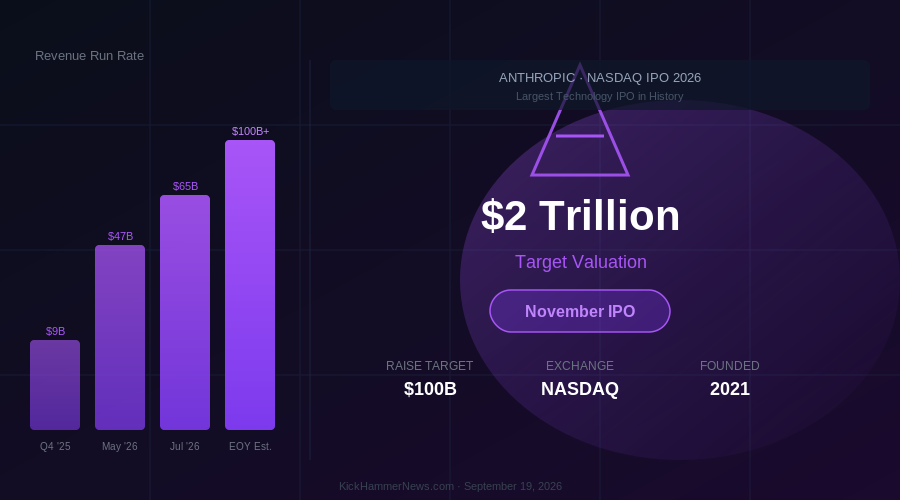
Anthropic, the San Francisco-based artificial intelligence company best known for its Claude family of AI models, is moving forward with plans to go public in November at a potential valuation of $2 trillion — a figure that would place the company among the most valuable entities ever to debut on public markets. If achieved, the offering would raise as much as $100 billion, making it one of the largest IPOs in financial history.
From Startup to Generational Wealth Event
Founded in 2021 by former OpenAI researchers Dario Amodei, Daniela Amodei, and a small team of colleagues, Anthropic spent its early years operating in relative obscurity compared to its rivals. That changed dramatically as Claude — the company’s flagship AI assistant — gained traction in enterprise markets, and as concerns about AI safety made Anthropic’s mission-driven approach increasingly attractive to both customers and investors.
The company filed its S-1 registration statement with the Securities and Exchange Commission in June 2026, setting the stage for a Nasdaq listing. Now, according to sources cited by The Wall Street Journal, Anthropic has shifted its target listing window from October to November, giving the company additional time to finalize underwriters, share structure, and pricing details — none of which have been formally disclosed.
Revenue Growth That Defies Conventional Logic
What makes the $2 trillion valuation figure even remotely defensible is Anthropic’s extraordinary revenue trajectory. The company’s annualized revenue run rate reportedly exceeded $65 billion by the end of July 2026, up from approximately $47 billion in May and roughly $9 billion at the close of 2025. Investors now expect total revenue to surpass $100 billion before the year ends.
This level of growth — compressing what typically takes decades into eighteen months — reflects the unusual economics of large language model deployment. Once a frontier model is trained, the cost of serving millions of additional users is largely a function of compute, not headcount, and Anthropic’s infrastructure investments have positioned the company to scale at a pace that legacy software companies simply could not match.
Claude’s enterprise contracts have been a major engine of this growth. Businesses across finance, healthcare, legal services, and software development have embedded Claude into their workflows at a rate that has surprised even Anthropic’s own projections. Claude subscriptions, offered at multiple tiers for individual and team users, provide a recurring revenue base that analysts say will be critical to sustaining the company’s growth trajectory once the initial IPO excitement subsides.
The Math Behind $2 Trillion
Bankers and investors working on the deal have reportedly discussed a listing valuation of up to $2 trillion based on projected 2028 revenue of $190 billion to $200 billion — a multiple that is aggressive but not without precedent in high-growth technology. The S-1 filing’s final pricing will ultimately depend on market conditions in November, investor appetite for AI exposure, and how Anthropic’s roadmap lands with institutional buyers who have already poured billions into the sector.
For context, a $2 trillion market cap would place Anthropic alongside Apple and Nvidia as one of the three most valuable public companies in the world on the day of its debut. It would also represent more than twice the current market capitalization of Meta Platforms and approximately four times that of Tesla.
These comparisons are deliberately provocative. Anthropic is not yet profitable on a GAAP basis — its compute costs and research expenditures remain enormous — but the company’s most recent quarter saw it break even on an operating basis, a milestone Anthropic executives publicly celebrated as proof that the unit economics of AI at scale can eventually converge with traditional software margins.
The Competitive Landscape Going Public
Anthropic’s IPO comes at a moment of profound flux in the AI industry. OpenAI, Anthropic’s closest rival, delayed its own public offering in September after internal safety concerns about its next flagship model prompted regulators and board members to request additional review time. That delay has inadvertently given Anthropic a window to define the narrative of what a “responsible” AI company going public looks like.
Google, Microsoft, Meta, and Amazon have all made substantial investments in either Anthropic itself or competing AI ventures. Amazon’s multi-billion-dollar AWS partnership with Anthropic remains one of the most strategically significant relationships in the sector, providing Anthropic with cloud infrastructure at scale while giving Amazon a distribution footprint for Claude that rivals anything OpenAI can offer through Azure.
The IPO also arrives in the wake of Anthropic’s first profitable quarter, announced earlier this month — a development that fundamentally changed the story the company can tell to public market investors. The path from “AI safety nonprofit spinoff” to “the most valuable technology IPO in history” is not a narrative anyone predicted when Dario Amodei left OpenAI in 2021, but it is, against all odds, the story that has materialized.
Safety as a Selling Point
One of the more unusual aspects of Anthropic’s public market debut is the degree to which AI safety — historically a constraint on deployment, not a driver of revenue — has become central to the company’s brand proposition. Enterprise customers in regulated industries have overwhelmingly chosen Claude over competitors precisely because Anthropic’s Constitutional AI training approach and its emphasis on transparency around model limitations reduce legal and reputational exposure.
Dario Amodei spent much of this week calling for a more cautious pace of development for the most powerful AI systems, a position that might seem counterintuitive for a CEO preparing the largest IPO in AI history. But Anthropic’s messaging has consistently held that safety and commercial success are not in tension — and the $65 billion annualized revenue figure suggests that a substantial portion of the market agrees.
What Comes Next
The November IPO window is narrow. Markets have been volatile in the back half of 2026, and the AI sector has experienced its share of headline risk, from regulatory scrutiny in Brussels to antitrust probes in Washington targeting Nvidia’s recent acquisitions. Anthropic’s leadership will need to thread a careful needle: projecting confidence in a historic offering while managing expectations about profitability timelines and the continued cost of frontier model training.
If the offering succeeds at or near the rumored valuation, it will mark a decisive moment not just for Anthropic but for the entire AI industry — confirmation that the transformative technology built over the past decade has created durable enterprise value, and that the companies which bet on it earliest have been rewarded in a way that is now legible to every institutional investor on earth.
For now, all eyes turn to November. The biggest IPO in AI history — and possibly in the history of technology — is on the clock.


