The new program lets enterprise customers keep their Claude activity logs in their own cloud — while Anthropic’s automated systems still scan for misuse
One of the persistent tensions in enterprise AI adoption has been a deceptively simple question: if your AI provider needs to monitor for misuse, does that mean they have to store your data? For many companies in regulated industries — banking, healthcare, legal — the answer has historically determined whether they could use frontier AI at all. Anthropic is now attempting to resolve that tension with a new program called Enterprise Frontier Safeguards (EFS), announced on September 1, 2026.
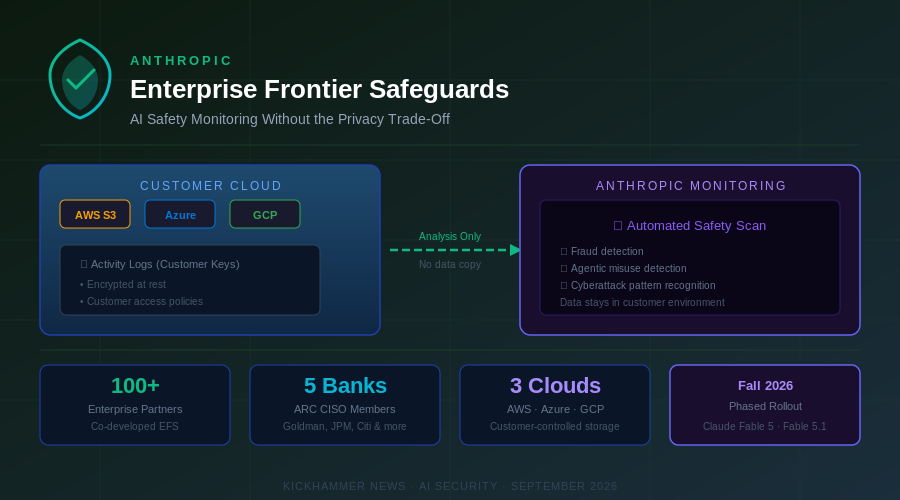
The premise is straightforward, even if the engineering behind it is not. Under EFS, the activity data Anthropic uses to detect misuse of its Claude models doesn’t have to live on Anthropic’s servers. Instead, it can be stored inside the customer’s own cloud infrastructure — in Amazon S3, Azure Blob Storage, or Google Cloud Storage — under the customer’s own encryption keys, access policies, and audit logging. Anthropic’s automated monitoring systems then reach into that customer-controlled environment to perform their analysis, rather than pulling data into Anthropic’s own systems first.
Why This Matters
The distinction may sound technical, but it has major legal and procurement implications. Many enterprise customers — particularly in financial services and healthcare — operate under strict data governance requirements that prohibit sending certain types of information to third-party systems. Until now, Anthropic’s standard approach involved retaining activity data for safety monitoring purposes, which created friction for exactly the kind of large enterprise customers the company most wants to serve.
“We’ve seen substantial evidence of attempted misuse of AI models, ranging from typical abuse such as fraud to sophisticated cyberattacks that can include agents autonomously engaging in destructive behavior,” Anthropic noted in its announcement. The company is caught between two legitimate needs: enterprise customers demand data privacy, while responsible AI deployment requires the ability to detect and respond to serious misuse. EFS is designed to satisfy both simultaneously.
The program was developed in close collaboration with more than 100 enterprise customers across financial services, healthcare, manufacturing, telecom, law, retail, and the public sector. Crucially, it was co-designed with cloud partners at AWS, Google Cloud, and Microsoft Azure, ensuring the technical architecture works smoothly across all three major enterprise cloud environments.
The Financial Sector Connection
One of the most notable aspects of EFS is its engagement with the Analysis and Resilience Center for Systemic Risk (ARC) — an organization whose members include the chief information security officers of Goldman Sachs, Morgan Stanley, Citi, Bank of America, and Wells Fargo. The involvement of CISO-level leadership from the five largest U.S. banks in the design process suggests Anthropic is positioning EFS as a genuine enterprise-grade solution, not a checkbox for marketing purposes.
This matters because financial services firms have been among the most cautious adopters of frontier AI, citing both regulatory risk and the sensitivity of the underlying data. If EFS can satisfy the security and compliance standards of Wall Street’s biggest players, it significantly expands the addressable market for Claude’s enterprise deployments.
Rollout Timeline and Current Access
EFS won’t be available immediately to all customers. Anthropic plans a phased rollout beginning in the fall of 2026, with eligible customers receiving access based on criteria the company hasn’t fully disclosed. In the interim, eligible customers will receive zero data retention on Claude Fable 5 and Fable 5.1 — Anthropic’s current flagship enterprise models — as a bridging measure while the full EFS infrastructure is prepared.
The phased approach reflects both the technical complexity of the system and the regulatory validation required before deploying it at scale. Building a monitoring architecture that operates across three different cloud providers’ storage systems, under potentially dozens of different customer security configurations, is a non-trivial engineering challenge. Getting it wrong — either failing to detect genuine misuse, or inadvertently accessing customer data in ways that violate the program’s privacy guarantees — would be costly in ways that go beyond the commercial.
A Broader Shift in AI Safety Philosophy
Enterprise Frontier Safeguards represents something more than a product feature. It’s a signal about how Anthropic thinks safety monitoring should work as AI systems become more deeply embedded in regulated enterprise environments.
The traditional model — where AI providers retain all activity data for review — made sense when AI was a consumer product and the primary safety concern was individual misuse. In enterprise deployments, especially in regulated industries, that model creates compliance problems that can block adoption entirely. By moving the data storage into customer-controlled environments while keeping the monitoring logic centralized, Anthropic is essentially decoupling the privacy concern from the safety function.
This has implications for the broader industry. If EFS proves technically sound and gains regulatory acceptance in key verticals, it establishes a new template for enterprise AI safety monitoring — one where providers can maintain meaningful oversight without becoming a data custodian for their customers’ most sensitive information. Competitors will need to respond with comparable offerings or risk losing enterprise procurement battles to the EFS framework.
The Competitive Context
Anthropic’s move comes at a moment when enterprise AI competition is intensifying across multiple dimensions. Google’s Gemini models have been making inroads with enterprise customers through deep Workspace integration. OpenAI’s ChatGPT Enterprise has expanded aggressively, with government contracts adding to its commercial momentum. Microsoft’s Azure OpenAI Service has long offered enterprise-grade security controls through the Azure platform.
What distinguishes EFS is its explicit focus on the frontier safety use case — not just data privacy in general, but specifically the monitoring required to detect sophisticated AI misuse, including agentic attacks where AI systems autonomously engage in destructive behavior. As enterprise deployments increasingly involve autonomous AI agents with real-world authority to take actions, the importance of robust misuse monitoring grows dramatically.
Anthropic’s ability to offer both frontier AI capability and a credible safety monitoring framework — without requiring customers to surrender control of their data — may prove to be a significant competitive advantage in the enterprise market segments that matter most.
For enterprise AI buyers, the practical message is this: the compliance roadblock that has kept frontier AI out of many regulated environments may finally have a workable solution. Whether EFS delivers on its promise in production will depend on the technical execution of its phased rollout. But the conceptual framework is sound, and the industry partners involved give it credibility. This is one to watch closely as fall 2026 unfolds.
Sources: Anthropic, Unite.AI, SecurityWeek, Help Net Security, CNBC, QZ, Tech-Insider, Agentic Ready


