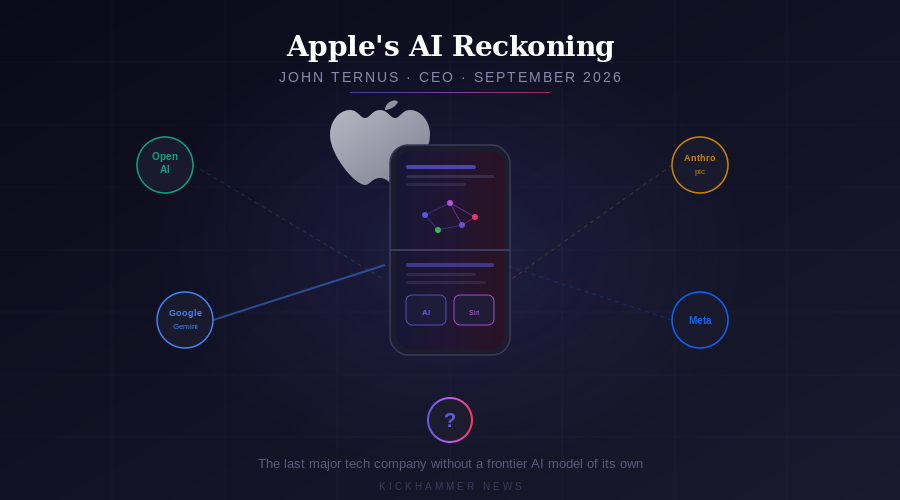
On September 1, 2026, John Ternus sat down at a desk in Cupertino, California, as the new chief executive of the world’s most valuable company — and arguably its most interesting problem in artificial intelligence. Tim Cook had spent 15 years transforming Apple from a hardware powerhouse into a services empire. Now Ternus, a quiet engineering veteran who spent over two decades building the physical objects that define modern life, inherits something neither Cook nor Steve Jobs ever faced: an Apple that is genuinely, measurably behind.
Behind in AI. The last major tech giant without a frontier model of its own.
The Engineer Who Built the iPhone Inherits an AI Race He Didn’t Start
John Ternus joined Apple in 2001, during the original iPod era, and spent his career in product design and hardware engineering. He became Senior Vice President of Hardware Engineering in 2021 and is widely credited for steering Apple through the Silicon transition — moving the Mac lineup from Intel processors to Apple’s own M-series chips with surprisingly little turbulence. He’s the kind of executive who thinks in atoms, not algorithms: manufacturing tolerances, thermal envelopes, supply chain choreography.
That background is either Apple’s greatest asset or its greatest liability right now, depending on who you ask.
The AI race of 2024–2026 was not decided by hardware. It was decided by models — by the large language systems that OpenAI, Google DeepMind, Anthropic, Meta, and a dozen other organizations trained on oceans of data at extraordinary cost. Apple did not build one of those. Instead, Tim Cook struck a deal: Apple would pay Google roughly $1 billion annually to integrate Gemini into a rebuilt Siri, giving iPhones the underlying intelligence they needed to stay competitive without Apple developing frontier AI capabilities in-house.
It was a pragmatic move that has aged poorly.
Siri’s Gemini Problem
When Apple unveiled iOS 27 and its new Siri experience — backed by Google Gemini — the initial response was mixed. The integration works, in the sense that Siri can now have coherent multi-turn conversations, reason through complex tasks, and interface with third-party apps in ways the old Siri never could. But reviewers and users noticed immediately that the seams show. Siri-powered-by-Gemini answers questions about Google’s products with a subtle familiarity. It occasionally defers to Google search in ways that feel off-brand. And it carries a persistent asterisk: Apple’s flagship AI is powered by a competitor.
More structurally, the licensing arrangement means Apple has no control over the model’s development direction, its safety properties, or its fundamental capabilities. If Google decides to change how Gemini behaves, Apple comes along for the ride. If Gemini falls behind models from OpenAI or Anthropic, Apple has no internal team to close the gap.
Ternus, in his first major press appearance as CEO, acknowledged the arrangement while defending it on hardware grounds. “The best AI device in the world,” he told TechCrunch in early September, “is still the iPhone.” His argument: Apple’s advantage lies not in the model weights but in the device ecosystem — the sensors, the secure enclave, the tight hardware-software integration that gives AI systems on-device capabilities they can’t match running from a cloud.
It’s a genuinely interesting argument. It’s also a bet that the hardware layer remains the key differentiator in a world where software intelligence is becoming increasingly commoditized.
The Foldable iPhone Duo: Hardware as AI Philosophy
Ternus made his first product event splash on September 9, introducing the iPhone Duo — Apple’s first foldable smartphone, priced from $1,999 to $3,199. The Duo unfolds to a 7.6-inch continuous display and is the thinnest iPhone ever built. By any measure, it’s an extraordinary piece of hardware engineering: exactly the kind of thing Ternus built his career doing.
But the Duo is also a statement about Ternus’s AI philosophy. Apple positioned the foldable form factor not primarily as a productivity device or a media consumption platform, but as the ideal AI companion — a device large enough to display AI-generated content richly, small enough to carry everywhere, and secure enough to handle sensitive personal data without it leaving the device.
The iPhone Duo includes a new smart display mode that can recognize who’s speaking and tailor content dynamically — a feature Apple is calling “Presence Awareness” — alongside deeper integration with the rebuilt Siri. The device also debuts new on-device processing capabilities through the next-generation Apple Silicon chip inside, which Apple claims can handle a larger class of AI inference tasks without a cloud round-trip.
It’s a coherent story. Apple is betting that device-level AI — private, fast, contextually aware — is where the real value will be captured as model capabilities converge across the major providers.
The Structural Risk No Hardware Can Fix
Ternus’s hardware bet has merit. But it rests on an assumption that is being tested in real time: that frontier model capabilities are close enough to “good enough” that which model powers your device matters less than the device itself.
That assumption may not hold.
OpenAI’s GPT-5.6, which powers Microsoft’s Copilot suite and increasingly large parts of enterprise software, has demonstrated capabilities in reasoning and code generation that put it measurably ahead of Gemini on several benchmarks. Anthropic’s Claude Fable, released earlier this year, has become the preferred model for professional knowledge work in a significant segment of the market. If the gap between the best frontier models and the one Apple licensed continues to widen, the “iPhone as the best AI hub” argument gets harder to make.
Apple’s AI chief — a new role Ternus created when he restructured the leadership bench at the start of his tenure — reportedly has a mandate to evaluate options for building or acquiring frontier model capabilities in-house. The company has the cash to do it. The question is whether it has the institutional culture and the talent pipeline to catch up in a race that started without it.
What Comes Next for Apple’s AI Future
Industry observers are watching for a few key signals in the coming months. Will Apple attempt to acquire an AI lab outright? Several mid-tier model developers have valuations that would be trivially digestible for Apple’s balance sheet. Will Apple significantly expand its AI research footprint and begin pre-training its own models, even if they won’t be competitive with frontier systems for years?
There’s also the services angle. Apple’s services revenue — App Store, iCloud, Apple TV+, Apple Music — has become the company’s most reliable profit engine. Every one of those services now has an AI-shaped hole in it: content recommendation, search, creative tools, coding assistance. Apple could build proprietary model capabilities tuned narrowly for those services, even without competing head-to-head in the general-purpose AI market.
Ternus has given no public indication of which direction he’ll choose. He’s focused his public remarks almost entirely on hardware — the iPhone, the Duo, the upcoming smart home display — and on the device-as-AI-hub philosophy. Internally, the picture is reportedly more urgent.
The Bigger Stakes
There is a version of the next five years in which Apple’s bet pays off handsomely: hardware becomes the moat, the model providers converge on similar capabilities, and the iPhone’s integration and privacy advantages define the AI user experience in the way Apple’s design sensibility defined the smartphone era.
There is another version in which model intelligence compounds in ways that make the underlying hardware feel almost irrelevant — where the AI you have access to matters more than the device you’re holding, the same way a great app was always more important than the processor underneath.
John Ternus is betting on the first version. He may be right. He may also be the last Apple CEO who had the option to make a different bet and chose not to.
The company that built the device that changed computing is now running a technology race it didn’t choose to enter — and the engineer who built its best devices is now responsible for figuring out whether hardware alone can win.
It’s the most interesting question in technology right now. And it started today.
KickHammer Tech covers the intersection of AI, software, and the devices that run them.


