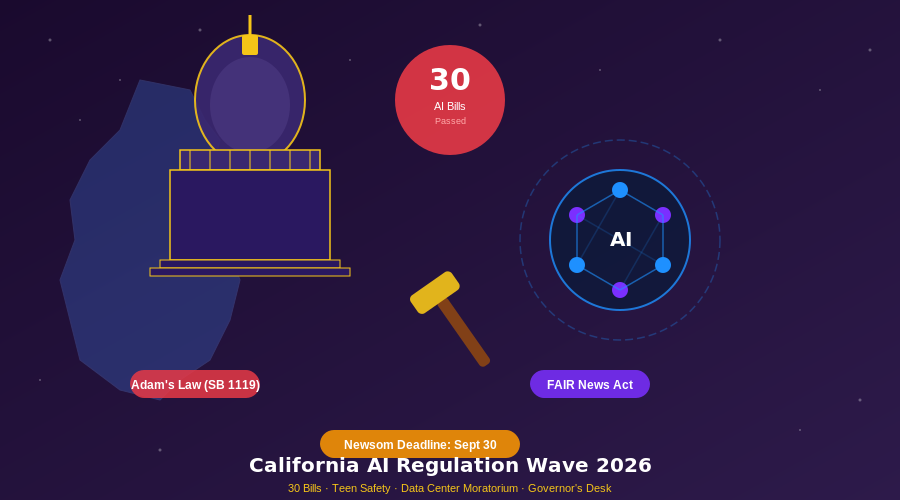
California has once again positioned itself at the center of the American debate over artificial intelligence governance. As the state legislature wrapped its 2026 session, lawmakers passed approximately 30 AI-related bills in a single sweep — the most ambitious burst of AI legislation in the state’s history. Governor Gavin Newsom now has until September 30 to sign or veto them, and the decisions he makes in the next few weeks will have consequences that extend well beyond California’s borders.
The Scope of What Passed
The sheer breadth of this legislative session is striking. Where previous years produced a handful of targeted AI bills — often focused on narrow issues like deepfakes, automated hiring, or chatbot disclosure — 2026’s session addressed the full stack of AI governance concerns in a single push.
The legislation covers companion chatbot safety requirements, an AI training data transparency act, the FAIR News Act (requiring AI systems that summarize or redistribute news content to provide attribution and compensation mechanisms), a moratorium on new AI data center construction pending environmental review, and a ban on AI-assisted surveillance pricing — the practice of using real-time behavioral data to adjust prices dynamically based on what an algorithm thinks an individual consumer will pay.
That last item has attracted particular attention from retailers and e-commerce platforms, which have increasingly relied on AI pricing engines to optimize revenue. Critics argue the practice is a form of price discrimination that penalizes lower-income consumers who may exhibit different browsing patterns than wealthier ones. Proponents of AI pricing counter that dynamic pricing improves market efficiency and isn’t fundamentally different from practices that have existed in airline and hotel booking for decades. The California bill would require disclosure when AI-assisted pricing is in use and ban certain forms of the practice entirely.
Adam’s Law: The Chatbot Safety Flashpoint
Of all the bills heading to Newsom’s desk, Adam’s Law — formally Senate Bill 1119 — has generated the most urgent public discussion. Named after Adam Raine, a teenager who died by suicide in 2024 after extended interactions with an AI companion chatbot, the legislation would significantly strengthen pre-release testing requirements and ongoing safety monitoring for any AI chatbot designed to interact with users under 18.
Under the bill, AI companion operators would be required to conduct documented safety evaluations before deploying products to minors, implement real-time monitoring for conversations that exhibit warning signs of self-harm ideation, and maintain human escalation pathways — meaning that when an AI system detects a user may be in distress, it must be capable of routing that user to human support rather than continuing to engage with automated responses.
The bill also imposes liability standards that are notably stricter than what currently applies to social media platforms. While Section 230 of the Communications Decency Act has historically shielded platforms from liability for user-generated content, AI companion chatbots generate their own responses algorithmically — a distinction that legislators argue removes the rationale for the same liability shield.
For the companies building AI companion products — a category that has exploded in popularity among teenagers and young adults over the past three years — Adam’s Law represents a significant compliance challenge. Testing protocols that were previously informal or proprietary would become legally mandated and auditable. Companies that want to serve California’s 9 million minors would need to build safety infrastructure that can withstand regulatory scrutiny.
Newsom’s Balancing Act
Governor Newsom’s relationship with AI legislation has been one of the defining political narratives of his tenure. In 2024, he vetoed SB 1047, the sweeping AI safety bill that would have imposed liability on frontier model developers for catastrophic harms — a decision that drew praise from Silicon Valley and criticism from AI safety advocates. His rationale then was that broad liability frameworks would chill innovation and push AI development out of California.
The 2026 session puts him in a more complicated position. Many of this year’s bills are narrower and more targeted than SB 1047 was — Adam’s Law, for instance, applies specifically to chatbots designed for minors, not to AI development broadly. Vetoing a chatbot safety bill named after a dead teenager is a considerably harder political calculation than vetoing an abstract liability framework.
Industry groups have already begun lobbying against several of the bills, arguing that requirements like mandatory pre-release testing create compliance burdens that will disadvantage smaller startups relative to large incumbents who can absorb the costs. The data center moratorium has drawn particularly sharp opposition from the tech industry and from labor groups who point to construction jobs and the state’s broader economic stake in remaining the center of AI infrastructure investment.
On the other side, advocacy groups for AI safety, digital rights organizations, and consumer protection advocates are pressing hard for Newsom to sign the package largely intact. They argue that California’s size — both as an economy and as a consumer market — gives it the leverage to set de facto national standards in the absence of federal action. If California requires chatbot safety testing for minors, every major AI company selling products to California consumers will need to comply, effectively raising the floor for the entire industry.
The Federal Vacuum
California’s legislative surge is happening in a context that makes it more significant than it might otherwise be: Washington has largely stepped back from comprehensive AI regulation.
The Great American AI Act, passed by Congress earlier this year, established a federal framework that focused primarily on government use of AI and national security applications. It deliberately left consumer-facing AI products and private-sector deployments largely to existing regulatory agencies — the FTC, the CFPB, and sector-specific regulators — rather than creating new enforceable standards. The result is a patchwork where some AI applications face meaningful oversight and many others face very little.
Into that gap, California has stepped. It’s a dynamic the state has played before, most notably with data privacy — the California Consumer Privacy Act of 2018 effectively became a national baseline that pushed many companies to extend CCPA-equivalent protections to all their users rather than maintain separate privacy standards for California and everywhere else.
The AI industry is watching to see whether the same effect plays out here. Companies large enough to have dedicated policy teams are already gaming out compliance scenarios: which bills, if signed, would require changes to their products globally rather than just for California users? Which would create obligations so California-specific that they’d have to build parallel systems?
What Comes Next
Newsom has until September 30 to act on each bill individually. He is widely expected to sign some and veto others — the question is where he draws the line and what his veto rationales signal about his broader AI policy philosophy heading into what political observers expect to be an active 2027 legislative session.
Adam’s Law is considered the most likely to be signed, given its political salience and relatively targeted scope. The data center moratorium faces the steepest odds, given the governor’s consistent support for AI infrastructure investment. The FAIR News Act, which touches the politically potent issue of journalism economics in the AI era, is seen as a genuine toss-up.
Whatever Newsom signs, the 2026 California AI legislative session marks a turning point. The state has moved from reactive, issue-by-issue AI policy to something that looks more like a comprehensive regulatory framework assembled bill by bill. The question now is whether that framework holds together legally, whether it achieves its stated goals, and whether the rest of the country follows.
For AI companies, the message from Sacramento is clear: the era of building AI products in a regulatory vacuum is ending, at least in the world’s fifth-largest economy. How they respond will shape the industry’s trajectory for years to come.


