OpenAI’s latest feature turns your own emails and messages into a personalized writing coach — and it might be the most intimate AI integration yet.
The emails you’ve sent over years. The Slack messages you’ve fired off to colleagues. The Google Docs you’ve carefully crafted for quarterly reviews. Until now, all of that was just data sitting in apps you use every day. As of September 7, 2026, OpenAI wants to use it to teach ChatGPT how to sound like you.
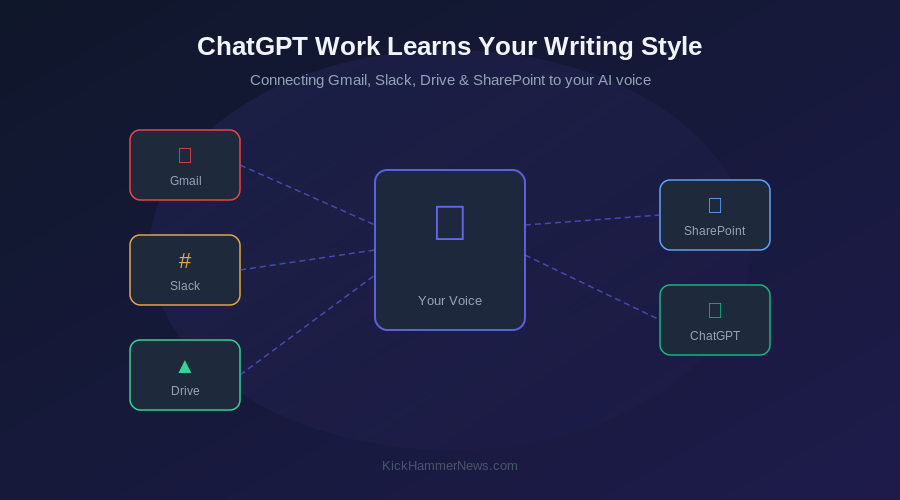
OpenAI quietly rolled out “Writing Styles” for ChatGPT Work, a feature that connects to your workplace tools — Gmail, Google Drive, Slack, and Microsoft SharePoint — and learns the patterns that define how you write. The result: AI-generated drafts that don’t just sound like generic corporate AI, but that carry your voice, your habits, your quirks.
It’s a small announcement in the grand noise of AI news, but the implications are significant. And not everyone will be comfortable with what it requires.
How It Works
Setting up Writing Styles takes less than five minutes. Navigate to Settings → Personalization → Writing Style inside ChatGPT Work on the web, connect one or more of your workplace tools, and the system begins analyzing your communications.
What is it looking for? According to OpenAI’s documentation, the model identifies:
Once the style is established, it applies automatically whenever you ask ChatGPT Work to draft something — an email reply, a project proposal, a performance review, a cold outreach message. The AI generates text that reads like you wrote it, not like it was stamped out of a template.
The style applies across both web and mobile, meaning the same personalized voice follows you whether you’re on your laptop or responding to something from your phone.
Why This Matters
The AI writing assistant market has exploded in the past two years. Anthropic’s Claude, Google’s Gemini for Workspace, and Microsoft Copilot have all made significant inroads into enterprise productivity. But one persistent complaint has dogged all of them: the outputs sound like AI. There’s a certain smoothness, a certain corporate blandness, that gives them away.
Writing Styles is OpenAI’s most direct answer yet to that problem. Instead of trying to train a universal “good writer” voice, the feature trains on your voice. The underlying bet is that the uncanny valley of AI writing isn’t about capability — it’s about personalization.
For power users of ChatGPT Work, this could be a genuine productivity multiplier. Consider the executive who writes hundreds of emails a week: drafts that already sound like her don’t require heavy editing, they just require a quick read-through. Consider the sales rep who has developed a distinctive follow-up cadence over years: now that cadence can be replicated and scaled across his entire pipeline.
There’s also a less flattering use case that OpenAI is clearly aware of but hasn’t addressed publicly: the feature makes it substantially easier to delegate communication work entirely to AI while maintaining plausible deniability that you wrote it yourself. When AI sounds exactly like you, the question of authorship becomes philosophically murky.
The Privacy Calculus
This is where Writing Styles gets complicated.
To learn your voice, OpenAI needs to read your messages. Gmail. Slack. Google Drive. SharePoint. These are not low-stakes data sources. They contain your professional relationships, your unreleased ideas, your salary negotiations, your candid assessments of colleagues and products.
OpenAI has stated that connected data is used to personalize style and is not used to train the base model. But the company’s track record on data handling has attracted scrutiny, and enterprise security teams will almost certainly have questions before they let employees connect their inboxes.
For companies already paying for ChatGPT Work’s enterprise tier, there are presumably contractual data protections in place. For individual paid subscribers, the privacy policy governs what happens to connected data — and that document runs 7,000 words.
Privacy advocates have already flagged concerns. Connecting your professional communications to an AI system creates a detailed behavioral profile. Even if OpenAI doesn’t use it for model training, the data must be processed and stored somewhere, and any data storage carries risk.
Expect IT departments to move cautiously here. The feature will likely be welcomed by individuals before it gets blanket enterprise approval.
The Competitive Landscape
OpenAI is not alone in this space. Microsoft’s Copilot has had access to Exchange and Teams data for over a year, though its writing personalization has been more limited. Google’s Gemini for Workspace has deep Gmail integration and recently added writing tone preferences. Anthropic’s Claude has no comparable consumer-facing feature, though its enterprise offerings include extensive customization.
What differentiates OpenAI’s approach is the breadth of the integration and the explicit framing around voice cloning. By connecting multiple tools simultaneously, the model gets a richer picture of how a person writes across different contexts — formal vs. informal, internal vs. external. That cross-context modeling could produce notably better personalization than systems that learn from a single platform.
Whether the output is actually indistinguishable from the human original remains to be independently tested. Personalization features in AI writing tools have often promised more than they deliver, with “writing style” amounting to little more than tone preferences (formal, casual, friendly) rather than genuine voice replication.
What Comes Next
If Writing Styles works as described, it sets a precedent that will be hard for competitors to ignore. The natural next step is expanding the data sources — calendar, documents, meeting transcripts, even browser history — to build an increasingly complete model of how a person communicates.
The further out extrapolation raises questions that aren’t purely technical. When AI learns your voice well enough that others can’t tell the difference, what does that mean for professional communication as a social act? What accountability exists when something you “wrote” — but didn’t — causes a problem?
For now, those questions remain philosophical. What’s concrete is this: for the millions of professionals who spend their days battling email overload, ChatGPT Work’s Writing Styles feature offers a genuinely appealing promise. Your words, your voice, generated in seconds.
The catch, as always with AI personalization, is what you have to hand over to get there.
ChatGPT Work’s Writing Styles feature is available to paid subscribers with ChatGPT Work access. Setup is available on the web; the learned style applies on web and mobile.


