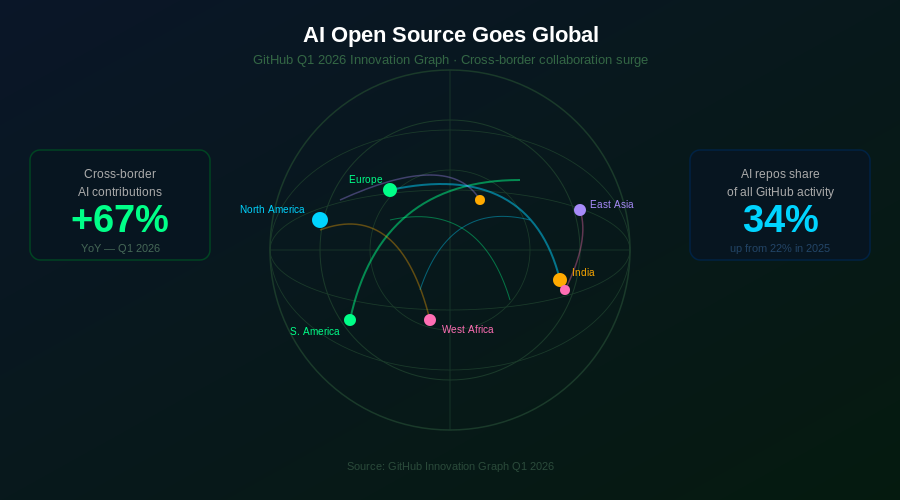
When GitHub released its Q1 2026 Innovation Graph this week, buried inside the quarterly dataset was a number that stopped developers and researchers mid-scroll: a 67 percent spike in cross-border contributions to AI repositories compared to the same period last year. In a world increasingly defined by AI nationalism — export controls, compute embargoes, and competing national AI strategies — the data tells a strikingly different story at the level of individual developers. AI open source collaboration is becoming more global, not less.
What the Numbers Actually Show
The GitHub Innovation Graph is the company’s attempt to make the pulse of global software development legible. It tracks contributions, repository creation, and community engagement across more than 150 countries. The Q1 2026 edition, covering January through March 2026, shows overall open source activity growing at a healthy clip — but AI-related repositories are in a different category entirely.
AI repositories saw a 67 percent year-over-year increase in cross-border pull requests, meaning contributors in one country submitting code to projects hosted or primarily maintained in another. The growth was roughly uniform across three corridors: contributions flowing from the Global South into North American and European AI projects; intra-Asian collaboration (particularly between Indian, Japanese, South Korean, and Southeast Asian developers); and a surprising uptick in contributions from Eastern European developers into projects across all regions.
The absolute numbers are striking as well. AI repositories now account for approximately 34 percent of all open source activity on GitHub by contribution volume, up from roughly 22 percent in Q1 2025. That’s not just more AI projects being created — it’s existing AI projects attracting dramatically more contributors and more active development cycles than virtually any other category of software.
Why Cross-Border AI Collaboration Is Accelerating
Several forces are converging to make global AI open source collaboration the path of least resistance for the development community.
First, the tooling has matured dramatically. The ecosystem around large language models — frameworks like LangChain, LlamaIndex, and their successors; inference engines optimized for various hardware; fine-tuning pipelines for domain-specific applications — has become sufficiently standardized that developers anywhere can contribute meaningfully without needing access to the most expensive compute. A developer in Lagos or Jakarta with a consumer GPU and a well-documented API can now make a genuine contribution to a frontier AI project.
Second, the models themselves have become easier to work with. Open-weight models from Meta’s Llama lineage, Mistral’s releases, and dozens of community fine-tunes have created a tier of capable AI that doesn’t require hyperscale infrastructure to run or modify. This has dramatically democratized participation — you don’t need Google-scale resources to do meaningful AI research or engineering.
Third, and perhaps most importantly, the problems that AI needs to solve are globally distributed. Building AI systems that work well across languages, cultural contexts, and geographic domains requires contributors who inhabit those contexts. A voice AI system that needs to handle code-switching between Hindi and English, or a computer vision model that needs to perform reliably in the visual environment of West African cities, requires developers and annotators who understand those environments from the inside. The cross-border collaboration surge isn’t just altruism — it’s the AI community recognizing a capability gap and organically filling it.
The Geopolitical Paradox
The 67 percent collaboration spike sits in jarring tension with the dominant geopolitical narrative around AI. The past two years have seen increasingly aggressive AI export controls from the United States, competing infrastructure investment programs from China and the European Union, and a general trend toward AI sovereignty — the idea that nations should develop their own AI capabilities rather than depending on foreign models or infrastructure.
Yet developers appear to be largely voting with their keyboards against fragmentation. The countries with the fastest-growing cross-border AI contribution rates in Q1 2026 include Brazil, India, Nigeria, Poland, and Vietnam — a list that cuts across geopolitical blocs and economic development levels. The AI open source community is, in a real sense, constructing its own internationalism below the waterline of state policy.
This doesn’t mean geopolitical risks are absent. Security researchers and policy analysts have raised legitimate concerns about supply chain risks in open source AI — the possibility of malicious contributions, hidden backdoors, or poisoned training data slipping through community review processes. GitHub itself has invested heavily in automated scanning and contribution analysis tools to surface anomalous patterns, and the open source AI community has developed increasingly rigorous code review norms.
But the baseline posture of the global developer community remains collaborative. When GitHub’s data shows a 67 percent cross-border surge, it’s a reminder that the people actually building AI systems often have more in common with each other — shared programming languages, shared frameworks, shared technical problems — than with the political actors shaping AI policy in their respective capitals.
What This Means for Enterprises
For organizations building AI-dependent products and services, GitHub’s data has practical implications that go beyond the feel-good story of global collaboration.
The first is talent distribution. The acceleration of cross-border contribution means the pool of developers with meaningful AI experience is growing fastest outside traditional tech hubs. Companies that limit their hiring to San Francisco, London, or Singapore are fishing in an increasingly unrepresentative pond. The developers who understand how to make AI work in Hindi, Bahasa Indonesia, or Swahili — or who have built AI systems optimized for low-bandwidth environments — are disproportionately located outside the traditional centers of tech gravity.
The second is the compounding value of open source investment. GitHub’s data shows that AI repositories with active corporate backing — regular commits from professional developers, responsive maintainers, good documentation, and clear contribution guidelines — attract dramatically more cross-border contributors than projects that lack these characteristics. Companies that invest in open source AI aren’t just doing community relations; they’re tapping into a globally distributed labor market that contributes improvements, catches bugs, and extends functionality at no direct cost.
The third is risk. As AI components become more interconnected and globally distributed, supply chain security for AI software deserves the same scrutiny that hardware supply chains now receive. The 67 percent cross-border collaboration spike is largely a positive story, but it’s also a reminder that AI systems increasingly depend on contributions from hundreds of contributors across dozens of jurisdictions — each with different legal frameworks, different security norms, and different vulnerability to state pressure.
The View From the Maintainers
For the project maintainers on the receiving end of the collaboration surge, the experience has been both gratifying and demanding. Several prominent open source AI project leads described to industry publications this week the challenge of managing contribution queues that have grown tenfold in 18 months. Review bandwidth — human hours spent evaluating pull requests, giving feedback, and merging code — has become the binding constraint on many projects, not the number of contributors willing to participate.
This has accelerated interest in AI-assisted code review itself, a somewhat recursive development: AI models helping manage the flood of contributions to AI projects. Several major open source AI repositories have deployed fine-tuned review assistants that do initial screening of pull requests, flag obvious issues, and help prioritize the human reviewer’s attention. The results, maintainers report, are mixed but improving — particularly for catching style and formatting issues and flagging contributions that conflict with existing architecture decisions.
What Comes Next
GitHub’s Q1 data represents a snapshot of a trend that shows no signs of decelerating. If anything, the factors driving cross-border AI collaboration — maturing tooling, accessible open-weight models, globally distributed problems to solve — are intensifying rather than leveling off.
The 67 percent cross-border surge in AI repository contributions is, at its core, a story about the nature of software in the age of AI. Code, unlike chips or data centers, still moves freely across borders. The developers building tomorrow’s AI systems are everywhere, and they are, for now, building together.
*Sources: GitHub Innovation Graph Q1 2026, AI Herald, LLM Stats*


