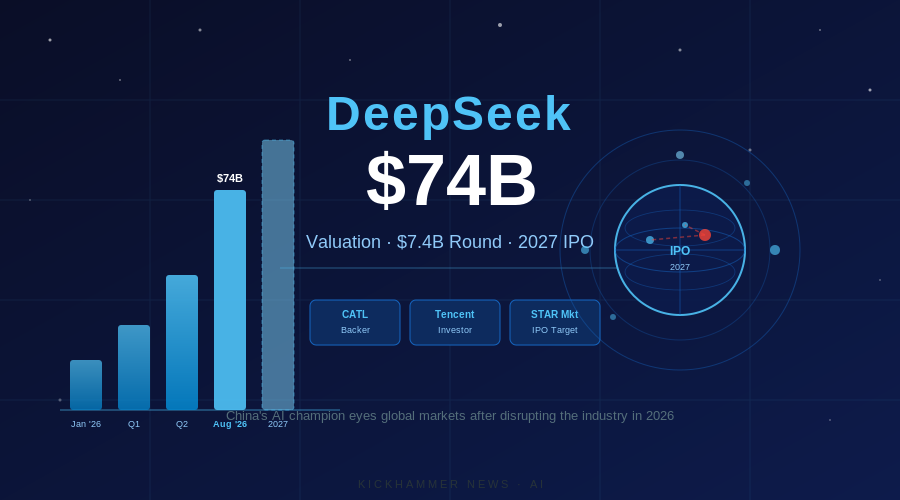
Just eighteen months ago, DeepSeek was a relatively obscure Chinese AI lab funded almost entirely by a hedge fund. Today, it is closing in on a $7.4 billion funding round that would value the company at $74 billion — making it one of the most valuable private technology companies in the world, and setting the stage for what could be the most consequential AI company IPO since the sector’s current boom began.
According to sources familiar with the matter, the financing round of approximately 50 billion yuan ($7.4 billion) is expected to finalize by the end of August, with proceeds earmarked for research, talent acquisition, and the computing infrastructure DeepSeek needs to stay competitive at the global frontier. The company is simultaneously laying groundwork for an IPO on Shanghai’s STAR Market, with insiders suggesting a filing as early as late 2026 and a public debut in 2027.
From Hedge Fund Skunkworks to Global AI Contender
DeepSeek’s trajectory is one of the more remarkable stories in recent technology history. Founded by Liang Wenfeng — who also runs the quantitative hedge fund High-Flyer Quant — the company operated for years in relative obscurity, building models while Western AI labs commanded the headlines and the capital.
That changed overnight in January 2026, when DeepSeek released models that matched the performance of leading Western systems at a small fraction of the training cost. The announcement briefly erased more than $500 billion from AI-linked U.S. equities in a single session, triggering an immediate reassessment of assumptions about the capital requirements of frontier AI development.
Now, with a valuation approaching $74 billion, DeepSeek is no longer a disruptor operating from the margins. It is a central player in the global AI race — one with backing from some of China’s most powerful corporate and institutional investors.
Who’s Backing the Round
The investor roster for the current round reflects just how seriously China’s establishment is treating DeepSeek’s prospects. Contemporary Amperex Technology Co. Limited, better known as CATL — the world’s largest electric vehicle battery manufacturer — is participating, having previously committed 5 billion yuan in an earlier fundraise. Tencent Holdings, one of China’s largest technology conglomerates, is also among the major backers.
On the venture side, existing investors Monolith and Shixiang Capital are participating in the current round, alongside new entrants including CPE, Legend Capital, and semiconductor-focused private equity firm Stony Creek Capital. State investment vehicles from the city of Hefei and funds tied to Chinese chipmaker GigaDevice are reportedly involved as well, signaling a degree of governmental alignment with DeepSeek’s ambitions that would have been remarkable for a private AI lab just a few years ago.
Founder Liang Wenfeng himself committed 20 billion yuan in a prior round, demonstrating conviction that goes well beyond the typical founder-as-cheerleader role. At the current valuation, the company he built from a quantitative trading operation is worth roughly the same as the annual GDP of a mid-sized nation.
The STAR Market Path
DeepSeek’s IPO ambitions point toward Shanghai’s STAR Market, China’s technology-focused exchange designed to accommodate high-growth companies that may not yet be profitable by traditional measures. STAR Market has hosted some of China’s most significant technology listings in recent years, including Unitree Robotics, the humanoid robot company that IPO’d in August 2026.
A DeepSeek listing would be a different order of magnitude. At a $74 billion pre-money valuation, the public offering — assuming a typical float — would rank among the largest technology IPOs globally in recent memory. It would also be a statement: that China’s AI ecosystem, which faced serious questions about its access to cutting-edge semiconductors following U.S. export controls, has not just survived but thrived.
The timeline suggests an IPO filing by end of 2026, with shares potentially beginning to trade in 2027. Whether regulators in Beijing and on the STAR Market move quickly enough to accommodate that schedule remains to be seen.
What DeepSeek Will Do With the Money
The proceeds have a straightforward purpose: compute, people, and research. DeepSeek’s early success came partly from extraordinary efficiency — its models ran on less hardware than Western counterparts required. But sustaining frontier performance means scaling up, and scaling up means spending.
U.S. export controls have complicated Chinese AI companies’ access to NVIDIA’s most capable chips, but DeepSeek has repeatedly demonstrated an ability to extract competitive performance from constrained hardware. The new funding will allow the company to acquire more of what it can access, while also bankrolling the research needed to continue closing any efficiency gaps.
Talent is equally critical. DeepSeek has already drawn top researchers, but the competition for AI engineers globally — and within China specifically — is intense. With $7.4 billion in new capital, the company will be able to match or exceed the compensation packages offered by its Western rivals.
The Global Implications
DeepSeek’s rise has been uncomfortable for the American AI industry in ways that go beyond simple competitive pressure. The efficiency of DeepSeek’s models challenged assumptions that frontier AI required tens of billions of dollars in training compute. That challenged, in turn, the valuations and investment theses of U.S. AI companies predicated on those assumptions.
Now, with DeepSeek itself approaching a $74 billion valuation, the picture is more complex. The company has demonstrated you can build competitive AI on less — but it is also raising vast sums, suggesting that even the most efficient approach still requires serious capital at scale.
For investors watching the global AI landscape, DeepSeek’s IPO will be a defining moment: a test of how Western capital markets value Chinese AI, and how Chinese regulators and markets value one of their most internationally prominent technology companies. For the AI industry overall, it will mark another inflection point in a sector that has been defined by them.
The question is no longer whether DeepSeek belongs in the conversation with OpenAI, Anthropic, and Google DeepMind. At $74 billion, it is already there.
Sources: China Money Network, Tech Startups, MLQ News, Superpower Daily, Blockonomi


