The Chinese AI lab that upended the industry with its open-weight models is preparing to go public — and the valuation would make it one of the largest tech listings in Chinese history.
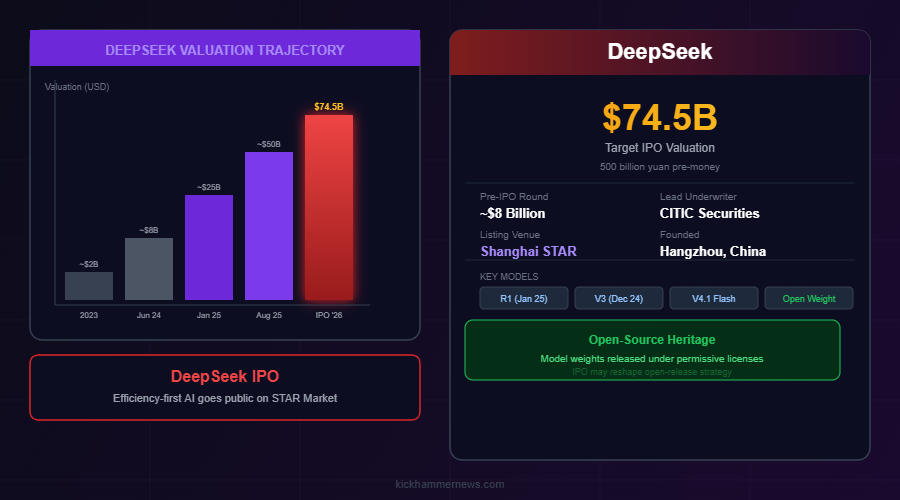
For eighteen months, DeepSeek operated as the most influential AI company in the world that almost no one outside China’s tech establishment had heard of. Then, in January 2025, it released R1 — a reasoning model that matched or exceeded OpenAI’s best at a fraction of the reported training cost — and everything changed. Now the Hangzhou-based company is preparing to go public on Shanghai’s tech-focused STAR Market, having retained CITIC Securities as its lead underwriter for the pre-listing process, with a potential valuation approaching 500 billion yuan, or roughly $74.5 billion at current exchange rates.
The IPO preparation, confirmed by sources familiar with the matter and reported by the South China Morning Post and Bloomberg on September 10, 2026, would cap a remarkable arc for a company that was, until its R1 release, known primarily as the research division of a Chinese quantitative hedge fund. If DeepSeek proceeds at its target valuation, the listing would rank among the largest technology IPOs in Chinese market history.
From Quant Fund Spinout to Global AI Contender
DeepSeek’s origins are unusual even by the unconventional standards of the AI industry. The company began as a research operation inside High-Flyer, a Hangzhou-based quantitative investment firm, before spinning out as an independent entity. Its founder and chief executive, Liang Wenfeng, directed the lab toward a specific and counterintuitive research priority: achieving frontier performance on dramatically constrained compute budgets.
The motivation was partly philosophical — Liang believed that algorithmic efficiency, not raw compute, would define the next generation of AI advances — and partly practical. Chinese AI companies have operated under U.S. export controls on advanced semiconductors since 2022, meaning they could not freely purchase the Nvidia H100 and A100 chips that American labs were using to train increasingly large models. If DeepSeek was going to compete, it had to find another way.
The results validated the approach. DeepSeek V3, released in late 2024, was trained on approximately 2,000 Nvidia H800 chips — a fraction of the compute used for comparable American models — and matched GPT-4o on standard benchmarks. R1, released in January 2025, demonstrated that the reasoning capabilities previously thought to require massive compute could be achieved through novel reinforcement learning techniques at a cost that DeepSeek claimed was under $6 million. The claim was disputed by some analysts, who argued it undercounted infrastructure costs, but the broader point — that frontier performance was not the exclusive domain of labs with billion-dollar training budgets — had an immediate and lasting effect on the industry.
The IPO Landscape
DeepSeek’s IPO preparation comes at a moment of intense activity in Chinese technology markets. Unitree, the humanoid robotics company, listed on the Shanghai STAR Market in August 2026. Huawei’s AI chip subsidiary is understood to be evaluating a separate listing. The Chinese government has explicitly positioned the STAR Market — which uses a registration-based IPO system modeled on Nasdaq — as the preferred venue for domestic AI champions, and has signaled a desire to see the country’s leading AI companies listed domestically rather than in Hong Kong or New York.
For DeepSeek, the domestic listing also sidesteps the increasingly complicated geopolitical calculus of a U.S. or Hong Kong offering. American politicians have repeatedly called for restrictions on Chinese AI companies accessing U.S. capital markets, and while those restrictions have not been enacted in their most aggressive form, the political risk of a New York listing is sufficiently elevated that a domestic offering is the straightforwardly simpler path.
The $74.5 billion pre-money valuation is based on a pre-IPO funding round that DeepSeek is conducting in parallel with its IPO preparations. The company had paused a second funding round in July after internal remarks to investors were leaked to Chinese media, then recommenced the process in August seeking approximately $8 billion. The funding round is intended to give institutional investors a position ahead of the public listing and to provide the company with capital to expand its compute infrastructure and model development program.
What DeepSeek Does With the Money
The intended use of IPO proceeds reflects where DeepSeek sees the next competitive frontier. The company has been explicit that its research philosophy — prioritizing algorithmic efficiency over brute-force compute — does not mean it plans to stay small. It means it believes it can achieve more with a given amount of compute than its competitors. Getting more compute is still a priority.
DeepSeek V4 and V4.1 Flash, released in August and September 2026, continued the pattern: highly capable models that punch above their weight in terms of compute efficiency, including strong multimodal capabilities added in V4.1. But the model generation that DeepSeek is now planning — internally referred to as V5 in early leaks — is understood to require substantially more training compute than anything the company has previously attempted. IPO proceeds would fund both the chip procurement (likely Huawei Ascend 920 and next-generation domestic alternatives, given export control constraints) and the data center infrastructure to support training runs at that scale.
The company is also investing heavily in inference infrastructure. One of the persistent challenges with DeepSeek’s models is that their popularity has strained the company’s own serving capacity, leading to intermittent availability issues for developers relying on the DeepSeek API. A significant portion of the capital raise is expected to go toward fixing that — building out inference clusters that can handle the scale of demand that DeepSeek’s models have attracted globally.
The Open-Source Question
Perhaps the most consequential question hanging over DeepSeek’s IPO is what it means for the company’s open-source model releases. DeepSeek has released the weights for several of its major models under permissive licenses, a practice that has made it enormously popular with developers and researchers worldwide and has been a major factor in its global brand recognition.
The tension between open-source releases and the obligations of a publicly listed company is real. Shareholders may reasonably ask why a company is giving away for free the technology it spent hundreds of millions of dollars to develop. Some analysts expect DeepSeek to shift toward a model where open-weight releases lag commercial API availability by several months, or where open weights are released for older model generations while current-generation models remain closed. Others believe the company will maintain its open-source commitments as a strategic differentiator, on the theory that the developer ecosystem it has built is worth more as a moat than the models are worth as closed commercial products.
DeepSeek has not publicly addressed this question ahead of its IPO filing, and it is unlikely to do so until the formal prospectus is published. It will be one of the most closely watched disclosures when it comes.
Global Implications
DeepSeek’s IPO would crystallize something that has been true for some time but has not yet been formally priced by public markets: Chinese AI is not a secondary story. The Hangzhou lab’s research has influenced model architectures at American competitors, its efficiency techniques have been adopted across the industry, and its open releases have seeded a global developer community that extends well beyond China.
A $75 billion public valuation would put DeepSeek roughly in the range of Anthropic’s last private valuation and substantially above Mistral’s. It would also make explicit what the competitive dynamics of the AI industry in 2026 already suggest: that the race for AI leadership is genuinely global, and that the assumption of American dominance that characterized the field through 2023 and most of 2024 has been permanently complicated.
For investors, the listing raises the straightforward question of whether a Chinese AI company operating under export controls, navigating geopolitical risk, and competing against both domestic champions and American giants can sustain the growth rate that a $75 billion valuation implies. For the AI industry more broadly, the more interesting question is what DeepSeek does with the money — and whether the company that built a frontier model on budget will still be a budget operator when it has billions of dollars to spend.


