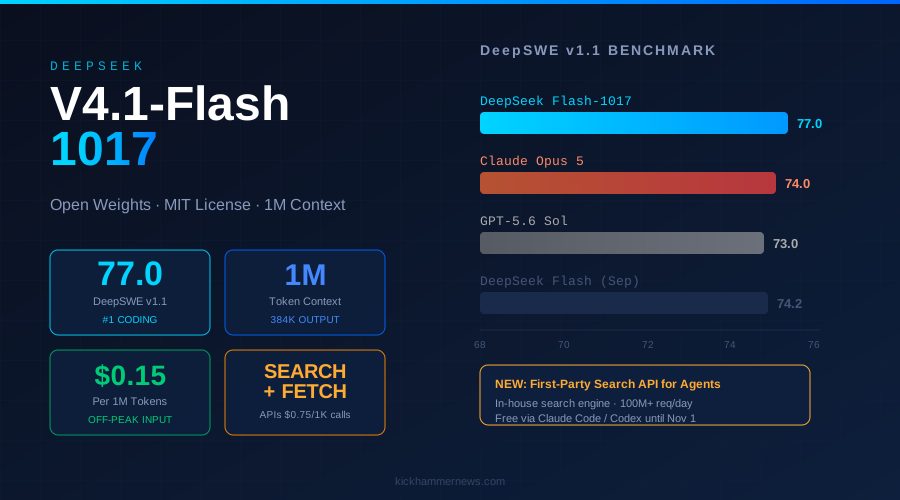
It beats Claude Opus 5 on the industry’s hardest coding benchmark, opens its weights to the world, and ships a $0.75 search API. DeepSeek’s latest move looks less like a model update and more like an infrastructure play.
There was no press release, no live-streamed keynote, no breathless countdown timer. On the morning of October 17, 2026, DeepSeek simply pushed a new checkpoint to its API, dropped the weights on Hugging Face, and opened two new endpoints that most of the AI world didn’t know they were waiting for. That’s the DeepSeek way — and it keeps working.
The model is called V4.1-Flash-1017, the “1017” being the date of training completion in the company’s naming convention. It arrives as an in-place upgrade to DeepSeek’s existing deepseek-flash API name, meaning every developer already using Flash gets the better model automatically. The weights, all 763 billion parameters in FP8, are now on Hugging Face and ModelScope under the MIT license — free to use, fine-tune, and deploy commercially without asking permission.
The Benchmark That Matters
The headline number is 77.0 on DeepSWE v1.1, the industry’s most rigorous benchmark for real-world software engineering tasks. The previous V4.1-Flash scored 74.2. Claude Opus 5 — Anthropic’s current flagship — scores 74.0. OpenAI’s GPT-5.6 Sol scores 73.0.
Let that sit for a moment. DeepSeek’s Flash model — designed for speed and low cost, not to be the most capable thing in the room — now scores higher on software engineering tasks than Anthropic’s top-of-line offering and OpenAI’s best production model.
The gains extend across DeepSeek’s 11-benchmark comparison table. Automation-Bench rose from 54.8 to 60.5. Agents’ Last Exam climbed from 31.8 to 35.4. Apex Bench v1.1 jumped from 64.6 to 72.1, putting it ahead of Claude Opus 5 (65.8) and GPT-5.6 Sol (54.3). The gains aren’t marginal — Terminal-Bench 4.0 improved by 11.1 points, and ProgramBench improved by 8.8.
Claude Opus 5 still leads in several categories: Humanity’s Last Exam (56.3 vs. 42.6 for Flash-1017), Terminal-Bench 4.0 (51.8 vs. 42.3), ProgramBench (37.0 vs. 29.1), and NL2Repo-Bench (75.3 vs. 68.2). Those gaps matter, particularly for tasks requiring deep general reasoning. But for automated software engineering — the workflow that the $50-billion-a-year AI coding market is built around — Flash-1017 is now the benchmark leader among models from major western and Chinese labs.
What Changed Inside the Model
DeepSeek’s technical paper, titled “Pushing the Limits of KV Cache Compression,” describes several architectural changes that make 1017 faster and cheaper to run despite being more capable.
The model uses a Causal Encoder-Decoder design across its 40 Transformer layers — 20 causal encoder layers and 20 decoder layers — which nearly halves prefill compute compared to the previous architecture. A new FP4 main KV cache reduces memory footprint to roughly one-quarter of V4-Flash’s global KV size. Bounded replay shrinks the persistent KV cache to about one-eighth. The result is a model that, per DeepSeek’s claims, completes tasks faster and generates shorter outputs, which means lower cost per task for developers even before accounting for any price cuts.
The model was post-trained with reinforcement learning using self-feedback, specifically targeting end-to-end project completion. DeepSeek’s demo reel for the release includes a fully playable recreation of Portal 2 built in the Godot engine and a navigable 3D model of Beijing’s Forbidden City, both generated from prompt to working artifact with minimal human guidance. Whether those demos are representative of typical production use is another question — but the benchmark numbers are independently verifiable.
The Search API Nobody Saw Coming
The bigger story, in terms of strategic implications, may not be the model update at all.
Alongside V4.1-Flash-1017, DeepSeek quietly opened two new API endpoints: a Search API (POST /v1/tools/search) and a Fetch API (POST /v1/tools/fetch). The Search API queries DeepSeek’s in-house search engine — which the company says processes hundreds of millions of requests per day — and returns ranked results with rerank scores, authority tiers, and operator support for site:, lang:, after:, and before: filters. The Fetch API retrieves a single URL and returns its content as Markdown.
Both endpoints cost $0.75 per 1,000 successful calls. Failed calls and empty results are free. Rate limits are set at 5 queries per second per account. And for the next two weeks — until November 1, 2026 — calls made through server-side tools in DeepSeek Harness, Claude Code, or Codex are free entirely.
This matters because one of the most consistent friction points in building AI agents is grounding them in current information. Until now, agent developers had to either buy access to third-party search APIs (Tavily, Brave Search, Bing Search), build their own scraping infrastructure, or accept that their agents would hallucinate when asked about anything after their training cutoff. DeepSeek just made that problem optional. For $0.75 per thousand calls, any agent using Flash-1017 gets a first-party search layer behind the same API key.
The pricing puts real competitive pressure on dedicated search API providers whose whole business model is selling web access to AI developers. DeepSeek’s search infrastructure, already running at scale for its own products, is now a commercial offering — and at these prices, the economics for most agent builders tilt heavily toward using it.
Valuation and What Comes Next
The model release comes as DeepSeek’s funding round is reportedly growing. CNBC reported this week that the round has expanded to between $12 billion and $15 billion, pushing the company’s valuation to approximately $75 billion — ahead of a planned IPO on the Shanghai Stock Exchange.
That valuation frames what DeepSeek is actually doing with these releases differently than it might appear from the outside. Each model drop isn’t just a capability milestone — it’s a demonstration to prospective investors and enterprise customers that the company can maintain technical leadership while building the infrastructure layers (hosting, search, agent tooling) that high-value enterprise deployments actually require. Giving developers a free search API trial period through Claude Code and Codex isn’t generosity; it’s distribution.
What This Means for Developers
For developers building AI systems today, Flash-1017 changes several calculations. If your pipeline involves software engineering, code review, or agentic task completion, the cheapest capable model in the world just got meaningfully better. If your agents need web access, you now have a credible first-party option at a price point that undercuts most alternatives.
The weights being MIT-licensed means you’re not locked into DeepSeek’s API if you’d rather self-host or fine-tune. The architecture improvements mean self-hosted deployments will be more memory-efficient than the previous Flash. And the benchmark gap between Flash-1017 and the previous generation — while maintaining the same $0.15/$0.60 per million token pricing off-peak — means every developer using Flash automatically got a free upgrade this morning.
DeepSeek didn’t make an announcement. They just made the thing better and let the leaderboard do the talking.


