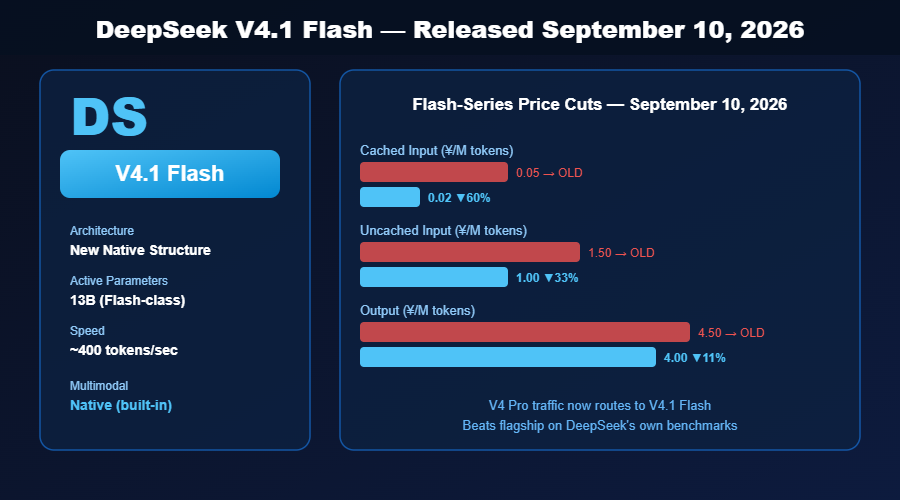
DeepSeek officially released V4.1 Flash today, a model the Chinese AI lab says surpasses its own V4 Pro flagship on performance, speed, and cost — all from a model architecture that weighs a fraction of the competition. The release, timed to around Beijing time September 10, arrives alongside a significant price cut and a routing change that immediately affects every V4 Pro user on DeepSeek’s API.
A New Structure, Not Just an Incremental Update
The “4.1” in the name undersells what DeepSeek is claiming here. Unlike the V4-Flash-0731 release in July — which was essentially the official packaging of the V4-Flash architecture with enhanced agentic capabilities — V4.1 Flash introduces what DeepSeek calls “a new model structure” with native multimodal support baked into the base design.
That distinction matters more than it sounds. The previous vision-capable model, V4-Flash-Vision-Exp, achieved image understanding by grafting a separate vision encoder and aligner onto the existing text architecture. Native multimodal means images are part of the base design from the ground up — the same approach that has driven capability leaps at other labs. The implication is that multimodal reasoning, not just image description, becomes a first-class feature rather than an add-on.
DeepSeek has not published a technical paper or parameter count for V4.1 Flash, so the architectural details remain unconfirmed. What is documented is the release’s speed profile: community testers who accessed the deepseek-v4.1-flash-expires-on-0910 preview model reported approximately 400 tokens per second throughput, with one user measuring end-to-end generation 3.9 to 6 times faster than V4-Flash-Vision-Exp on practical tasks including 49K-token document retrieval and SVG code generation.
The V4 Pro Replacement Signal
Perhaps the most telling detail in the release is how DeepSeek is routing traffic. Starting today, all requests sent to the deepseek-v4-pro API endpoint are automatically served by V4.1 Flash and billed at V4.1 Flash prices — not V4 Pro prices — until a V4.1 Pro model eventually ships.
V4 Pro is a 1.6 trillion total parameter model with 49 billion active parameters. V4 Flash runs 284 billion total with 13 billion active. The fact that DeepSeek is comfortable routing its flagship’s traffic through a model one-fifth the active size — and is advertising this as an upgrade rather than a downgrade — encapsulates the argument DeepSeek has been making since its original V3 release shocked the industry: that efficient sparse architectures can match dense behemoths at a fraction of the compute cost.
In DeepSeek’s own internal and external test runs, V4.1 Flash beats V4 Pro on all four dimensions the lab measured: performance, cost, speed, and total time. No benchmark table has been published yet, so these claims will face outside scrutiny in the coming days from developers who can compare outputs directly.
Price Cuts That Target Agentic Workloads
The pricing changes effective today are surgical. DeepSeek cut Flash-series cached input prices by 60 percent, uncached input by 33 percent, and output by 11 percent.
The asymmetry is intentional. Cached input tokens — those that represent context re-read on every turn of a long-running agent — drop from 0.05 yuan to 0.02 yuan per million tokens during off-peak hours. For multi-turn agentic applications where the same background context gets re-sent with every API call, this is not a 60 percent discount on a line item. It is a fundamental change to the economics of running persistent AI agents at scale.
The deeper reduction on cached tokens, with a milder cut on output, reflects where DeepSeek sees the most elastic demand. Teams building agentic systems — customer service bots, research pipelines, coding agents — have been constrained less by the per-token output cost and more by the accumulated cost of repeatedly re-reading long system prompts and tool outputs. V4.1 Flash’s new pricing directly addresses that friction.
For users who were previously on V4 Pro, the effective price change is even more dramatic. V4 Pro’s uncached input cost 4.5 yuan per million tokens off-peak; V4.1 Flash at the new rates costs 1.00 yuan. That is a 78 percent reduction for a model DeepSeek says performs better.
Context: DeepSeek’s Rapid Release Cadence
This release completes one of the most compressed model release cycles in the industry. DeepSeek shipped V4-Flash-0731 on July 31, V4-Pro-0813 on August 13, V4-Flash-Vision-Exp on August 21, and now V4.1 Flash on September 10. Three meaningful architecture updates in six weeks, each one shipping with open weights or verified API endpoints.
The preview mechanism DeepSeek used this time — opening a test model under a temporary ID with an expiry date, then releasing the final version when the test window closes — was new for the lab. The test id deepseek-v4.1-flash-expires-on-0910 was available from September 8 through today, giving developers two days of hands-on testing before the permanent release landed. DeepSeek’s transparency here stands in contrast to its broader communications style: the company rarely posts on social media, does not comment on competitor releases, and typically announces models through technical documentation rather than press events.
What Comes Next: V4.1 Pro on the Horizon
The routing notice confirmed something else: the existence of a V4.1 Pro. “Until V4.1 Pro launches” is DeepSeek’s own language, making this the first official mention of a flagship counterpart to today’s V4.1 Flash. If the pattern of the V4 generation holds — Flash arrives first, Pro follows roughly two weeks later — the industry should expect a 1.6 trillion parameter V4.1 Pro before the end of September.
What that model would look like is entirely speculative at this point. But if V4.1 Flash already beats V4 Pro on DeepSeek’s benchmarks, the question for a V4.1 Pro becomes genuinely interesting: what does the lab’s full-scale flagship look like when the Flash-class model has already crossed the previous flagship’s performance line?
Industry Implications
The recurring story of 2026 has been the relentless compression of the capability frontier. A year ago, models at the performance level DeepSeek is claiming for V4.1 Flash required data center-scale deployments. Today’s release is designed to run cost-effectively enough that developers can re-invoke it dozens of times per user interaction without the economics breaking down.
For enterprises evaluating AI infrastructure, the V4.1 Flash release adds urgency to a question that has been building all year: the gap between frontier model performance and frontier model cost is closing fast, and the labs driving that compression are not necessarily the ones with the largest training clusters. DeepSeek’s ability to ship a model that outperforms its own flagship — and is cheaper to run — with a team and infrastructure that remains far smaller than its US counterparts is a continued demonstration that architectural efficiency may matter as much as raw scale.
The model is live on DeepSeek’s API today. Open weights and a formal model card are expected to follow on Hugging Face in the coming weeks, based on the lab’s standard release pattern.


