France’s Emmanuel Macron has been saying for years that Europe needs a “third way” in artificial intelligence — an alternative to American closed models that can be switched off by their makers and Chinese open-weight models that come with their own geopolitical baggage. On October 6, that third way showed up with a terabyte of parameters and a nickname: Le Chonk.
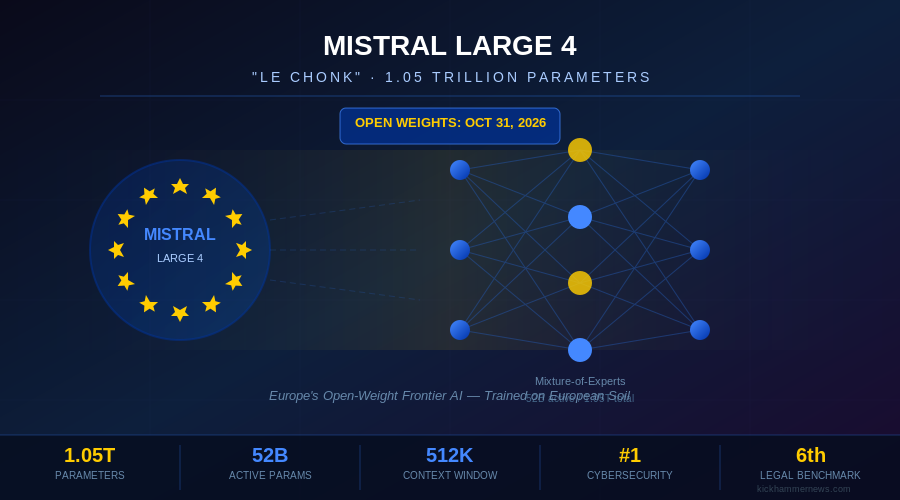
Mistral AI, the French startup that has quietly become Europe’s most credible AI frontier lab, released Mistral Large 4 — a 1.05-trillion-parameter multimodal mixture-of-experts model that the company says will ship its open weights to the world on October 31. If Mistral delivers on that date, it will be the largest open-weight model ever released to the public, eclipsing the previous record holders from DeepSeek and Qwen by a factor of several times.
The release has been covered mostly as a benchmark story. It should not be. This is, first and foremost, a sovereignty story.
What Mistral Large 4 Actually Is
Under the hood, Large 4 uses a granular mixture-of-experts architecture. Of its 1.05 trillion total parameters, only about 52 billion are active during any given inference pass — a trick that lets the model reach frontier-scale knowledge while keeping the compute cost closer to a mid-sized dense model. A 1.6-billion-parameter vision encoder handles image understanding, making it natively multimodal across text and images.
The model was trained on 3,800 NVIDIA Grace Blackwell GPUs housed in European data centers, across more than 160 languages. Mistral VP of Science Pierre Stock told TechCrunch this represents “two to three times fewer GPUs than our Chinese competitors” — a figure the company is citing as evidence that European training infrastructure can compete without matching the raw compute spend of hyperscaler rivals.
The context window is officially listed at 1 million tokens on Mistral’s model card, though third-party evaluators Artificial Analysis and Vercel are recording 524,288 tokens in live testing. That discrepancy remains unresolved, but either figure puts it among the longest-context models currently available.
The Benchmark Picture: Specialist Strength, Coding Weakness
Early independent benchmark results tell a mixed story that turns out to be more interesting than either “it beats everything” or “it disappoints.”
On the Vals Index — a broad composite leaderboard covering 44 models across diverse tasks — Large 4 scores 48.05%, placing 32nd. That puts it near Chinese competitors DeepSeek V4 Pro (47.63%) and Qwen 3.8 Max (48.27%), and meaningfully behind Google’s Gemini 4 Argon (68.90%), Anthropic’s Claude Sonnet 5.5 (67.04%) and Claude Opus 5.5 (66.97%), and OpenAI’s models.
But the Vals Index is a generalist composite. Where Large 4 stands out is in the domains Mistral explicitly designed it for.
On Harvey’s Legal Agent benchmark — the most demanding real-world legal evaluation, pitting 75 models against actual law firm tasks — Large 4 scores 15.83%, ranking sixth globally. That is a remarkable result: it beats GPT-6 Astra (5.42%), Claude Opus 5.5 (3.75%), and Claude Sonnet 5.5 (2.92%). Only Gemini 4 Argon (19.58%) and a handful of specialists score higher.
Finance Agent v2, a similarly practitioner-facing test, gives Large 4 a score of 54.68% — just above GPT-6 Astra (53.54%) and within reach of Claude Sonnet 5.5 (58.10%) and Opus 5.5 (58.59%), though Gemini 4 Argon still leads at 65.40%.
On AA’s CyberGym End-to-End cybersecurity benchmark, Large 4 posts 81.7% — the top score on that leaderboard.
Where the model conspicuously struggles is coding. On Artificial Analysis’s Terminal-Bench 4, Large 4 scores only 22.73%, versus Claude Opus 5.5’s 65.15% and Claude Sonnet 5.5’s 64.14%. This is a significant gap, and it matters: the “year of the agent” framing that has dominated 2026 depends heavily on coding ability, since most agents write and execute code. Mistral’s Achilles’ heel here will limit Large 4’s adoption in developer tooling until a correction arrives.
The Price That Changes the Conversation
Large 4 launched with a 50% promotional discount: $0.68 per million input tokens and $2.09 per million output tokens, with the discount reportedly running until around October 20 before jumping to $1.36/$4.18. Even at full price, the economics are striking for legal and finance users.
A typical 10,000-input, 2,000-output request costs about $0.011 at Large 4’s launch price. The same request runs roughly $0.04 on GPT-6.1 Sol or Claude Sonnet 5.5, and about $0.08 on Claude Opus 5.5. For legal workflows processing thousands of documents, that 3–7x cost differential is enormous — especially when Large 4 outperforms those models on the Harvey Legal benchmark anyway.
The Sovereignty Argument
ASML, the Dutch chipmaker whose EUV lithography machines are the single most critical chokepoint in semiconductor supply chains, led Mistral’s Series C. Samsung led the Series D last month at a €21 billion valuation — roughly $24.4 billion. The investor lineup is not coincidental. It reflects a deliberate bet that Europe needs AI infrastructure it actually controls, built and stored on European soil, auditable by European institutions.
Pierre Stock made the audit argument explicitly: open-weight models are easier for governments, enterprises, and security researchers to inspect than black-box APIs hosted by American or Chinese hyperscalers. For a hospital system in Germany, a financial regulator in France, or a defense contractor in Poland, “you can audit it” is not a marketing slogan — it is a procurement requirement.
Macron’s “third way” framing has sometimes sounded more aspirational than operational. Large 4 gives it a concrete instantiation. A European head of state can, for the first time, point to a frontier-class model trained on European soil that will be freely available to download, run, and inspect.
The Open Weight Question That Still Hangs
The promise of open weights by October 31 carries one significant uncertainty: the license. Mistral’s previous Large 3 used Apache 2.0 — the most permissive major open-source license, allowing commercial use, modification, and redistribution without restriction. The Large 4 model card still shows “Coming soon” for the license section. Large 3’s terms do not automatically carry over, and the commercial stakes at a €21 billion valuation are very different from those at Mistral’s Series A.
Whether Large 4 ships with Apache 2.0, a more restrictive community license, or something in between will determine how sovereign its sovereignty claim actually is. A model you can download but not commercially deploy is a different product from a model you can freely integrate into a national AI stack.
The open-source AI community is watching the October 31 date closely — both for whether the weights arrive on time and for what license they carry. Mistral has earned substantial goodwill with its track record of delivering open releases. The pressure to maintain that reputation is one of its most valuable strategic assets.
What Comes Next
The 50% pricing discount ends around October 20. Open weights are penciled for October 31. For enterprise customers evaluating whether to build legal, finance, or cybersecurity workflows on Large 4, the next three weeks are the evaluation window.
For the broader AI industry, Mistral Large 4 poses a harder question than its benchmark position suggests. The model is not the best generalist available. It may not win a benchmark face-off against Claude Opus 5.5 or Gemini 4 Argon in a head-to-head coding shootout. But it is the first frontier-scale open-weight model to be trained, audited, and controlled entirely outside the two dominant geopolitical blocs in AI — and it outperforms those same flagship models where legal and compliance professionals actually need to use AI.
In a world where AI adoption increasingly runs into regulatory walls, sovereignty requirements, and data residency mandates, that profile may be more commercially durable than any leaderboard position. Mistral is not trying to win the benchmark war. It is trying to be the model that Europe — and every institution that values auditability over convenience — can actually trust to stay plugged in.
Le Chonk has arrived. The question is what it will be allowed to become.


