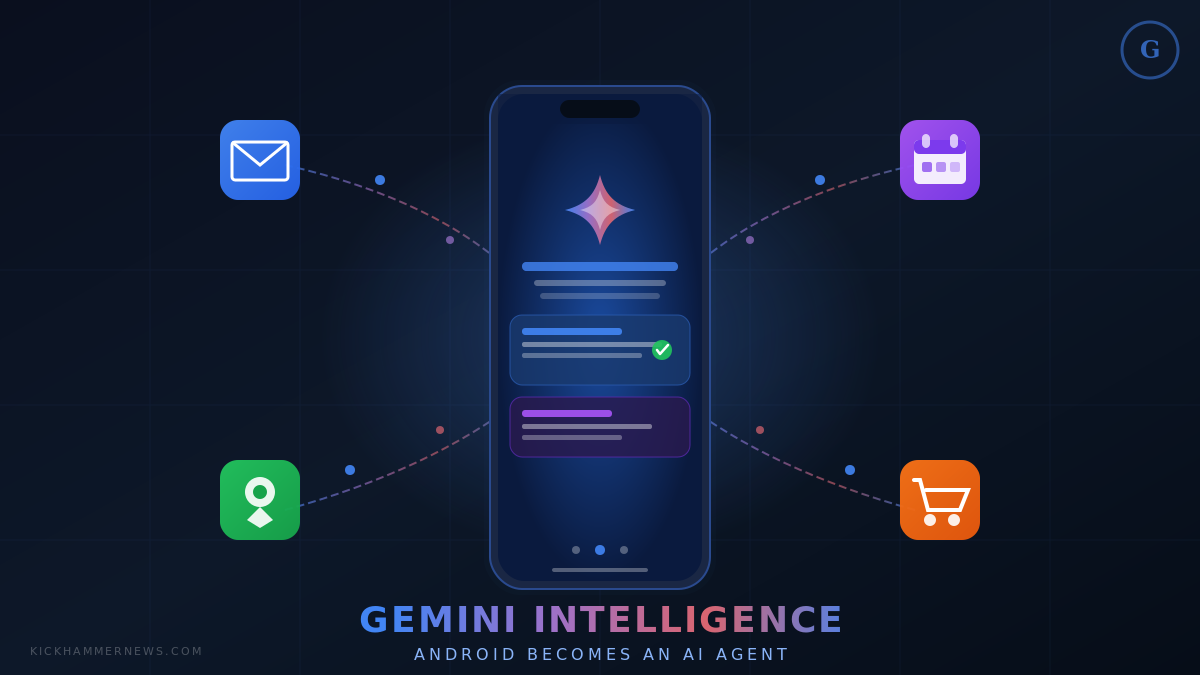
Your smartphone is no longer just a tool you operate. Starting this summer, Google’s Gemini will operate it with you — booking spin classes, building shopping carts, and navigating your apps while you watch.
For two decades, the smartphone has been the most powerful personal computer most people ever touch. And for two decades, the fundamental contract has been the same: you tap, it responds. You open the app. You type the query. You tap “buy.” The phone does nothing until you tell it to.
Google officially ended that era on May 12, 2026.
At the Android Show: I/O Edition — a major pre-keynote event ahead of next week’s Google I/O — the company unveiled Gemini Intelligence, a sweeping new AI layer baked into Android itself. Not an app. Not a chatbot you summon with a long press. An intelligence layer running underneath the operating system, capable of understanding what’s on your screen, moving across apps without you directing it, and completing multi-step tasks on your behalf.
The implications are significant. And the timing is not accidental.
What Gemini Intelligence Actually Does
The demos shown at the Android Show were, in Google’s own words, designed to illustrate how Gemini Intelligence is “not just a rebrand” — it’s the AI becoming Android’s nervous system.
Here’s what that looks like in practice:
A user long-presses over a grocery list in Google Keep. Gemini Intelligence reads the list, opens the delivery app, adds each item to the cart, and surfaces the checkout screen — no copy-pasting, no app switching, no manual entry required. Another user asks Gemini to “grab me a front-row bike at tomorrow’s spin class.” Gemini navigates to the fitness app, finds the right class, selects the preferred seat, and books it.
This is what Google is calling cross-app task automation — the ability for Gemini to move fluidly between third-party applications, understand context, and complete tasks that previously required a human to manually chain together half a dozen steps.
Gemini in Chrome, rolling out in late June, will go further still. It will research and summarize content across multiple web pages simultaneously. A new feature called Chrome Auto Browse will handle routine online tasks entirely autonomously — the kind of low-stakes browsing drudgery that nobody wants to do but everybody has to.
New tools like Rambler in Google’s Gboard keyboard will clean up voice-typed messages in real time, automatically converting messy, filler-word-laden speech into polished written text. And a natural-language widget builder lets users describe what they want (“a weather widget showing the next 48 hours and my commute time”) and have Gemini create it on the spot.
Why Now: The Apple Factor
If you’re wondering why Google is moving this fast, the answer has a very specific name: Apple.
Apple is widely expected to deliver a sweeping AI reboot of Siri at WWDC next month, completing the transformation the company promised at last year’s developer conference. Apple has had the structural advantage of controlling both hardware and software on a massive installed base — and it has been systematically building toward an AI assistant that can take action across all of its apps and services.
Google’s Gemini Intelligence announcement is, in part, a strategic preemption. Android powers roughly 72% of the global smartphone market, but the premium segment — where Apple has historically dominated — is exactly where AI features are most likely to drive upgrade cycles, advertising loyalty, and ecosystem lock-in.
The Android Show itself, scheduled as a dedicated pre-event before the main Google I/O keynote on May 19, signals how seriously Google is treating this moment. The company isn’t waiting for its traditional developer conference to make its biggest consumer AI pitch. It’s making it now, in front of the broadest possible audience, with working features rather than promises.
Beyond the Phone: The Bigger Platform Play
The scope of Gemini Intelligence extends well beyond your Android handset. Google announced that Gemini will be embedded across the entire Android ecosystem — Wear OS smartwatches, Android Auto in your car, Android XR headsets, and ChromeOS laptops.
And on the laptop front, Google introduced an entirely new product category: Googlebooks. Built with partners including Acer, ASUS, and Lenovo, Googlebooks are premium Android-powered laptops with Gemini baked in from the ground up. They support Android apps, allow phone app streaming, and include AI-native features like Magic Pointer and Create My Widget. The first Googlebooks are expected to ship this fall.
This is a clear shot across the bow at both Apple’s MacBook lineup and Microsoft’s increasingly AI-forward Copilot+ PC initiative. For years, the knock on Android laptops was that they couldn’t compete with the polish and ecosystem integration of macOS or Windows. Googlebooks, at least in concept, answers that critique by making Gemini the differentiator — a layer of intelligence that neither Apple nor Microsoft can easily replicate on Android.
The Tradeoffs Nobody Is Talking About
There are real questions underneath the excitement that Google’s announcements don’t fully answer.
Cross-app automation requires deep access to what’s on your screen — your messages, your calendar, your shopping history, your medical appointments. Google has committed to keeping these features on-device where possible, but the line between “helpful intelligence” and “surveillance infrastructure” is one the company will need to navigate carefully, particularly in Europe where digital privacy regulators are watching every move.
There’s also the question of reliability. Agentic AI that books the wrong spin class, orders the wrong groceries, or clicks the wrong button in a financial app isn’t just annoying — it can cause real harm. Google says the system will “come back to the user before completing a transaction,” keeping humans in the loop for consequential actions, but the boundary between what triggers a confirmation and what doesn’t will matter enormously.
And for third-party developers, the dynamics are complicated. Gemini Intelligence benefits apps that are “readable” by AI — well-structured, semantically labeled, cooperating with the new APIs. Apps that don’t cooperate risk becoming invisible to users who let Gemini navigate for them. That’s a new kind of platform power that will draw scrutiny.
What Happens Next Week
Google I/O’s main keynote, scheduled for May 19, will almost certainly go further. The Android Show was explicitly framed as a preview — an appetizer for the AI announcements still to come, including expected reveals around Gemini model upgrades, Project Astra (Google’s long-running effort to build a universal AI assistant), and likely the first look at Android 17.
The picture emerging is one of a company that has spent three years building toward this moment. The Google Assistant of 2019 looks almost quaint by comparison — a voice interface that could set timers and tell you the weather. Gemini Intelligence is something categorically different: an AI that doesn’t wait to be asked, understands the full context of your digital life, and acts on your behalf across the most complex software environment most people ever use.
Whether that’s the future users actually want — and trust — is a question that will be answered not in keynotes, but in the quiet moments when Gemini does something you didn’t expect. For better or worse, Android’s next chapter has begun.
Sources: Google Blog, BusinessToday, CNBC, Android Authority, Engadget, Tom’s Guide, Gizchina, How2Shout


