October 10, 2026
The AI model race just got a new contender — and it hasn’t even launched yet.
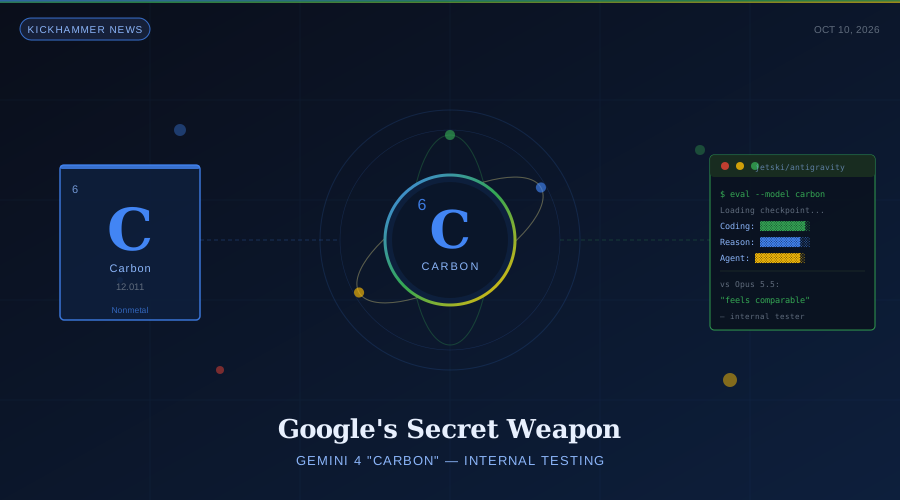
Internal sources at Google report that the company is testing a new Gemini 4 checkpoint, codenamed Carbon, across its internal development platforms. Early impressions from employees who’ve had hands-on access are striking: at least one developer described Carbon’s coding performance as feeling “comparable to Anthropic’s Opus 5.5” — a comparison that, if it holds up in public benchmarks, would be a significant milestone in the intensifying contest for AI supremacy at the frontier.
For context: Claude Opus 5.5 is currently Anthropic’s most capable model, priced at $4 per million input tokens and $20 per million output tokens. Matching it — even impressionistically — would mean Google’s next model could challenge the reigning benchmark champion for the most demanding coding and reasoning tasks. That’s a big claim from a hallway conversation. But the fact that it’s being made internally, and that it’s leaked, says something about the temperature inside Google’s AI labs right now.
What We Know About Carbon
Carbon is not a public model. It can’t be called through any API, and Google has declined to comment on internal roadmaps. What’s been reported — primarily by Business Insider and corroborated by AI-focused outlets — is that Carbon is a distinct internal checkpoint from Barium-B, the build that was selected for the public release of Gemini 4 “Argon.” In other words, Carbon is what comes after Argon in Google’s internal pipeline.
Google’s Jetski environment, where Carbon is reportedly being tested, is an internal platform tied to Antigravity, the company’s agentic coding system. That the model is being evaluated in an environment built for autonomous software development suggests Carbon’s strengths may lie specifically in the kinds of agentic, multi-step coding tasks that are increasingly becoming the benchmark that matters most.
No official scores, evals, or methodology have been published. The only public-facing performance claim is that informal developer impression — and benchmarks, when they come, will inevitably complicate the picture. But the buzz is real.
Where Gemini 4 Argon Fits
To understand why Carbon matters, you need to understand what Gemini 4 Argon already is.
Argon, the current public-facing Gemini 4 model, launched in recent weeks to a measured rollout: first to vetted cybersecurity defenders, then to paid API customers. Priced at $2 per million input tokens and $10 per million output tokens, it undercuts Claude Opus 5.5 by half while competing at similar capability levels on most general tasks. At the WebexOne conference last week, Cisco announced it was embedding Argon into its new Webex AI infrastructure. At the Google Gemini at Work event on October 8, Argon was the engine powering the company’s newly announced enterprise agents — agents that now have their own email addresses, Workspace identities, and persistent state.
By most accounts, Argon is a capable frontier model. But internally, some Google developers found it less convincing specifically for coding work — which is precisely where AI models are most intensely competitive right now.
That’s where Carbon comes in.
The Coding Battlefront
Coding benchmarks have become the ground on which the AI model war is most visibly fought. It’s not hard to see why: coding performance is measurable, reproducible, and directly tied to developer productivity — the use case with the clearest enterprise dollar value. Anthropic’s Claude Haiku 5.5, released just this week, scored a stunning 72.4% on OSWorld 2.1’s computer use benchmark, up from 15.7%. Claude Opus 5.5 remains the reference model for the most demanding agentic coding workflows. OpenAI’s GPT-6 Luna just opened its Decisions API to public beta, positioning itself for high-speed enterprise inference.
Into this landscape steps Carbon — not yet real in any commercial sense, but real in the minds of the engineers who’ve used it. And that matters. Internal impressions are often predictive. Models that impress Google engineers in Jetski have a way of becoming the models that define the next cycle of competition.
If Carbon lands anywhere close to what early testers suggest, it would mean Google has closed a gap that has cost it real developer mindshare. The last year has seen Anthropic’s Claude models gain a genuine reputation among software engineers for coding quality — a reputation that has translated into enterprise adoption at companies from Asana to HubSpot to Cognition. Google would very much like that reputation back.
What’s in a Codename?
Google’s internal model naming conventions are an open secret by this point. Gemini 4’s checkpoints are named after elements: Barium-B was selected as the Argon release. Carbon is next on the periodic table. Whoever eventually gets the Carbon checkpoint — whenever Google decides it’s ready — will likely receive a different public-facing name, possibly reflecting a new tier or a new generation depending on how the model measures up at launch.
The use of elemental names is partly Google’s way of managing a complex internal pipeline where multiple checkpoints are in development simultaneously. Not every checkpoint ships. Barium-B became Argon; Carbon may become something else, or it may ship with significant further training. What’s clear is that Google’s internal roadmap remains active well past the point of Argon’s release.
The Broader Race
The AI capability race in October 2026 is moving at a pace that makes even six-month-old models feel dated. OpenAI has GPT-6 Luna in the field. Anthropic has Opus 5.5 and just slashed Haiku 5.5’s price by 90%. Google has Argon and, apparently, Carbon waiting in the wings. DeepSeek has its fresh $12–15 billion financing round and is training at scales that were science fiction eighteen months ago.
What’s changed in this cycle is that the performance gaps between frontier labs are narrowing. Where once a new model from a top lab could expect to dominate benchmarks for months, the window of clear superiority has compressed to weeks. Carbon, if it performs as advertised internally, may not stay ahead for long — even if it launches at the top.
That’s the uncomfortable reality behind the leaked praise. Not that “Carbon feels like Opus 5.5” is a small thing. It isn’t. But Anthropic isn’t standing still either. The AI lab that produced Opus 5.5 is the same one that’s been deploying models for infrastructure defense, shipping Haiku 5.5, and training the next frontier model on whatever compute it has available. By the time Carbon ships publicly, Opus 6 may already be in internal testing somewhere in San Francisco.
What It Means for Developers
For developers watching from the outside, the Carbon leak is a useful signal: the frontier is about to move again. Gemini 4 Argon, which many considered Google’s most competitive model yet, may have a successor that closes the gap on the coding benchmarks that matter most.
That means re-evaluating routing decisions. Any enterprise architecture built around a stable performance gap between Anthropic and Google should probably plan for that gap to narrow — or flip — sometime in Q1 2027, assuming Carbon ships on a reasonable timeline.
For now, Carbon is just a codename and a developer’s impression. But in the AI race, that’s often how the next chapter starts.
Sources: Business Insider, AI Weekly, OrcaRouter AI, Storyboard18


