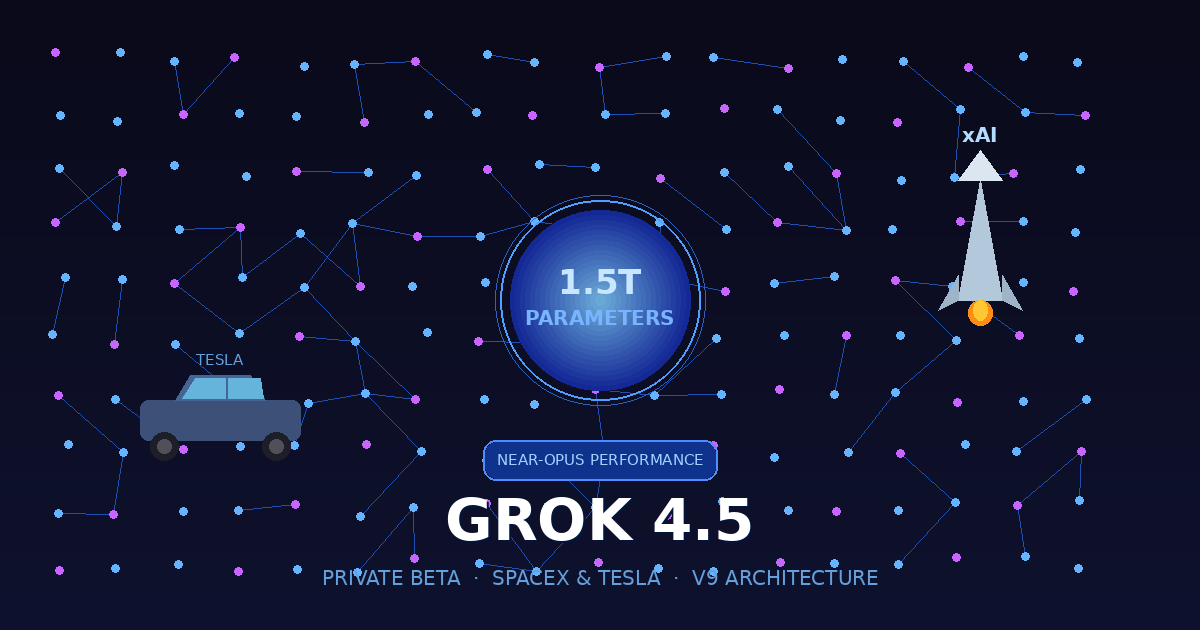
xAI’s 1.5-trillion-parameter V9 model has entered private beta at SpaceX and Tesla, with internal evals claiming performance close to — or exceeding — Claude Opus. The monthly model cadence is accelerating. Grok 5 is already training.
On the morning of June 28, 2026, Elon Musk posted a brief update on X that quietly upended the frontier AI leaderboard conversation. Grok 4.5, based on xAI’s new V9 foundation model with 1.5 trillion parameters, had entered private beta at SpaceX and Tesla. Internal evaluations, Musk wrote, showed performance “close to, perhaps exceeding Opus” — a direct reference to Claude Opus 4.8, the current benchmark leader on the Artificial Analysis Intelligence Index.
The statement was short. The implications are enormous.
What V9 Actually Means
Grok 4.5 is not an incremental upgrade. The V9 foundation model that powers it completed training on May 26, 2026, and represents a ground-up architectural redesign from the v8-small model currently running production Grok traffic on X. The scale jump is significant: v8-small runs at roughly 500 billion parameters, Grok 4.4 (shipped in late May) pushed that to approximately 1 trillion, and V9 takes another step to 1.5 trillion — a 50% increase in roughly one month.
For context, most frontier labs treat model generation leaps as once-per-year affairs with multi-month preparation and fanfare. xAI is executing 50% scale increases on a monthly cadence and deploying them inside Musk’s own companies as the test environment.
The architecture details remain proprietary, but the V9 training run prioritized reinforcement learning from production data, an approach Musk described as producing “daily advancements” through xAI’s internal Grok Build coding harness. Rather than running controlled benchmark evaluations in a lab setting, xAI is using actual SpaceX aerospace engineering workflows and Tesla vehicle software development as the stress test.
Cursor Data: The Acquisition That Changed the Training Stack
The most strategically interesting detail in Musk’s announcement is the mention of Cursor training data. SpaceX acquired Anysphere — the company behind the Cursor AI coding IDE — for $60 billion in June 2026, a figure that raised eyebrows across the venture community at the time. The Grok 4.5 announcement reveals what SpaceX was buying: not just an IDE product, but a massive dataset of real-world developer coding sessions.
Cursor processes millions of coding interactions daily, capturing the full context of how human engineers write, debug, revise, and iterate on code in production environments. This is qualitatively different from training on GitHub repositories or coding benchmarks, which capture finished code rather than the messy, real-world process of getting there. Supplemental training on Cursor IDE session data gives Grok 4.5 exposure to coding reasoning patterns that no other frontier model has access to, because no other frontier lab owns the IDE generating that data.
It is a vertical integration play applied to AI training, and it may prove to be the most consequential part of the $60 billion acquisition.
The Opus Comparison: What “Close To, Perhaps Exceeding” Actually Means
Musk’s performance claim deserves careful unpacking. As of July 5, 2026, there are no independent third-party benchmarks for Grok 4.5. The only data points come from xAI’s internal evaluations at SpaceX and Tesla, supplemented by anecdotal reports from developer Mehul Mohan, who tested an early build and described the experience as “similar to Opus.”
Claude Opus 4.8 currently leads the Artificial Analysis Intelligence Index at 61.4 and scored 69.2% on agentic coding benchmarks in Anthropic’s published evaluations. These are the numbers Grok 4.5 is being compared against — but the comparison is being made by xAI itself, using evaluation tasks run on xAI’s own infrastructure.
This does not mean the claim is wrong. It means it is unverified. History offers a useful reference: when xAI announced Grok 4.4 with similar performance claims, independent benchmark data eventually confirmed competitive performance on coding tasks while showing gaps on broader reasoning and instruction-following. The public data for Grok 4.5 will emerge when either xAI publishes a system card or the model reaches broader release. Until then, the Opus comparison is a directional signal, not an established fact.
What is not in dispute: the Grok Build harness is running daily improvement cycles on Grok 4.5 throughout the beta period. The model that reaches public release will have accumulated weeks of additional reinforcement learning on real SpaceX and Tesla engineering tasks before most users encounter it.
Monthly Cadence and the Road to Grok 5
The most operationally significant detail in xAI’s announcement is the commitment to a monthly model release cadence. Musk confirmed that SpaceX plans to ship “completely new models trained from scratch” every month through the end of 2026. The V9 architecture will produce a sequence of variants — Grok 4.5, 4.6, 4.7, and onward through Q4 2026 — each incorporating additional reinforcement learning and capability improvement.
No other frontier lab has publicly committed to this release velocity. Anthropic ships major model updates roughly quarterly. OpenAI has been on a similar cadence. Google DeepMind operates on internal research timelines that do not translate directly to public release schedules. xAI’s monthly-release strategy is either a genuine capability advantage — if monthly iteration produces compounding improvements — or a marketing posture that sacrifices depth for frequency. The second half of 2026 will answer that question.
On the longer horizon, Grok 5 is already in training on Colossus 2, xAI’s second-generation supercomputing cluster, alongside six other concurrent training runs. Musk has publicly targeted 6 to 10 trillion parameters for Grok 5 — a scale that would make it the largest publicly disclosed model architecture ever built. If Grok 4.5 at 1.5 trillion is “close to Opus,” Grok 5 at 6 to 10 trillion is operating in a different regime entirely, assuming scale continues to translate to capability.
Why SpaceX and Tesla Are the Real Benchmark
The deployment strategy is worth examining on its own terms. xAI is not running Grok 4.5 through standard academic benchmarks and releasing scores. It is running the model through SpaceX’s actual rocket engineering workflows and Tesla’s vehicle software development pipelines.
These are among the most technically demanding real-world environments any AI model could face. SpaceX’s engineers work with fluid dynamics simulations, structural analysis, launch trajectory optimization, and fault diagnosis across complex hardware systems. Tesla’s software team is building and debugging autonomous driving systems, battery management firmware, and vehicle control logic. If Grok 4.5 performs well in these contexts — and the fact that xAI has not publicly walked back the beta suggests it has — that is a more meaningful signal than any leaderboard score.
There is also a strategic dimension. By making SpaceX and Tesla the primary evaluation environments, xAI ensures that Grok 4.5’s capabilities are shaped by the specific technical domains where Musk’s companies have the most to gain. The model that emerges from beta will be exceptionally well-calibrated for aerospace and automotive engineering. Whether that specificity transfers to general enterprise use cases at the level the benchmark comparisons imply is a separate question.
The Competitive Moment
Grok 4.5’s private beta arrives at an unusual moment in the frontier AI race. Anthropic just restored Fable 5 globally after an 18-day export control pause, while simultaneously launching Claude Sonnet 5 as a new default mid-tier model. OpenAI is navigating its September IPO while managing a model portfolio that now spans GPT-5.5 through the newly previewed GPT-5.6. Meta’s Watermelon training run is reportedly matching GPT-5.5 on internal evaluations. Meituan just open-sourced LongCat-2.0, a 1.6-trillion-parameter model trained entirely on domestic Chinese chips.
Every major player is pushing simultaneously. The differentiation question is no longer “who has the biggest model” but “who can deploy the most capable model in the most useful contexts at the right price.” xAI’s vertical integration play — owning the IDE that generates the training data, deploying inside companies with genuinely hard engineering problems, and iterating monthly — is a specific answer to that question. Whether it is the right answer will be clearer by October.
For now, the V9 is in the building. And the building is a rocket factory.
Article published July 5, 2026. Grok 4.5 public benchmark data was not available at publication time. This article will be updated when independent evaluations are released.


