Speed, scale, and a fundamentally different architecture are reshaping what’s possible in real-time AI
The AI model race has always been about who’s biggest, who’s smartest, and who’s cheapest. But Inception Labs is playing a different game — and this week, with the launch of Mercury 2.5, they may have just proved their bet is paying off.
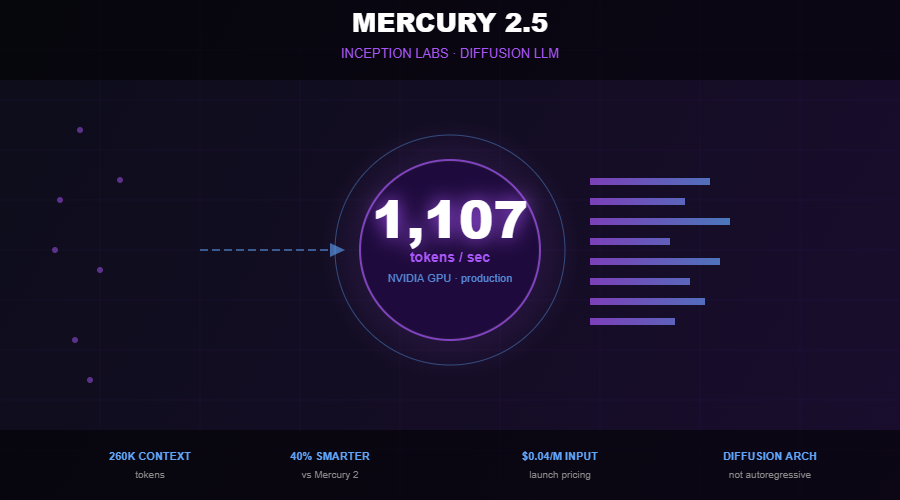
Mercury 2.5 isn’t just a faster model. It’s a faster kind of model. Built on diffusion architecture rather than the autoregressive transformer design that underpins virtually every major LLM — GPT, Claude, Gemini, Llama — Mercury 2.5 generates text in fundamentally different ways. Where a traditional model writes one token at a time, left to right, diffusion models start with noise and iteratively refine the whole output in parallel. The result: production throughput of over 1,107 tokens per second on widely available NVIDIA GPUs, a speed figure that isn’t just incrementally better — it’s in a different league.
The Numbers That Matter
Inception’s launch announcement packs a lot of benchmarks, but a few figures stand out. Mercury 2.5 delivers a 40% intelligence improvement over its predecessor Mercury 2, while maintaining the same low-latency, low-cost serving profile. The context window has grown from 128K to 260K tokens — a meaningful leap for document-heavy enterprise workflows. New native capabilities include tunable reasoning, native tool use, JSON mode, and parallel tool calls.
Pricing starts at $0.20 per million input tokens and $0.75 per million output tokens, with an aggressive 80% launch discount dropping those to $0.04 and $0.15 respectively. At those rates, Mercury 2.5 positions itself as a competitive alternative to Gemini 3.5 Flash-Lite and OpenAI’s GPT-5.6 Luna Low — mid-tier frontier models that dominate high-throughput production pipelines — at a fraction of the cost.
Why Architecture Matters Here
Diffusion language models have been around as a research concept for several years, but Inception was founded by the Stanford, UCLA, and Cornell researchers behind the first practical diffusion LLM, and they’ve been quietly building out the commercial stack while the transformer giants captured all the headlines.
The architectural difference isn’t just an engineering curiosity. For specific workloads, it’s a practical advantage. Voice AI, coding assistants, real-time search augmentation, and agentic systems that need fast, parallel outputs all benefit disproportionately from high token throughput. A model that can complete a complex query in milliseconds isn’t just a convenience — it changes what kinds of applications are economically viable at scale.
Traditional models have their own advantages: they’ve had years of refinement, massive training budgets, and ecosystem tooling that diffusion models are still building. Mercury 2.5 is available on the Inception API, OpenRouter, and Baseten — solid coverage, but not the full breadth of deployment options that GPT or Claude enjoy. The model isn’t gunning for the frontier reasoning crown; it’s going after the real-time, high-throughput segment where transformer architecture carries fundamental latency costs.
The Competitive Landscape
The timing of Mercury 2.5’s launch is notable. It arrives in a market where frontier model providers — OpenAI, Anthropic, Google — are increasingly moving toward tiered model families that address both high-capability and high-efficiency use cases. OpenAI’s GPT-5.6 Luna Low, Gemini 3.5 Flash-Lite, and Anthropic’s Claude Haiku are all optimized for speed and cost. Mercury 2.5 is directly benchmarked against these, and Inception’s claim is that on throughput, it wins by a significant margin while staying competitive on intelligence.
Independent reviews have been cautiously positive. The model performs strongly on coding tasks, structured generation, and tasks that benefit from parallel processing. On long-form reasoning benchmarks, the frontier heavyweights still edge ahead — but Mercury 2.5 isn’t priced or positioned as a reasoning model. It’s positioned as infrastructure: fast, cheap, and capable enough for the bulk of production AI workloads.
Google has been quietly developing its own diffusion-based language model, and the industry is watching whether transformer architecture’s dominance is as permanent as it appears. Mercury 2.5’s commercial launch demonstrates that diffusion LLMs aren’t a research curiosity — they’re in production, they’re shipping to paying customers, and they’re taking benchmarks seriously.
What This Means for Developers
For developers and companies building on AI APIs, Mercury 2.5 offers an interesting option for workloads where speed and cost outweigh absolute capability. At $0.04 per million input tokens during the launch discount period, the economics for high-volume pipelines are hard to ignore. Voice agents, real-time coding suggestions, document processing, and classification tasks are all natural fits.
The 260K context window is large enough to handle full codebases, lengthy legal documents, or multi-turn conversation histories without chunking — a practical benefit that many enterprise customers care about as much as raw benchmark performance.
Tool use and JSON mode support are table-stakes for agentic applications, and their inclusion in Mercury 2.5 signals that Inception is serious about competing in the workflow-automation space, not just raw text generation.
The Road Ahead
Inception has built something genuinely unusual: a commercially viable, production-ready language model that works differently from everything else in the market. Mercury 2.5’s 1,100 tokens-per-second throughput is a proof of concept for what that architecture can do at scale, and the company has already demonstrated a clear improvement trajectory from Mercury through Mercury 2 to Mercury 2.5.
The question isn’t whether diffusion LLMs will find their niche — Mercury 2.5 suggests they already have. The question is how far that niche expands. If the architecture can be pushed further up the capability ladder without sacrificing the speed advantage, Inception could go from an interesting alternative to a foundational player in the AI infrastructure stack.
In a market where every major lab is competing on the same transformer-based paradigm, that’s a genuinely differentiated position. Whether the market rewards differentiation or just capability is a question that 2026’s AI landscape is still working out — but with Mercury 2.5, Inception is at least making the case louder than before.
Mercury 2.5 is available now via the Inception API, OpenRouter, and Baseten.


