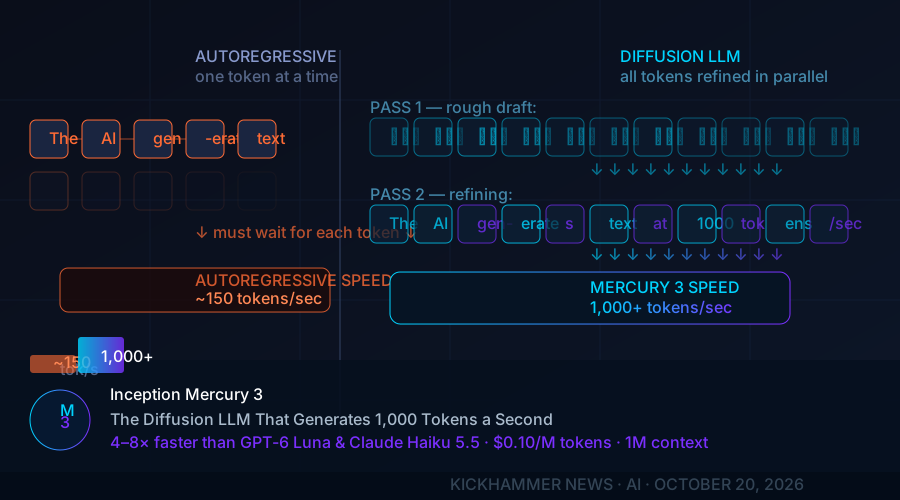
Every mainstream AI language model today works the same way: one token at a time, left to right, word by word. It’s the architecture that powers GPT-6, Claude, Gemini, and everything else you’ve ever typed into a chatbox. Inception’s Mercury 3 does none of that — and today it launched with a claim that’s turning heads across the AI industry: more than 1,000 tokens per second, at a quality it says matches GPT-6 Luna and Claude Haiku 5.5.
If the benchmarks hold up under independent scrutiny, Mercury 3 may be the clearest proof yet that there is a fundamentally different path to fast, intelligent AI — one that the rest of the industry has mostly left unexplored.
What Every Other AI Model Does
To understand why Mercury 3 is different, you have to understand what “autoregressive” means — the term that describes how the overwhelming majority of language models generate text.
When you ask ChatGPT a question, the model generates its answer one token at a time. It produces the first word, then uses that output to predict the second word, then uses both to predict the third, and so on until it reaches the end of its response. The process is inherently sequential. Every token depends on the one before it. That dependency is baked into the architecture: you cannot generate token 50 until you have generated tokens 1 through 49.
This creates a hard ceiling on throughput. You can run autoregressive models on faster hardware, but you can’t parallelize the generation itself. The tokens must come out in order.
How Mercury 3 Breaks That Ceiling
Mercury 3 is a diffusion language model — a dLLM, in Inception’s terminology. The architecture is borrowed from image generation, where models like Stable Diffusion and DALL-E 3 have long worked by starting with noise and progressively refining it into a coherent image.
Mercury 3 applies that same logic to text. Instead of committing to one token before producing the next, it starts with a rough, noisy draft of the entire output — all tokens simultaneously — and then iteratively refines that draft until it converges on coherent, accurate text. The refinement passes happen in parallel across the full output length.
The result is speed that autoregressive models cannot match on principle, not just in practice. Inception reports more than 1,000 tokens per second on widely available NVIDIA GPUs, which the company says is four to eight times faster than GPT-6 Luna and Claude Haiku 5.5 on comparable hardware. At those numbers, a 500-word response that might take three to four seconds from a standard model arrives in under a second.
“We’re showing that the limits to scaling diffusion models are compute and data, not fundamental algorithmic barriers,” said Stefano Ermon, Inception’s co-founder and CEO.
The Benchmarks — and the Caveats
Inception says Mercury 3 matches or beats GPT-6 Luna and Claude Haiku 5.5 across a broad range of standard benchmarks. The model is about three times more capable than its predecessor, Mercury 2.5, while maintaining similar inference speeds — and it does this at more than 40 times the scale of Mercury 1, the original model Inception launched in June 2025.
The context window has grown to 1 million tokens, up from 260,000 in Mercury 2.5. The model is OpenAI API-compatible, meaning developers can switch to it without rewriting their code.
Pricing is aggressive: $0.20 per million input tokens and $0.70 per million output tokens at standard rates, with a 50 percent launch discount dropping those to $0.10 and $0.35. At those numbers, a workload of 50 million input tokens and 10 million output tokens per day costs roughly $8.50 — significantly cheaper than comparable tiers from OpenAI and Anthropic.
The caveats are real, though. As of launch, no independent research group has reproduced Inception’s speed or quality numbers. The company hasn’t disclosed Mercury 3’s parameter count, and it hasn’t named the specific benchmarks it used for quality comparisons. Diffusion text models have historically lagged autoregressive models on output coherence over very long generations — a problem Inception says Mercury 3 has largely solved, but that claim will need third-party verification before the enterprise community treats it as settled.
Inception is also explicit about what Mercury 3 is not built for: deep multi-step reasoning, frontier-level coding benchmarks, or the hardest research tasks. Mercury 3 is a speed-and-cost tier play, not a replacement for the heavyweight models at the top of the capability stack.
Why Speed Matters More Than It Used To
For a single-user chatbot interaction, the difference between 150 tokens per second and 1,000 tokens per second is barely perceptible. The human reading the screen can’t absorb text that fast anyway.
But AI agents don’t read the way humans do. A modern agentic pipeline might call a language model dozens or hundreds of times to complete a single task — once to plan, once to search, once to summarize each result, once to draft, once to critique, once to revise. Each of those calls compounds. If each model invocation takes two seconds instead of a fraction of a second, a 50-step agentic workflow goes from taking a minute to taking nearly two hours.
This is the market Mercury 3 is targeting. Ermon put it plainly: the model is “almost instant in the way you get answers.” For agentic systems, instant isn’t just faster — it changes what’s economically viable to build. Tasks that were too slow or too expensive to delegate to AI in a loop become tractable when the model responds in milliseconds rather than seconds.
Inception even used Mercury 3 to help train itself. The company says swarms of Mercury 3 agents were deployed during the model’s own improvement process, contributing roughly 16 percent of the speed gains on top of manual work by the engineering team — an early example of the self-acceleration dynamics that fast, cheap inference makes possible.
The Broader Picture: Diffusion Is No Longer a Curiosity
Inception isn’t alone in pursuing this direction. In June 2026, Google DeepMind released DiffusionGemma, a diffusion text model for research use. Academic labs have published a steady stream of papers on discrete diffusion models for language since 2023. But most of the commercial AI market has continued to bet on autoregressive scaling, and Inception remains the clearest commercial proof point that diffusion LLMs can compete on quality at scale.
Mercury 3 is available today through Inception’s own API, OpenRouter, Baseten, and Vercel’s AI Gateway. It is not open source. Enterprise customers can access dedicated capacity, autoscaling, compliance controls, and configurable data retention.
Inception says it has already started training its next model.
What It Means
Mercury 3’s launch does three things at once. It gives developers a credible, cheap, extremely fast option for latency-sensitive and high-volume workloads — customer support, real-time translation, bulk summarization, live captioning, and the inner loops of agentic pipelines. It provides the strongest commercial evidence yet that diffusion LLMs can achieve competitive quality at scale, not just competitive speed. And it raises an implicit question for the rest of the industry: how much performance has been left on the table by the field’s near-universal commitment to autoregressive generation?
The benchmarks need independent verification. The quality claims need real-world stress testing. But if Mercury 3 delivers even half of what Inception is promising, it’s the most important model architecture news of 2026 — not because it’s the smartest AI ever built, but because it generates answers so fast that an entirely new class of applications becomes possible.
Speed, it turns out, is not just a feature. At 1,000 tokens per second, it’s a different kind of intelligence.


